

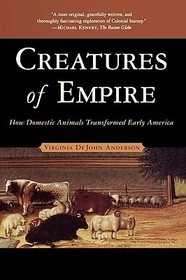
Creatures of Empire
How Domestic Animals Transformed Early America
- Publisher's listprice GBP 19.99
-
9 025 Ft (8 595 Ft + 5% VAT)
The price is estimated because at the time of ordering we do not know what conversion rates will apply to HUF / product currency when the book arrives. In case HUF is weaker, the price increases slightly, in case HUF is stronger, the price goes lower slightly.
- Discount 10% (cc. 903 Ft off)
- Discounted price 8 122 Ft (7 736 Ft + 5% VAT)
Subcribe now and take benefit of a favourable price.
Subscribe
9 025 Ft

Availability
printed on demand
Why don't you give exact delivery time?
Delivery time is estimated on our previous experiences. We give estimations only, because we order from outside Hungary, and the delivery time mainly depends on how quickly the publisher supplies the book. Faster or slower deliveries both happen, but we do our best to supply as quickly as possible.
Product details:
- Publisher OUP USA
- Date of Publication 25 May 2006
- ISBN 9780195304466
- Binding Paperback
- No. of pages336 pages
- Size 234x157x18 mm
- Weight 485 g
- Language English
- Illustrations 7 halftones, 2 maps 0
Categories
Short description:
Paperback edition of an original and groundbreaking work of colonial American history. Anderson argues that pigs, cows and other animals were critical agents of imperialism.
MoreLong description:
When we think of the key figures of early American history, we think of explorers, or pilgrims, or Native Americans--not cattle, or goats, or swine. But as Virginia DeJohn Anderson reveals in this brilliantly original account of colonists in New England and the Chesapeake region, livestock played a vitally important role in the settling of the New World.
Livestock, Anderson writes, were a central factor in the cultural clash between colonists and Indians as well as a driving force in the expansion west. By bringing livestock across the Atlantic, colonists believed that they provided the means to realize America's potential. It was thought that if the Native Americans learned to keep livestock as well, they would be that much closer to assimilating the colonist's culture, especially their Christian faith. But colonists failed to anticipate the problems that would arise as Indians began encountering free-ranging livestock at almost every turn, often trespassing in their cornfields. Moreover, when growing populations and an expansive style of husbandry required far more space than they had expected, colonists could see no alternative but to appropriate Indian land. This created tensions that reached the boiling point with King Philip's War and Bacon's Rebellion. And it established a pattern that would repeat time and again over the next two centuries.
A stunning account that presents our history in a truly new light, Creatures of Empire restores a vital element of our past, illuminating one of the great forces of colonization and the expansion westward.
Anderson is highly successful in presenting the transformation of Early America from both the native and English sides ... she has produced a rare instance of a book that can make us look again at aspects of the historical landscape which have long been taken for granted.

