

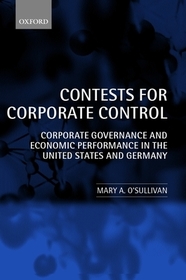
Contests for Corporate Control
Corporate Governance and Economic Performance in the United States and Germany
-
10% KEDVEZMÉNY?
- A kedvezmény csak az 'Értesítés a kedvenc témákról' hírlevelünk címzettjeinek rendeléseire érvényes.
- Kiadói listaár GBP 61.00
-
27 541 Ft (26 230 Ft + 5% áfa)
Az ár azért becsült, mert a rendelés pillanatában nem lehet pontosan tudni, hogy a beérkezéskor milyen lesz a forint árfolyama az adott termék eredeti devizájához képest. Ha a forint romlana, kissé többet, ha javulna, kissé kevesebbet kell majd fizetnie.
- Kedvezmény(ek) 10% (kb. 2 754 Ft)
- Kedvezményes ár 24 787 Ft (23 607 Ft + 5% áfa)
Iratkozzon fel most és részesüljön kedvezőbb árainkból!
Feliratkozom
27 541 Ft

Beszerezhetőség
Megrendelésre a kiadó utánnyomja a könyvet. Rendelhető, de a szokásosnál kicsit lassabban érkezik meg.
Why don't you give exact delivery time?
A beszerzés időigényét az eddigi tapasztalatokra alapozva adjuk meg. Azért becsült, mert a terméket külföldről hozzuk be, így a kiadó kiszolgálásának pillanatnyi gyorsaságától is függ. A megadottnál gyorsabb és lassabb szállítás is elképzelhető, de mindent megteszünk, hogy Ön a lehető leghamarabb jusson hozzá a termékhez.
A termék adatai:
- Kiadó OUP Oxford
- Megjelenés dátuma 2001. június 28.
- ISBN 9780199244867
- Kötéstípus Puhakötés
- Terjedelem346 oldal
- Méret 234x157x20 mm
- Súly 504 g
- Nyelv angol
- Illusztrációk numerous tables and figures 0
Kategóriák
Rövid leírás:
A challenging and informed examination of the links between the general business environment and the operations, decisions, and organization of firms. O'Sullivan explores the links between the two 'hot' issues, corporate governance and innovation.
TöbbHosszú leírás:
During the 1990s, corporate governance became a hot issue in all of the advanced economies. For decades, major business corporations had reinvested earnings and developed long-term relations with their labour forces as they expanded the scale and scope of their operations. As a result, these corporations had made themselves central to resource allocation and economic performance in the national economies in which they had evolved. Then, beginning in the 1980s and picking up momentum in the 1990s, came the contests for corporate control. Previously silent stockholders, now empowered by institutional investors, demanded that corporations be run to 'maximize shareholder value'. In the United States many, if not most, top corporate executives have now embraced this ideology.
In this highly original book, Mary O'Sullivan provides a critical analysis of the theoretical foundations for the shareholder value principle of corporate governance and for the alternative perspective that corporations should be run in the interests of 'stakeholders'. She embeds her arguments on the relation between corporate governance and economic performance in historical accounts of the dynamics of corporate growth in the United States and Germany over the course of the twentieth century. O'Sullivan explains the emergence and consequences of 'maximizing shareholder value' as a principle of corporate governance in the United States over the past two decades, and provides unique insights into the contests for corporate control that have unfolded in Germany over the past few years.
This book, based on detailed historical research in both countries, represents a powerful challenge to current orthodoxy. It also has the great merit of focusing attention on questions that really matter. . . . [Mary O'Sullivan's] answers should give admirers of American capitalism pause for thought.
Tartalomjegyzék:
Introduction
Chapter 1: Innovation, Resource Allocation, and Governance
Chapter 2: Transforming the Debates on Corporate Governance
Chapter 3: The Foundations of Managerial Control in the United States
Chapter 4: The Post-War Evolution of Managerial Control in the United States
Chapter 5: Challenges to Post-War Managerial Control in the US
Chapter 6: US Corporate Responses to New Challenges
Chapter 7: From Managerial to Contested Control in Germany
Chapter 8: The Emerging Challenges to Organizational Control in Germany
Conclusion

