

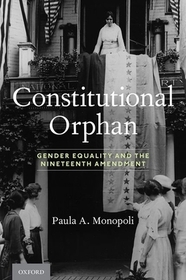
Constitutional Orphan
Gender Equality and the Nineteenth Amendment
-
10% KEDVEZMÉNY?
- A kedvezmény csak az 'Értesítés a kedvenc témákról' hírlevelünk címzettjeinek rendeléseire érvényes.
- Kiadói listaár GBP 36.99
-
16 700 Ft (15 905 Ft + 5% áfa)
Az ár azért becsült, mert a rendelés pillanatában nem lehet pontosan tudni, hogy a beérkezéskor milyen lesz a forint árfolyama az adott termék eredeti devizájához képest. Ha a forint romlana, kissé többet, ha javulna, kissé kevesebbet kell majd fizetnie.
- Kedvezmény(ek) 10% (cc. 1 670 Ft off)
- Kedvezményes ár 15 030 Ft (14 315 Ft + 5% áfa)
Iratkozzon fel most és részesüljön kedvezőbb árainkból!
Feliratkozom
16 700 Ft

Beszerezhetőség
Megrendelésre a kiadó utánnyomja a könyvet. Rendelhető, de a szokásosnál kicsit lassabban érkezik meg.
Why don't you give exact delivery time?
A beszerzés időigényét az eddigi tapasztalatokra alapozva adjuk meg. Azért becsült, mert a terméket külföldről hozzuk be, így a kiadó kiszolgálásának pillanatnyi gyorsaságától is függ. A megadottnál gyorsabb és lassabb szállítás is elképzelhető, de mindent megteszünk, hogy Ön a lehető leghamarabb jusson hozzá a termékhez.
A termék adatai:
- Kiadó OUP USA
- Megjelenés dátuma 2020. október 16.
- ISBN 9780190092795
- Kötéstípus Keménykötés
- Terjedelem256 oldal
- Méret 160x236x27 mm
- Súly 522 g
- Nyelv angol 46
Kategóriák
Rövid leírás:
Constitutional Orphan explores the role of the former suffragists in the emergence of a limited conception of the Nineteenth Amendment, that the Nineteenth was simply a rule preventing states from discriminating against women at the ballot box. The book describes new legal scholarship, which suggests how the Nineteenth can be used more robustly to fully secure gender equality today.
TöbbHosszú leírás:
In Constitutional Orphan, Professor Paula Monopoli explores the significant role of former suffragists in the constitutional development of the Nineteenth Amendment the woman suffrage amendment ratified in 1920. She sheds new light on the connection between the suffragists as institutional actors in civil society and the emergence of a "thin" conception of the Nineteenth Amendment as a mere nondiscrimination in voting rule, rather than a robust equality norm. In this compelling legal history, Monopoli illuminates how the Nineteenth had implications for federalism, women's citizenship and the definition of equality, as well as how gender, race and class intersect to affect our constitutional development.
Monopoli explores the choice by both the National Woman's Party and the National American Woman Suffrage Association to turn away from African American suffragists who were denied the vote even after ratification of the Nineteenth Amendment. Using original sources, legislative history and case analysis, she develops a persuasive theory connecting that moral and strategic failure to the emergence of a narrow interpretation of the amendment. Monopoli also evaluates the impact of class divisions among former suffragist allies. These divisions around support for the NWP's Equal Rights Amendment, found social feminists opposing that "blanket" amendment for fear of its impact on the constitutional validity of protective labor legislation for working-class women.
Monopoli details how many state courts, left without federal enforcement legislation to guide them, used strict construction to cabin the emergence of a more robust interpretation of the Nineteenth Amendment, as a broad equality norm. She concludes with an examination of new legal scholarship that suggests ways in which such a robust understanding of the Nineteenth Amendment could be used today to expand gender equality. In this compelling legal history, Monopoli illuminates how gender, race and class intersect to affect our constitutional development.
In this path breaking new book, Paula Monopoli bridges conversations in history and law to ask why the Nineteenth Amendment has been overlooked and become a "Constitutional Orphan" in the Constitution's interpretation ... Her magnificent recovery of this history will enable the Amendment's more robust and intersectional interpretation and enforcement in the years ahead.
Tartalomjegyzék:
Introduction
Chapter 1: Ratification
Chapter 2: Validity
Chapter 3: Enforcement Legislation
Chapter 4: A Self-Executing Amendment
Chapter 5: Voting and Jury Service
Chapter 6: Voting and Holding Public Office
Chapter 7: Defining Equality
Chapter 8: The Nineteenth Amendment Today

