

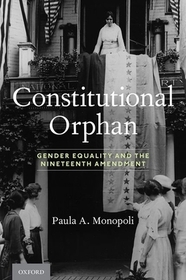
Constitutional Orphan
Gender Equality and the Nineteenth Amendment
- Publisher's listprice GBP 36.99
-
16 700 Ft (15 905 Ft + 5% VAT)
The price is estimated because at the time of ordering we do not know what conversion rates will apply to HUF / product currency when the book arrives. In case HUF is weaker, the price increases slightly, in case HUF is stronger, the price goes lower slightly.
- Discount 10% (cc. 1 670 Ft off)
- Discounted price 15 030 Ft (14 315 Ft + 5% VAT)
Subcribe now and take benefit of a favourable price.
Subscribe
16 700 Ft

Availability
printed on demand
Why don't you give exact delivery time?
Delivery time is estimated on our previous experiences. We give estimations only, because we order from outside Hungary, and the delivery time mainly depends on how quickly the publisher supplies the book. Faster or slower deliveries both happen, but we do our best to supply as quickly as possible.
Product details:
- Publisher OUP USA
- Date of Publication 16 October 2020
- ISBN 9780190092795
- Binding Hardback
- No. of pages256 pages
- Size 160x236x27 mm
- Weight 522 g
- Language English 46
Categories
Short description:
Constitutional Orphan explores the role of the former suffragists in the emergence of a limited conception of the Nineteenth Amendment, that the Nineteenth was simply a rule preventing states from discriminating against women at the ballot box. The book describes new legal scholarship, which suggests how the Nineteenth can be used more robustly to fully secure gender equality today.
MoreLong description:
In Constitutional Orphan, Professor Paula Monopoli explores the significant role of former suffragists in the constitutional development of the Nineteenth Amendment the woman suffrage amendment ratified in 1920. She sheds new light on the connection between the suffragists as institutional actors in civil society and the emergence of a "thin" conception of the Nineteenth Amendment as a mere nondiscrimination in voting rule, rather than a robust equality norm. In this compelling legal history, Monopoli illuminates how the Nineteenth had implications for federalism, women's citizenship and the definition of equality, as well as how gender, race and class intersect to affect our constitutional development.
Monopoli explores the choice by both the National Woman's Party and the National American Woman Suffrage Association to turn away from African American suffragists who were denied the vote even after ratification of the Nineteenth Amendment. Using original sources, legislative history and case analysis, she develops a persuasive theory connecting that moral and strategic failure to the emergence of a narrow interpretation of the amendment. Monopoli also evaluates the impact of class divisions among former suffragist allies. These divisions around support for the NWP's Equal Rights Amendment, found social feminists opposing that "blanket" amendment for fear of its impact on the constitutional validity of protective labor legislation for working-class women.
Monopoli details how many state courts, left without federal enforcement legislation to guide them, used strict construction to cabin the emergence of a more robust interpretation of the Nineteenth Amendment, as a broad equality norm. She concludes with an examination of new legal scholarship that suggests ways in which such a robust understanding of the Nineteenth Amendment could be used today to expand gender equality. In this compelling legal history, Monopoli illuminates how gender, race and class intersect to affect our constitutional development.
In this path breaking new book, Paula Monopoli bridges conversations in history and law to ask why the Nineteenth Amendment has been overlooked and become a "Constitutional Orphan" in the Constitution's interpretation ... Her magnificent recovery of this history will enable the Amendment's more robust and intersectional interpretation and enforcement in the years ahead.
Table of Contents:
Introduction
Chapter 1: Ratification
Chapter 2: Validity
Chapter 3: Enforcement Legislation
Chapter 4: A Self-Executing Amendment
Chapter 5: Voting and Jury Service
Chapter 6: Voting and Holding Public Office
Chapter 7: Defining Equality
Chapter 8: The Nineteenth Amendment Today

