

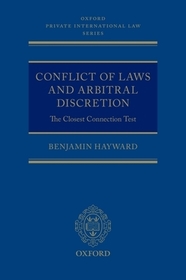
Conflict of Laws and Arbitral Discretion
The Closest Connection Test
Sorozatcím: Oxford Private International Law Series;
-
10% KEDVEZMÉNY?
- A kedvezmény csak az 'Értesítés a kedvenc témákról' hírlevelünk címzettjeinek rendeléseire érvényes.
- Kiadói listaár GBP 137.50
-
62 081 Ft (59 125 Ft + 5% áfa)
Az ár azért becsült, mert a rendelés pillanatában nem lehet pontosan tudni, hogy a beérkezéskor milyen lesz a forint árfolyama az adott termék eredeti devizájához képest. Ha a forint romlana, kissé többet, ha javulna, kissé kevesebbet kell majd fizetnie.
- Kedvezmény(ek) 10% (cc. 6 208 Ft off)
- Kedvezményes ár 55 873 Ft (53 213 Ft + 5% áfa)
Iratkozzon fel most és részesüljön kedvezőbb árainkból!
Feliratkozom
62 081 Ft

Beszerezhetőség
Megrendelésre a kiadó utánnyomja a könyvet. Rendelhető, de a szokásosnál kicsit lassabban érkezik meg.
Why don't you give exact delivery time?
A beszerzés időigényét az eddigi tapasztalatokra alapozva adjuk meg. Azért becsült, mert a terméket külföldről hozzuk be, így a kiadó kiszolgálásának pillanatnyi gyorsaságától is függ. A megadottnál gyorsabb és lassabb szállítás is elképzelhető, de mindent megteszünk, hogy Ön a lehető leghamarabb jusson hozzá a termékhez.
A termék adatai:
- Kiadó OUP Oxford
- Megjelenés dátuma 2017. január 19.
- ISBN 9780198787440
- Kötéstípus Keménykötés
- Terjedelem380 oldal
- Méret 236x161x26 mm
- Súly 706 g
- Nyelv angol 0
Kategóriák
Rövid leírás:
This book identifies the difficulties that result from resolving conflicts of laws through unconstrained arbitral discretions. It establishes that a bright-line test would be a preferable way to resolve arbitral conflicts of laws. Specifically, it recommends a modified Art. 4 Rome Convention rule as the ideal basis for law reform in this area.
TöbbHosszú leírás:
Arbitration is the dispute resolution method of choice in international commerce, but it rests on a complex legal foundation. In many international commercial contracts, the parties will choose the law governing any future disputes. However, where the parties do not choose a governing law, the prevailing approach in arbitration is to afford arbitrators broad and largely unfettered discretion to choose the law considered most appropriate or most applicable. The uncertainty resulting from this discretion potentially affects the parties' rights and obligations, the performance of their contract, the presentation of their cases, and negotiations undertaken to settle their disputes.
In this text, Dr Benjamin Hayward critically reviews the prevailing approach to the conflict of laws in international commercial arbitration. The text adopts a focused and detail-oriented analysis - being based on a study of more than 130 sets of arbitral laws and rules from around the world, and drawing heavily on arbitral case law. Nevertheless, it remains both practical and accessible, taking as its focus the needs and expectations of commercial parties, who are the ultimate users of international commercial arbitration.
This text identifies the difficulties that result from resolving conflicts of laws through broad and unconstrained arbitral discretions. It establishes that a bright-line test would be a preferable way to resolve arbitral conflicts of laws. Specifically, it recommends a modified Art. 4 Rome Convention rule as the ideal basis for law reform in this area of arbitral procedure.
Conflict of Laws and Arbitral Discretion: The Closest Connection Test, is an excellent, much-needed, well-written, well- argued book. It provides an illuminating outline of the existing practice of international commercial arbitration and offers a comprehensive argument on how to improve it. The broad community of international arbitration and conflict of laws practitioners and scholars around the world should be thankful Dr. Hayward for that.
Tartalomjegyzék:
Introduction and Context
The Current Regulation of Conflicts of Laws in International Commercial Arbitration
Identified Issues in the Current Regulatory Regime
A Proposed Solution: A Bright-Line Test
A Proposed Bright-Line Test: The Closest Connection Test
A Proposed Closest Connection Test: The Modified Art. 4 'Rome Convention' Rule
Conclusion

