

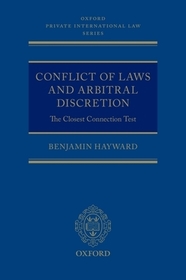
Conflict of Laws and Arbitral Discretion
The Closest Connection Test
Series: Oxford Private International Law Series;
- Publisher's listprice GBP 137.50
-
62 081 Ft (59 125 Ft + 5% VAT)
The price is estimated because at the time of ordering we do not know what conversion rates will apply to HUF / product currency when the book arrives. In case HUF is weaker, the price increases slightly, in case HUF is stronger, the price goes lower slightly.
- Discount 10% (cc. 6 208 Ft off)
- Discounted price 55 873 Ft (53 213 Ft + 5% VAT)
Subcribe now and take benefit of a favourable price.
Subscribe
62 081 Ft

Availability
printed on demand
Why don't you give exact delivery time?
Delivery time is estimated on our previous experiences. We give estimations only, because we order from outside Hungary, and the delivery time mainly depends on how quickly the publisher supplies the book. Faster or slower deliveries both happen, but we do our best to supply as quickly as possible.
Product details:
- Publisher OUP Oxford
- Date of Publication 19 January 2017
- ISBN 9780198787440
- Binding Hardback
- No. of pages380 pages
- Size 236x161x26 mm
- Weight 706 g
- Language English 0
Categories
Short description:
This book identifies the difficulties that result from resolving conflicts of laws through unconstrained arbitral discretions. It establishes that a bright-line test would be a preferable way to resolve arbitral conflicts of laws. Specifically, it recommends a modified Art. 4 Rome Convention rule as the ideal basis for law reform in this area.
MoreLong description:
Arbitration is the dispute resolution method of choice in international commerce, but it rests on a complex legal foundation. In many international commercial contracts, the parties will choose the law governing any future disputes. However, where the parties do not choose a governing law, the prevailing approach in arbitration is to afford arbitrators broad and largely unfettered discretion to choose the law considered most appropriate or most applicable. The uncertainty resulting from this discretion potentially affects the parties' rights and obligations, the performance of their contract, the presentation of their cases, and negotiations undertaken to settle their disputes.
In this text, Dr Benjamin Hayward critically reviews the prevailing approach to the conflict of laws in international commercial arbitration. The text adopts a focused and detail-oriented analysis - being based on a study of more than 130 sets of arbitral laws and rules from around the world, and drawing heavily on arbitral case law. Nevertheless, it remains both practical and accessible, taking as its focus the needs and expectations of commercial parties, who are the ultimate users of international commercial arbitration.
This text identifies the difficulties that result from resolving conflicts of laws through broad and unconstrained arbitral discretions. It establishes that a bright-line test would be a preferable way to resolve arbitral conflicts of laws. Specifically, it recommends a modified Art. 4 Rome Convention rule as the ideal basis for law reform in this area of arbitral procedure.
Conflict of Laws and Arbitral Discretion: The Closest Connection Test, is an excellent, much-needed, well-written, well- argued book. It provides an illuminating outline of the existing practice of international commercial arbitration and offers a comprehensive argument on how to improve it. The broad community of international arbitration and conflict of laws practitioners and scholars around the world should be thankful Dr. Hayward for that.
Table of Contents:
Introduction and Context
The Current Regulation of Conflicts of Laws in International Commercial Arbitration
Identified Issues in the Current Regulatory Regime
A Proposed Solution: A Bright-Line Test
A Proposed Bright-Line Test: The Closest Connection Test
A Proposed Closest Connection Test: The Modified Art. 4 'Rome Convention' Rule
Conclusion

