

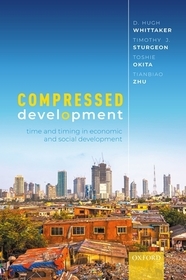
Compressed Development
Time and Timing in Economic and Social Development
-
10% KEDVEZMÉNY?
- A kedvezmény csak az 'Értesítés a kedvenc témákról' hírlevelünk címzettjeinek rendeléseire érvényes.
- Kiadói listaár GBP 95.00
-
42 892 Ft (40 850 Ft + 5% áfa)
Az ár azért becsült, mert a rendelés pillanatában nem lehet pontosan tudni, hogy a beérkezéskor milyen lesz a forint árfolyama az adott termék eredeti devizájához képest. Ha a forint romlana, kissé többet, ha javulna, kissé kevesebbet kell majd fizetnie.
- Kedvezmény(ek) 10% (cc. 4 289 Ft off)
- Kedvezményes ár 38 603 Ft (36 765 Ft + 5% áfa)
Iratkozzon fel most és részesüljön kedvezőbb árainkból!
Feliratkozom
42 892 Ft

Beszerezhetőség
Megrendelésre a kiadó utánnyomja a könyvet. Rendelhető, de a szokásosnál kicsit lassabban érkezik meg.
Why don't you give exact delivery time?
A beszerzés időigényét az eddigi tapasztalatokra alapozva adjuk meg. Azért becsült, mert a terméket külföldről hozzuk be, így a kiadó kiszolgálásának pillanatnyi gyorsaságától is függ. A megadottnál gyorsabb és lassabb szállítás is elképzelhető, de mindent megteszünk, hogy Ön a lehető leghamarabb jusson hozzá a termékhez.
A termék adatai:
- Kiadó OUP Oxford
- Megjelenés dátuma 2020. szeptember 17.
- ISBN 9780198744948
- Kötéstípus Keménykötés
- Terjedelem296 oldal
- Méret 242x163x23 mm
- Súly 626 g
- Nyelv angol 38
Kategóriák
Rövid leírás:
Balancing and blending ideas of globalization with an understanding of historical and institutional contexts of development is an important challenge for many across the social sciences. This book aims to bridge some of these debates through the concept of 'compressed development', addressing areas of time, space, and strategy compression.
TöbbHosszú leírás:
This book proposes a new way to approach comparative international development by focusing on time and timing in economic and social development. The UK industrialized over two centuries, and then started to de-industrialize in the late 1960s. Today, the most rapid developers experience aspects of industrialization and de-industrialization simultaneously. It is no longer clear that industrialization offers the path of growth it once did; industrialization has become 'thin.' Demographic and social challenges that earlier developers faced sequentially now come at the same time. Rapid growers experience compression most acutely, but the spatial and temporal fusing of past and present is widespread, affecting high-, middle-, and lower-income countries alike.
Timing refers to the differences in historical periods in which development takes place. The geopolitical, institutional and technological environment for countries recently integrated into the global economy has been vastly different from that of the preceding postwar decades of 'embedded liberalism,' although it does contain echoes of the 'first globalization' and 'first financialization' a century ago. The first era of liberalism did not end well, and the second is similarly foundering on the rocks of nationalism and protectionism, as it is being battered by a global pandemic.
The authors propose an interdisciplinary conceptual framework based on co-evolving state-market and organization-technology dyads, which will help readers make sense of contemporary development across multiple societies, sectors and geographies, and provide a template for historical comparison.
"...the authors provide a compelling analysis of the ways in which the crisis of Fordism and the rise of the 'network model' of production is central to understand the industrial shaping of the current era of development. The authors are careful in pointing out how this crisis was not simply a crisis of competitiveness driven by the 'Japanese model' of lean production; it was also a social crisis for workers which undermined the social conditions for innovation and productivity across Western Capitalism. In fact, within Western firms, 'lean practices were often applied piecemeal. Reduced in-process inventory and increased monitoring raising productivity and quality were not coupled with employer commitment to job security - required to motivate buy-in from workers - as it was in Japan.
Tartalomjegyzék:
Compressed Development, an Introduction
Part 1: Conceptualizing Compressed Development
Time Compression: From Stages To Simultaneity
Eras: States and Markets
Eras: Organizations and Technology
Part 2: Experiences of Compressed Development
China and Japan's Divergent Institutions
Varieties of Compressed Development
Employment, Skills, and Upgrading
Social Policy: Education as a New Frontier of Compression
Part 3: Navigating Compressed Development
The Adaptive (Developmental) State
Are We All Compressed Developers?

