

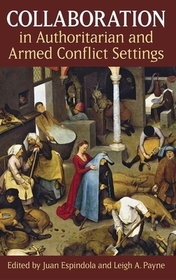
Collaboration in Authoritarian and Armed Conflict Settings
Sorozatcím: Proceedings of the British Academy; 248;
-
10% KEDVEZMÉNY?
- A kedvezmény csak az 'Értesítés a kedvenc témákról' hírlevelünk címzettjeinek rendeléseire érvényes.
- Kiadói listaár GBP 70.00
-
31 605 Ft (30 100 Ft + 5% áfa)
Az ár azért becsült, mert a rendelés pillanatában nem lehet pontosan tudni, hogy a beérkezéskor milyen lesz a forint árfolyama az adott termék eredeti devizájához képest. Ha a forint romlana, kissé többet, ha javulna, kissé kevesebbet kell majd fizetnie.
- Kedvezmény(ek) 10% (cc. 3 161 Ft off)
- Kedvezményes ár 28 445 Ft (27 090 Ft + 5% áfa)
Iratkozzon fel most és részesüljön kedvezőbb árainkból!
Feliratkozom
31 605 Ft

Beszerezhetőség
Becsült beszerzési idő: A Prosperónál jelenleg nincsen raktáron, de a kiadónál igen. Beszerzés kb. 3-5 hét..
A Prosperónál jelenleg nincsen raktáron.
Why don't you give exact delivery time?
A beszerzés időigényét az eddigi tapasztalatokra alapozva adjuk meg. Azért becsült, mert a terméket külföldről hozzuk be, így a kiadó kiszolgálásának pillanatnyi gyorsaságától is függ. A megadottnál gyorsabb és lassabb szállítás is elképzelhető, de mindent megteszünk, hogy Ön a lehető leghamarabb jusson hozzá a termékhez.
A termék adatai:
- Kiadó OUP Oxford
- Megjelenés dátuma 2022. június 16.
- ISBN 9780197267059
- Kötéstípus Keménykötés
- Terjedelem294 oldal
- Méret 241x160x20 mm
- Súly 590 g
- Nyelv angol
- Illusztrációk 3 figures 204
Kategóriák
Rövid leírás:
Collaboration in Authoritarian and Armed Conflict Settings offers an array of examples to demonstrate the ubiquity of collaboration and its extension over territory and time. It also teases out a framework for examining collaboration, merging history, philosophy, political science, sociology, law, and literary studies.
TöbbHosszú leírás:
Who is the collaborator, or in whose eyes? What is the motivation to collaborate: for material gain, for ideology, for duty? When is collaboration betraying a hated enemy, and when is it something else: personal revenge or an instrumental, rational, or even coerced response to a situation, for example? Why do collaborators meet such harsh punishment and stigma when they are revealed as such? Can they ever atone or find redemption? Beyond the perception of the stakeholders involved, how harmful is collaboration? Does it exacerbate or abate violence? Is it always evil or can it sometimes be seen as mitigating wrongs? The chapters in Collaboration in Authoritarian and Armed Conflict Settings explore these thorny questions through a set of case studies, disciplinary approaches, and temporal and regional contexts. They show the range of the types of collaboration; the ubiquity of collaboration across time, countries, political systems, and political and cultural conflicts.
TöbbTartalomjegyzék:
Coming to Terms with Collaboration: An Introduction,Juan Espindola and Leigh A. Payne
Part I: The Politics of Collaboration
Native Intelligence: African Detectives and Informers in White South Africa,Jacob Dlamini
Be My Character: Framing the Female Collaborator in Postdictatorship Argentine Novels,Ksenija Bilbija
Collaborationism in Low-Intensity Conflicts: The Case of the Basque Country,Luis de la Calle
Part II: Collaboration Moments
Collaboration and Opportunism in Communist Czechoslovakia,Mark Drumbl and Barbora Hol--
Black Collaboration During American Slavery,Andrea L. Dennis
Third-Party Collaborators in the Colombian Armed Conflict: A Paramilitary Case Study,Gerson Iv--n Arias and Carlos Andr--s Prieto
Informing, Intelligence, and Public Policy in Northern Ireland: Some Overlooked Negative Consequences of Deploying Informers against Political Violence,Ron Dudai and Kevin Hearty
Part III: Holding Collaborators Accountable
The Collaboration of the Intellectuals: Legal Academia and the Third Reich,Oren Gross
Grudge Informers and Beyond: On Accountability for Collaborators with Repressive Regimes,Colleen Murphy
Business Collaborators on Trial: Legal Obstacles to Corporate Accountability in Argentina,Gabriel Pereira
International Law and Collaboration: A Tentative Embrace,Shane Darcy
Conclusion: Reckoning with Collaboration,Juan Espindola and Leigh A. Payne
Index

