

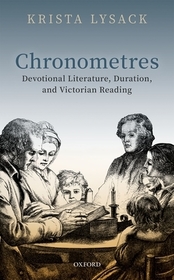
Chronometres
Devotional Literature, Duration, and Victorian Reading
-
10% KEDVEZMÉNY?
- A kedvezmény csak az 'Értesítés a kedvenc témákról' hírlevelünk címzettjeinek rendeléseire érvényes.
- Kiadói listaár GBP 81.00
-
36 571 Ft (34 830 Ft + 5% áfa)
Az ár azért becsült, mert a rendelés pillanatában nem lehet pontosan tudni, hogy a beérkezéskor milyen lesz a forint árfolyama az adott termék eredeti devizájához képest. Ha a forint romlana, kissé többet, ha javulna, kissé kevesebbet kell majd fizetnie.
- Kedvezmény(ek) 10% (cc. 3 657 Ft off)
- Kedvezményes ár 32 914 Ft (31 347 Ft + 5% áfa)
Iratkozzon fel most és részesüljön kedvezőbb árainkból!
Feliratkozom
36 571 Ft

Beszerezhetőség
Megrendelésre a kiadó utánnyomja a könyvet. Rendelhető, de a szokásosnál kicsit lassabban érkezik meg.
Why don't you give exact delivery time?
A beszerzés időigényét az eddigi tapasztalatokra alapozva adjuk meg. Azért becsült, mert a terméket külföldről hozzuk be, így a kiadó kiszolgálásának pillanatnyi gyorsaságától is függ. A megadottnál gyorsabb és lassabb szállítás is elképzelhető, de mindent megteszünk, hogy Ön a lehető leghamarabb jusson hozzá a termékhez.
A termék adatai:
- Kiadó OUP Oxford
- Megjelenés dátuma 2019. szeptember 26.
- ISBN 9780198836162
- Kötéstípus Keménykötés
- Terjedelem240 oldal
- Méret 224x144x18 mm
- Súly 406 g
- Nyelv angol 0
Kategóriák
Rövid leírás:
This volume explores the reading culture and practices of Victorian devotional literature. It examines poetic cycles by John Keble, Alfred Tennyson, Christina Rossetti, and Frances Ridley Havergal; family prayer manuals, Sunday-reading books and periodicals; and devotional gift books and daily textbooks.
TöbbHosszú leírás:
What does it mean to feel time, to sense its passing along the sinews and nerves of the body as much as the synapses of the mind? And how do books, as material arrangements of print and paper, mediate such temporal experiences? Chronometres: Devotional Literature, Duration, and Victorian Reading Culture is a study of the time-inflected reading practices of religious literature, the single largest market for print in Victorian Britain. It examines poetic cycles by John Keble, Alfred Tennyson, Christina Rossetti, and Frances Ridley Havergal; family prayer manuals, Sunday-reading books and periodicals; and devotional gift books and daily textbooks. Designed for diurnal and weekly reading, chronometrical literature tuned its readers' attentions to the idea of eternity and the everlasting peace of spiritual transcendence, but only in so far as it parcelled out reading into discrete increments that resembled the new industrial time-scales of factories and railway schedules. Chronometres thus takes up print culture, affect theory, and the religious turn in literary studies in order to explore the intersections between devotional practice and the condition of modernity. It argues that what defines Victorian devotional literature is the experience of its time signatures, those structures of feeling associated with its reading durations.
For many Victorians, reading devotionally increasingly meant reading in regular portions and often according to the calendar and work-day in contrast to the liturgical year. Keeping pace with the temporal measures of modernity, devotion became a routinized practice: a way of synchronizing the interior life of spirit with the exigencies of clock time. Chronometres considers how the deliverances afforded through time-scaled reading are persistently materialised in the body, both that of the book and of the reader. Recognizing that literature and devotion are not timeless abstractions, it asks how the materiality of books, conceived as horological relationships through reading, might bring about the felt experience of time. Even as Victorian devotion invites us to tarry over the page, it also prompts the question: what if it is 'eternity' that keeps time with the clock?
The calibration of consolation demonstrated in Chronometres can be reductive of religious affect. Lysack deserves much credit for a scrupulous and fascinating study in its own vein.
Tartalomjegyzék:
Introduction: Victorian Devotional Literature and the Strangeness of Everyday Time
Part One: Devotional Books in Time
The Christian Year and the Consolations of Synchronized Time
Christina Rossetti's Chronometrical Eternal
Part Two: The Form and Feel of Devotional Reading
Family Prayers: Devotional Daydreaming, Household Time, and the Labours of Attention
Sunday Reading: Boredom, Leisure, and Periodical Diversion
Part Three: Material Devotions and the Devotional Day
Arranging Daily Gifts of Devotion: Frances Ridley Havergal's Botanical Book Craft
Apportioning the Devotional Day: Daily Textbooks, Reading Systems, and In Memoriam A. H. H.
Afterword: Two Meditations
Bibliography

