

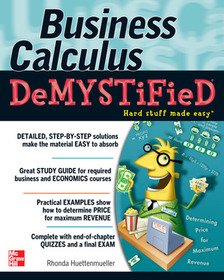
Business Calculus Demystified
Sorozatcím: Demystified;
-
10% KEDVEZMÉNY?
- A kedvezmény csak az 'Értesítés a kedvenc témákról' hírlevelünk címzettjeinek rendeléseire érvényes.
- Kiadói listaár GBP 25.99
-
11 734 Ft (11 175 Ft + 5% áfa)
Az ár azért becsült, mert a rendelés pillanatában nem lehet pontosan tudni, hogy a beérkezéskor milyen lesz a forint árfolyama az adott termék eredeti devizájához képest. Ha a forint romlana, kissé többet, ha javulna, kissé kevesebbet kell majd fizetnie.
- Kedvezmény(ek) 10% (kb. 1 174 Ft)
- Kedvezményes ár 10 560 Ft (10 058 Ft + 5% áfa)
Iratkozzon fel most és részesüljön kedvezőbb árainkból!
Feliratkozom
11 734 Ft

Beszerezhetőség
Megjelenése törölve vagy kivonva a forgalomból. Sajnos nem rendelhető.
Why don't you give exact delivery time?
A beszerzés időigényét az eddigi tapasztalatokra alapozva adjuk meg. Azért becsült, mert a terméket külföldről hozzuk be, így a kiadó kiszolgálásának pillanatnyi gyorsaságától is függ. A megadottnál gyorsabb és lassabb szállítás is elképzelhető, de mindent megteszünk, hogy Ön a lehető leghamarabb jusson hozzá a termékhez.
A termék adatai:
- Kiadó McGraw Hill
- Megjelenés dátuma 2007. február 16.
- ISBN 9780071451574
- Kötéstípus Puhakötés
- Terjedelem384 oldal
- Méret 231x185x28 mm
- Súly 594 g
- Nyelv angol 0
Kategóriák
Hosszú leírás:
Publisher's Note: Products purchased from Third Party sellers are not guaranteed by the publisher for quality, authenticity, or access to any online entitlements included with the product.
Take the FEAR OUT of Business Calculus
Business Calculus Demystified clarifies the concepts and processes of calculus and demonstrates their applications to the workplace. Best-selling math author Rhonda Huettenmueller uses the same combination of winning step-by-step teaching techniques and real-world business and mathematical examples that have succeeded with tens of thousands of college students, regardless of their math experience or affinity for the subject.
With Business Calculus Demystified, you learn at your own pace. You get explanations that make differentiation and integration -- the main concepts of calculus -- understandable and interesting. This unique self-teaching guide reinforces learning, builds your confidence and skill, and continuously demonstrates your mastery of topics with a wealth of practice problems and detailed solutions throughout, multiple-choice quizzes at the end of each chapter, and a "final exam" that tests your total understanding of business calculus.
Learn business calculus for the real world! This self-teaching course conquers confusion with clarity and ease. Get ready to:
- Get a solid foundation right from the start with a review of algebra
- Master one idea per section -- develop complete, comfortable understanding of a topic before proceeding to the next
- Find a well-explained definition of the derivative and its properties; instantaneous rates of change; the power, product, quotient, and chain rules; and layering different formulas
- Learn methods for maximizing revenue and profit... minimizing cost... and solving other optimizing problems
- See how to use calculus to sketch graphs
- Understand implicit differentiation, rational functions, exponents, and logarithm functions -- learn how to use log properties to simplify differentiation
- Painlessly learn integration formulas and techniques and applications of the integral
- Take a "final exam" and grade it yourself!
Who says business calculus has to be boring? Business Calculus Demystified is a lively and entertaining way to master this essential math subject!
Publisher's Note: Products purchased from Third Party sellers are not guaranteed by the publisher for quality, authenticity, or access to any online entitlements included with the product.
Take the FEAR OUT of Business Calculus
Business Calculus Demystified clarifies the concepts and processes of calculus and demonstrates their applications to the workplace. Best-selling math author Rhonda Huettenmueller uses the same combination of winning step-by-step teaching techniques and real-world business and mathematical examples that have succeeded with tens of thousands of college students, regardless of their math experience or affinity for the subject.
With Business Calculus Demystified, you learn at your own pace. You get explanations that make differentiation and integration -- the main concepts of calculus -- understandable and interesting. This unique self-teaching guide reinforces learning, builds your confidence and skill, and continuously demonstrates your mastery of topics with a wealth of practice problems and detailed solutions throughout, multiple-choice quizzes at the end of each chapter, and a "final exam" that tests your total understanding of business calculus.
Learn business calculus for the real world! This self-teaching course conquers confusion with clarity and ease. Get ready to:
- Get a solid foundation right from the start with a review of algebra
- Master one idea per section -- develop complete, comfortable understanding of a topic before proceeding to the next
- Find a well-explained definition of the derivative and its properties; instantaneous rates of change; the power, product, quotient, and chain rules; and layering different formulas
- Learn methods for maximizing revenue and profit... minimizing cost... and solving other optimizing problems
- See how to use calculus to sketch graphs
- Understand implicit differentiation, rational functions, exponents, and logarithm functions -- learn how to use log properties to simplify differentiation
- Painlessly learn integration formulas and techniques and applications of the integral
- Take a "final exam" and grade it yourself!
Who says business calculus has to be boring? Business Calculus Demystified is a lively and entertaining way to master this essential math subject!
TöbbTartalomjegyzék:
Chapter 1: Algebra ReviewThe slope and equation of a lineFinding x-interceptsSolving equationsQuadratic functionsThe vertexThe maximum/minimum value of a quadratic functionIncreasing/decreasing intervalsSome important exponent propertiesChapter 2: Average rate of changeLimitsChapter 3: Definition of derivativeProperties of the derivativeInstantaneous rates of changeThe tangent line- The Power Rule
- The Product Rule
- The Quotient Rule
- The Chain Rule
Layering different formulasChapter 5: Applications- Optimizing functions
- Maximizing revenue and profit, minimizing cost, and other optimizing problems
Chapter 6: The second derivativeConcavityAnother method for optimizing functionsChapter 7: Implicit differentiationChapter 8: Rational functionsLimits and asymptotesChapter 9: Using calculus to sketch graphsGraphs of polynomial functionsChapter 10: Exponents and Logarithm functionsUsing log properties to simplify differentiationChapter 11: Integration- The antiderivative
- Integration formulas
- The area under the curve
- More integration formulas
- Integration techniques
Chapter 12: Applications of the integral
Több
Finding x-interceptsSolving equationsQuadratic functionsThe vertexThe maximum/minimum value of a quadratic functionIncreasing/decreasing intervalsSome important exponent propertiesChapter 2: Average rate of changeLimitsChapter 3: Definition of derivativeProperties of the derivativeInstantaneous rates of changeThe tangent line- The Power Rule
- The Product Rule
- The Quotient Rule
- The Chain Rule
Layering different formulasChapter 5: Applications- Optimizing functions
- Maximizing revenue and profit, minimizing cost, and other optimizing problems
Chapter 6: The second derivativeConcavityAnother method for optimizing functionsChapter 7: Implicit differentiationChapter 8: Rational functionsLimits and asymptotesChapter 9: Using calculus to sketch graphsGraphs of polynomial functionsChapter 10: Exponents and Logarithm functionsUsing log properties to simplify differentiationChapter 11: Integration- The antiderivative
- Integration formulas
- The area under the curve
- More integration formulas
- Integration techniques
Chapter 12: Applications of the integral
Több
Quadratic functionsThe vertexThe maximum/minimum value of a quadratic functionIncreasing/decreasing intervalsSome important exponent propertiesChapter 2: Average rate of changeLimitsChapter 3: Definition of derivativeProperties of the derivativeInstantaneous rates of changeThe tangent line- The Power Rule
- The Product Rule
- The Quotient Rule
- The Chain Rule
Layering different formulasChapter 5: Applications- Optimizing functions
- Maximizing revenue and profit, minimizing cost, and other optimizing problems
Chapter 6: The second derivativeConcavityAnother method for optimizing functionsChapter 7: Implicit differentiationChapter 8: Rational functionsLimits and asymptotesChapter 9: Using calculus to sketch graphsGraphs of polynomial functionsChapter 10: Exponents and Logarithm functionsUsing log properties to simplify differentiationChapter 11: Integration- The antiderivative
- Integration formulas
- The area under the curve
- More integration formulas
- Integration techniques
Chapter 12: Applications of the integral
Több
The maximum/minimum value of a quadratic functionIncreasing/decreasing intervalsSome important exponent propertiesChapter 2: Average rate of changeLimitsChapter 3: Definition of derivativeProperties of the derivativeInstantaneous rates of changeThe tangent line- The Power Rule
- The Product Rule
- The Quotient Rule
- The Chain Rule
Layering different formulasChapter 5: Applications- Optimizing functions
- Maximizing revenue and profit, minimizing cost, and other optimizing problems
Chapter 6: The second derivativeConcavityAnother method for optimizing functionsChapter 7: Implicit differentiationChapter 8: Rational functionsLimits and asymptotesChapter 9: Using calculus to sketch graphsGraphs of polynomial functionsChapter 10: Exponents and Logarithm functionsUsing log properties to simplify differentiationChapter 11: Integration- The antiderivative
- Integration formulas
- The area under the curve
- More integration formulas
- Integration techniques
Chapter 12: Applications of the integral
Több
Some important exponent propertiesChapter 2: Average rate of changeLimitsChapter 3: Definition of derivativeProperties of the derivativeInstantaneous rates of changeThe tangent line- The Power Rule
- The Product Rule
- The Quotient Rule
- The Chain Rule
Layering different formulasChapter 5: Applications- Optimizing functions
- Maximizing revenue and profit, minimizing cost, and other optimizing problems
Chapter 6: The second derivativeConcavityAnother method for optimizing functionsChapter 7: Implicit differentiationChapter 8: Rational functionsLimits and asymptotesChapter 9: Using calculus to sketch graphsGraphs of polynomial functionsChapter 10: Exponents and Logarithm functionsUsing log properties to simplify differentiationChapter 11: Integration- The antiderivative
- Integration formulas
- The area under the curve
- More integration formulas
- Integration techniques
Chapter 12: Applications of the integral
Több
LimitsChapter 3: Definition of derivativeProperties of the derivativeInstantaneous rates of changeThe tangent line- The Power Rule
- The Product Rule
- The Quotient Rule
- The Chain Rule
Layering different formulasChapter 5: Applications- Optimizing functions
- Maximizing revenue and profit, minimizing cost, and other optimizing problems
Chapter 6: The second derivativeConcavityAnother method for optimizing functionsChapter 7: Implicit differentiationChapter 8: Rational functionsLimits and asymptotesChapter 9: Using calculus to sketch graphsGraphs of polynomial functionsChapter 10: Exponents and Logarithm functionsUsing log properties to simplify differentiationChapter 11: Integration- The antiderivative
- Integration formulas
- The area under the curve
- More integration formulas
- Integration techniques
Chapter 12: Applications of the integral
Több
Properties of the derivativeInstantaneous rates of changeThe tangent line- The Power Rule
- The Product Rule
- The Quotient Rule
- The Chain Rule
Layering different formulasChapter 5: Applications- Optimizing functions
- Maximizing revenue and profit, minimizing cost, and other optimizing problems
Chapter 6: The second derivativeConcavityAnother method for optimizing functionsChapter 7: Implicit differentiationChapter 8: Rational functionsLimits and asymptotesChapter 9: Using calculus to sketch graphsGraphs of polynomial functionsChapter 10: Exponents and Logarithm functionsUsing log properties to simplify differentiationChapter 11: Integration- The antiderivative
- Integration formulas
- The area under the curve
- More integration formulas
- Integration techniques
Chapter 12: Applications of the integral
Több
The tangent line- The Power Rule
- The Product Rule
- The Quotient Rule
- The Chain Rule
Layering different formulasChapter 5: Applications- Optimizing functions
- Maximizing revenue and profit, minimizing cost, and other optimizing problems
Chapter 6: The second derivativeConcavityAnother method for optimizing functionsChapter 7: Implicit differentiationChapter 8: Rational functionsLimits and asymptotesChapter 9: Using calculus to sketch graphsGraphs of polynomial functionsChapter 10: Exponents and Logarithm functionsUsing log properties to simplify differentiationChapter 11: Integration- The antiderivative
- Integration formulas
- The area under the curve
- More integration formulas
- Integration techniques
Chapter 12: Applications of the integral
Több
Chapter 5: Applications- Optimizing functions
- Maximizing revenue and profit, minimizing cost, and other optimizing problems
Chapter 6: The second derivativeConcavityAnother method for optimizing functionsChapter 7: Implicit differentiationChapter 8: Rational functionsLimits and asymptotesChapter 9: Using calculus to sketch graphsGraphs of polynomial functionsChapter 10: Exponents and Logarithm functionsUsing log properties to simplify differentiationChapter 11: Integration- The antiderivative
- Integration formulas
- The area under the curve
- More integration formulas
- Integration techniques
Chapter 12: Applications of the integral
Több
ConcavityAnother method for optimizing functionsChapter 7: Implicit differentiationChapter 8: Rational functionsLimits and asymptotesChapter 9: Using calculus to sketch graphsGraphs of polynomial functionsChapter 10: Exponents and Logarithm functionsUsing log properties to simplify differentiationChapter 11: Integration- The antiderivative
- Integration formulas
- The area under the curve
- More integration formulas
- Integration techniques
Chapter 12: Applications of the integral
Több
Chapter 7: Implicit differentiationChapter 8: Rational functionsLimits and asymptotesChapter 9: Using calculus to sketch graphsGraphs of polynomial functionsChapter 10: Exponents and Logarithm functionsUsing log properties to simplify differentiationChapter 11: Integration- The antiderivative
- Integration formulas
- The area under the curve
- More integration formulas
- Integration techniques
Chapter 12: Applications of the integral
Több
Limits and asymptotesChapter 9: Using calculus to sketch graphsGraphs of polynomial functionsChapter 10: Exponents and Logarithm functionsUsing log properties to simplify differentiationChapter 11: Integration- The antiderivative
- Integration formulas
- The area under the curve
- More integration formulas
- Integration techniques
Chapter 12: Applications of the integral
Több
Graphs of polynomial functionsChapter 10: Exponents and Logarithm functionsUsing log properties to simplify differentiationChapter 11: Integration- The antiderivative
- Integration formulas
- The area under the curve
- More integration formulas
- Integration techniques
Chapter 12: Applications of the integral
Több
Using log properties to simplify differentiationChapter 11: Integration- The antiderivative
- Integration formulas
- The area under the curve
- More integration formulas
- Integration techniques
Chapter 12: Applications of the integral
Több
- The antiderivative
- Integration formulas
- The area under the curve
- More integration formulas
- Integration techniques

