

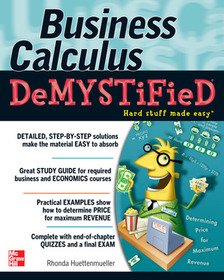
Business Calculus Demystified
Series: Demystified;
- Publisher's listprice GBP 25.99
-
11 734 Ft (11 175 Ft + 5% VAT)
The price is estimated because at the time of ordering we do not know what conversion rates will apply to HUF / product currency when the book arrives. In case HUF is weaker, the price increases slightly, in case HUF is stronger, the price goes lower slightly.
- Discount 10% (cc. 1 174 Ft off)
- Discounted price 10 560 Ft (10 058 Ft + 5% VAT)
Subcribe now and take benefit of a favourable price.
Subscribe
11 734 Ft

Availability
cancelled
Why don't you give exact delivery time?
Delivery time is estimated on our previous experiences. We give estimations only, because we order from outside Hungary, and the delivery time mainly depends on how quickly the publisher supplies the book. Faster or slower deliveries both happen, but we do our best to supply as quickly as possible.
Product details:
- Publisher McGraw Hill
- Date of Publication 16 February 2007
- ISBN 9780071451574
- Binding Paperback
- No. of pages384 pages
- Size 231x185x28 mm
- Weight 594 g
- Language English 0
Categories
Long description:
Publisher's Note: Products purchased from Third Party sellers are not guaranteed by the publisher for quality, authenticity, or access to any online entitlements included with the product.
Take the FEAR OUT of Business Calculus
Business Calculus Demystified clarifies the concepts and processes of calculus and demonstrates their applications to the workplace. Best-selling math author Rhonda Huettenmueller uses the same combination of winning step-by-step teaching techniques and real-world business and mathematical examples that have succeeded with tens of thousands of college students, regardless of their math experience or affinity for the subject.
With Business Calculus Demystified, you learn at your own pace. You get explanations that make differentiation and integration -- the main concepts of calculus -- understandable and interesting. This unique self-teaching guide reinforces learning, builds your confidence and skill, and continuously demonstrates your mastery of topics with a wealth of practice problems and detailed solutions throughout, multiple-choice quizzes at the end of each chapter, and a "final exam" that tests your total understanding of business calculus.
Learn business calculus for the real world! This self-teaching course conquers confusion with clarity and ease. Get ready to:
- Get a solid foundation right from the start with a review of algebra
- Master one idea per section -- develop complete, comfortable understanding of a topic before proceeding to the next
- Find a well-explained definition of the derivative and its properties; instantaneous rates of change; the power, product, quotient, and chain rules; and layering different formulas
- Learn methods for maximizing revenue and profit... minimizing cost... and solving other optimizing problems
- See how to use calculus to sketch graphs
- Understand implicit differentiation, rational functions, exponents, and logarithm functions -- learn how to use log properties to simplify differentiation
- Painlessly learn integration formulas and techniques and applications of the integral
- Take a "final exam" and grade it yourself!
Who says business calculus has to be boring? Business Calculus Demystified is a lively and entertaining way to master this essential math subject!
Publisher's Note: Products purchased from Third Party sellers are not guaranteed by the publisher for quality, authenticity, or access to any online entitlements included with the product.
Take the FEAR OUT of Business Calculus
Business Calculus Demystified clarifies the concepts and processes of calculus and demonstrates their applications to the workplace. Best-selling math author Rhonda Huettenmueller uses the same combination of winning step-by-step teaching techniques and real-world business and mathematical examples that have succeeded with tens of thousands of college students, regardless of their math experience or affinity for the subject.
With Business Calculus Demystified, you learn at your own pace. You get explanations that make differentiation and integration -- the main concepts of calculus -- understandable and interesting. This unique self-teaching guide reinforces learning, builds your confidence and skill, and continuously demonstrates your mastery of topics with a wealth of practice problems and detailed solutions throughout, multiple-choice quizzes at the end of each chapter, and a "final exam" that tests your total understanding of business calculus.
Learn business calculus for the real world! This self-teaching course conquers confusion with clarity and ease. Get ready to:
- Get a solid foundation right from the start with a review of algebra
- Master one idea per section -- develop complete, comfortable understanding of a topic before proceeding to the next
- Find a well-explained definition of the derivative and its properties; instantaneous rates of change; the power, product, quotient, and chain rules; and layering different formulas
- Learn methods for maximizing revenue and profit... minimizing cost... and solving other optimizing problems
- See how to use calculus to sketch graphs
- Understand implicit differentiation, rational functions, exponents, and logarithm functions -- learn how to use log properties to simplify differentiation
- Painlessly learn integration formulas and techniques and applications of the integral
- Take a "final exam" and grade it yourself!
Who says business calculus has to be boring? Business Calculus Demystified is a lively and entertaining way to master this essential math subject!
MoreTable of Contents:
Chapter 1: Algebra ReviewThe slope and equation of a lineFinding x-interceptsSolving equationsQuadratic functionsThe vertexThe maximum/minimum value of a quadratic functionIncreasing/decreasing intervalsSome important exponent propertiesChapter 2: Average rate of changeLimitsChapter 3: Definition of derivativeProperties of the derivativeInstantaneous rates of changeThe tangent line- The Power Rule
- The Product Rule
- The Quotient Rule
- The Chain Rule
Layering different formulasChapter 5: Applications- Optimizing functions
- Maximizing revenue and profit, minimizing cost, and other optimizing problems
Chapter 6: The second derivativeConcavityAnother method for optimizing functionsChapter 7: Implicit differentiationChapter 8: Rational functionsLimits and asymptotesChapter 9: Using calculus to sketch graphsGraphs of polynomial functionsChapter 10: Exponents and Logarithm functionsUsing log properties to simplify differentiationChapter 11: Integration- The antiderivative
- Integration formulas
- The area under the curve
- More integration formulas
- Integration techniques
Chapter 12: Applications of the integral
More
Finding x-interceptsSolving equationsQuadratic functionsThe vertexThe maximum/minimum value of a quadratic functionIncreasing/decreasing intervalsSome important exponent propertiesChapter 2: Average rate of changeLimitsChapter 3: Definition of derivativeProperties of the derivativeInstantaneous rates of changeThe tangent line- The Power Rule
- The Product Rule
- The Quotient Rule
- The Chain Rule
Layering different formulasChapter 5: Applications- Optimizing functions
- Maximizing revenue and profit, minimizing cost, and other optimizing problems
Chapter 6: The second derivativeConcavityAnother method for optimizing functionsChapter 7: Implicit differentiationChapter 8: Rational functionsLimits and asymptotesChapter 9: Using calculus to sketch graphsGraphs of polynomial functionsChapter 10: Exponents and Logarithm functionsUsing log properties to simplify differentiationChapter 11: Integration- The antiderivative
- Integration formulas
- The area under the curve
- More integration formulas
- Integration techniques
Chapter 12: Applications of the integral
More
Quadratic functionsThe vertexThe maximum/minimum value of a quadratic functionIncreasing/decreasing intervalsSome important exponent propertiesChapter 2: Average rate of changeLimitsChapter 3: Definition of derivativeProperties of the derivativeInstantaneous rates of changeThe tangent line- The Power Rule
- The Product Rule
- The Quotient Rule
- The Chain Rule
Layering different formulasChapter 5: Applications- Optimizing functions
- Maximizing revenue and profit, minimizing cost, and other optimizing problems
Chapter 6: The second derivativeConcavityAnother method for optimizing functionsChapter 7: Implicit differentiationChapter 8: Rational functionsLimits and asymptotesChapter 9: Using calculus to sketch graphsGraphs of polynomial functionsChapter 10: Exponents and Logarithm functionsUsing log properties to simplify differentiationChapter 11: Integration- The antiderivative
- Integration formulas
- The area under the curve
- More integration formulas
- Integration techniques
Chapter 12: Applications of the integral
More
The maximum/minimum value of a quadratic functionIncreasing/decreasing intervalsSome important exponent propertiesChapter 2: Average rate of changeLimitsChapter 3: Definition of derivativeProperties of the derivativeInstantaneous rates of changeThe tangent line- The Power Rule
- The Product Rule
- The Quotient Rule
- The Chain Rule
Layering different formulasChapter 5: Applications- Optimizing functions
- Maximizing revenue and profit, minimizing cost, and other optimizing problems
Chapter 6: The second derivativeConcavityAnother method for optimizing functionsChapter 7: Implicit differentiationChapter 8: Rational functionsLimits and asymptotesChapter 9: Using calculus to sketch graphsGraphs of polynomial functionsChapter 10: Exponents and Logarithm functionsUsing log properties to simplify differentiationChapter 11: Integration- The antiderivative
- Integration formulas
- The area under the curve
- More integration formulas
- Integration techniques
Chapter 12: Applications of the integral
More
Some important exponent propertiesChapter 2: Average rate of changeLimitsChapter 3: Definition of derivativeProperties of the derivativeInstantaneous rates of changeThe tangent line- The Power Rule
- The Product Rule
- The Quotient Rule
- The Chain Rule
Layering different formulasChapter 5: Applications- Optimizing functions
- Maximizing revenue and profit, minimizing cost, and other optimizing problems
Chapter 6: The second derivativeConcavityAnother method for optimizing functionsChapter 7: Implicit differentiationChapter 8: Rational functionsLimits and asymptotesChapter 9: Using calculus to sketch graphsGraphs of polynomial functionsChapter 10: Exponents and Logarithm functionsUsing log properties to simplify differentiationChapter 11: Integration- The antiderivative
- Integration formulas
- The area under the curve
- More integration formulas
- Integration techniques
Chapter 12: Applications of the integral
More
LimitsChapter 3: Definition of derivativeProperties of the derivativeInstantaneous rates of changeThe tangent line- The Power Rule
- The Product Rule
- The Quotient Rule
- The Chain Rule
Layering different formulasChapter 5: Applications- Optimizing functions
- Maximizing revenue and profit, minimizing cost, and other optimizing problems
Chapter 6: The second derivativeConcavityAnother method for optimizing functionsChapter 7: Implicit differentiationChapter 8: Rational functionsLimits and asymptotesChapter 9: Using calculus to sketch graphsGraphs of polynomial functionsChapter 10: Exponents and Logarithm functionsUsing log properties to simplify differentiationChapter 11: Integration- The antiderivative
- Integration formulas
- The area under the curve
- More integration formulas
- Integration techniques
Chapter 12: Applications of the integral
More
Properties of the derivativeInstantaneous rates of changeThe tangent line- The Power Rule
- The Product Rule
- The Quotient Rule
- The Chain Rule
Layering different formulasChapter 5: Applications- Optimizing functions
- Maximizing revenue and profit, minimizing cost, and other optimizing problems
Chapter 6: The second derivativeConcavityAnother method for optimizing functionsChapter 7: Implicit differentiationChapter 8: Rational functionsLimits and asymptotesChapter 9: Using calculus to sketch graphsGraphs of polynomial functionsChapter 10: Exponents and Logarithm functionsUsing log properties to simplify differentiationChapter 11: Integration- The antiderivative
- Integration formulas
- The area under the curve
- More integration formulas
- Integration techniques
Chapter 12: Applications of the integral
More
The tangent line- The Power Rule
- The Product Rule
- The Quotient Rule
- The Chain Rule
Layering different formulasChapter 5: Applications- Optimizing functions
- Maximizing revenue and profit, minimizing cost, and other optimizing problems
Chapter 6: The second derivativeConcavityAnother method for optimizing functionsChapter 7: Implicit differentiationChapter 8: Rational functionsLimits and asymptotesChapter 9: Using calculus to sketch graphsGraphs of polynomial functionsChapter 10: Exponents and Logarithm functionsUsing log properties to simplify differentiationChapter 11: Integration- The antiderivative
- Integration formulas
- The area under the curve
- More integration formulas
- Integration techniques
Chapter 12: Applications of the integral
More
Chapter 5: Applications- Optimizing functions
- Maximizing revenue and profit, minimizing cost, and other optimizing problems
Chapter 6: The second derivativeConcavityAnother method for optimizing functionsChapter 7: Implicit differentiationChapter 8: Rational functionsLimits and asymptotesChapter 9: Using calculus to sketch graphsGraphs of polynomial functionsChapter 10: Exponents and Logarithm functionsUsing log properties to simplify differentiationChapter 11: Integration- The antiderivative
- Integration formulas
- The area under the curve
- More integration formulas
- Integration techniques
Chapter 12: Applications of the integral
More
ConcavityAnother method for optimizing functionsChapter 7: Implicit differentiationChapter 8: Rational functionsLimits and asymptotesChapter 9: Using calculus to sketch graphsGraphs of polynomial functionsChapter 10: Exponents and Logarithm functionsUsing log properties to simplify differentiationChapter 11: Integration- The antiderivative
- Integration formulas
- The area under the curve
- More integration formulas
- Integration techniques
Chapter 12: Applications of the integral
More
Chapter 7: Implicit differentiationChapter 8: Rational functionsLimits and asymptotesChapter 9: Using calculus to sketch graphsGraphs of polynomial functionsChapter 10: Exponents and Logarithm functionsUsing log properties to simplify differentiationChapter 11: Integration- The antiderivative
- Integration formulas
- The area under the curve
- More integration formulas
- Integration techniques
Chapter 12: Applications of the integral
More
Limits and asymptotesChapter 9: Using calculus to sketch graphsGraphs of polynomial functionsChapter 10: Exponents and Logarithm functionsUsing log properties to simplify differentiationChapter 11: Integration- The antiderivative
- Integration formulas
- The area under the curve
- More integration formulas
- Integration techniques
Chapter 12: Applications of the integral
More
Graphs of polynomial functionsChapter 10: Exponents and Logarithm functionsUsing log properties to simplify differentiationChapter 11: Integration- The antiderivative
- Integration formulas
- The area under the curve
- More integration formulas
- Integration techniques
Chapter 12: Applications of the integral
More
Using log properties to simplify differentiationChapter 11: Integration- The antiderivative
- Integration formulas
- The area under the curve
- More integration formulas
- Integration techniques
Chapter 12: Applications of the integral
More
- The antiderivative
- Integration formulas
- The area under the curve
- More integration formulas
- Integration techniques

