

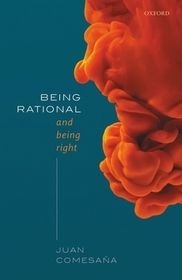
Being Rational and Being Right
-
20% KEDVEZMÉNY?
- A kedvezmény csak az 'Értesítés a kedvenc témákról' hírlevelünk címzettjeinek rendeléseire érvényes.
- Kiadói listaár GBP 80.00
-
36 120 Ft (34 400 Ft + 5% áfa)
Az ár azért becsült, mert a rendelés pillanatában nem lehet pontosan tudni, hogy a beérkezéskor milyen lesz a forint árfolyama az adott termék eredeti devizájához képest. Ha a forint romlana, kissé többet, ha javulna, kissé kevesebbet kell majd fizetnie.
- Kedvezmény(ek) 20% (cc. 7 224 Ft off)
- Kedvezményes ár 28 896 Ft (27 520 Ft + 5% áfa)
- A kedvezmény érvényes eddig: 2026. június 30.
Iratkozzon fel most és részesüljön kedvezőbb árainkból!
Feliratkozom
36 120 Ft

Beszerezhetőség
Becsült beszerzési idő: A Prosperónál jelenleg nincsen raktáron, de a kiadónál igen. Beszerzés kb. 3-5 hét..
A Prosperónál jelenleg nincsen raktáron.
Why don't you give exact delivery time?
A beszerzés időigényét az eddigi tapasztalatokra alapozva adjuk meg. Azért becsült, mert a terméket külföldről hozzuk be, így a kiadó kiszolgálásának pillanatnyi gyorsaságától is függ. A megadottnál gyorsabb és lassabb szállítás is elképzelhető, de mindent megteszünk, hogy Ön a lehető leghamarabb jusson hozzá a termékhez.
A termék adatai:
- Kiadó OUP Oxford
- Megjelenés dátuma 2020. március 13.
- ISBN 9780198847717
- Kötéstípus Keménykötés
- Terjedelem240 oldal
- Méret 232x159x18 mm
- Súly 496 g
- Nyelv angol 0
Kategóriák
Rövid leírás:
Juan Comesa--a presents a new framework for understanding the rationality of action and belief, which he calls "Experientalism". Arguing that rational action requires rational belief but tolerates false belief, Comesa--a provides a novel account of empirical evidence as consisting of the content of undefeated experiences.
TöbbHosszú leírás:
In Being Rational and Being Right, Juan Comesa--a argues for a cluster of theses related to the rationality of action and belief. His starting point is that rational action requires rational belief but tolerates false belief. From there, Comesa--a provides a novel account of empirical evidence according to which said evidence consists of the content of undefeated experiences. This view, which Comesa--a calls "Experientialism," differs from the two main views of empirical evidence on offer nowadays: Factualism, according to which our evidence is what we know, and Psychologism, according to which our experiences themselves are evidence. He reasons that Experientialism fares better than these rival views in explaining different features of rational belief and action. Comesa--a embeds this discussion in a Bayesian framework, and discusses in addition the problem of normative requirements, the easy knowledge problem, and how Experientialism compares to Evidentialism, Reliabilism, and Comesa--a's own (now superseded) Evidentialist Reliabilism.
TöbbTartalomjegyzék:
Introduction
Probability and Decision Theory
Objective Bayesianism and Knowledge-First Epistemolog
Knowledge-Based Decision Theory
Excuses, Would-Be Knowledge, and Rationality-Based Decision Theory
Experientialism
The Normative Force of Unjustified Beliefs
The Problem of Easy Rationality
Evidentialism, Reliabilism, Evidentialist Reliabilism?
Conclusion

