

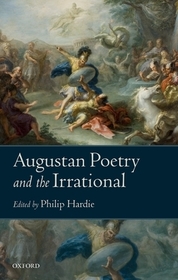
Augustan Poetry and the Irrational
-
10% KEDVEZMÉNY?
- A kedvezmény csak az 'Értesítés a kedvenc témákról' hírlevelünk címzettjeinek rendeléseire érvényes.
- Kiadói listaár GBP 152.50
-
68 853 Ft (65 575 Ft + 5% áfa)
Az ár azért becsült, mert a rendelés pillanatában nem lehet pontosan tudni, hogy a beérkezéskor milyen lesz a forint árfolyama az adott termék eredeti devizájához képest. Ha a forint romlana, kissé többet, ha javulna, kissé kevesebbet kell majd fizetnie.
- Kedvezmény(ek) 10% (cc. 6 885 Ft off)
- Kedvezményes ár 61 968 Ft (59 018 Ft + 5% áfa)
Iratkozzon fel most és részesüljön kedvezőbb árainkból!
Feliratkozom
68 853 Ft

Beszerezhetőség
Megrendelésre a kiadó utánnyomja a könyvet. Rendelhető, de a szokásosnál kicsit lassabban érkezik meg.
Why don't you give exact delivery time?
A beszerzés időigényét az eddigi tapasztalatokra alapozva adjuk meg. Azért becsült, mert a terméket külföldről hozzuk be, így a kiadó kiszolgálásának pillanatnyi gyorsaságától is függ. A megadottnál gyorsabb és lassabb szállítás is elképzelhető, de mindent megteszünk, hogy Ön a lehető leghamarabb jusson hozzá a termékhez.
A termék adatai:
- Kiadó OUP Oxford
- Megjelenés dátuma 2016. január 7.
- ISBN 9780198724728
- Kötéstípus Keménykötés
- Terjedelem344 oldal
- Méret 222x152x26 mm
- Súly 560 g
- Nyelv angol 0
Kategóriák
Rövid leírás:
Augustan Poetry and the Irrational, with contributions by some of the leading experts of the Augustan period as well as a number of younger scholars, examines the manifestations of the irrational in a range of Augustan poets, including Virgil, Horace, Ovid, and the love elegists, and also explores elements of post-classical reception.
TöbbHosszú leírás:
The establishment of the Augustan regime presents itself as the assertion of order and rationality in the political, ideological, and artistic spheres, after the disorder and madness of the civil wars of the late Republic. But the classical, Apollonian poetry of the Augustan period is fascinated by the irrational in both the public and private spheres. There is a vivid memory of the political and military furor that destroyed the Republic, and also an anxiety that furor may resurface, that the repressed may return. Epic and elegy are both obsessed with erotic madness: Dido experiences in her very public role the disabling effects of love that are both lamented and celebrated by the love elegists. Didactic (especially the Georgics) and the related Horatian exercises in satire and epistle, offer programmes for constructing rational order in the natural, political, and psychological worlds, but at best contain uneasily an ever-present threat of confusion and backsliding, and for the most part fall short of the austere standards of rational exposition set by Lucretius. Dionysus and the Dionysiac enjoy a prominence in Augustan poetry and art that goes well beyond the merely ornamental. The person of the emperor Augustus himself tests the limits of rational categorization.
Augustan Poetry and the Irrational contains contributions by some of the leading experts of the Augustan period as well as a number of younger scholars. An introduction which surveys the field as a whole is followed by chapters that examine the manifestations of the irrational in a range of Augustan poets, including Virgil, Horace, Ovid, and the love elegists, and also explore elements of post-classical reception.
...what the reader finds here is an eminently rewarding, fascinating set of papers that will do much to spur further consideration of a topic that is, paradoxically, both over-and understudied. To the degree that the papers do not conform to a predetermined dogmatism of interpretation, the reader will benefit from a fresh look at old problems, and will emerge with a better understanding of the challenges that confronted the poets of a world that no doubt often seemed to totter on the brink of madness
Tartalomjegyzék:
Preface
List of Contributors
Introduction: Augustan Poetry and the Irrational
Part 1: Civil War: Expiation and the Return of the Repressed
My Enemy's Enemy is My Enemy: Virgil's Illogical Use of metus hostilis
Orestes, Aeneas, and Augustus: Madness and Tragedy in Virgil's Aeneid
The Night of Reason: The Esquiline and Witches in Horace
Part 2: Order and Disorder: Counting and Accounts
Beyond 'Cosmos' and 'Logos': An Irrational Cosmology in Virgil, Georgics 1.231-58?
The Magic of Counting: On the Cantatoric Status of Poetry (Catullus 5 and 7' Horace Odes 1.11)
Under the Influence: Maecenas and Bacchus in Georgic 2
Part 3: Reason and Desire
Apollo in Tibullus 2.3 and 2.5
The Ars rhetorica: An Ovidian remedium for Female furor?
Augustan Gothic: Alexander Pope Reads Ovid
The Madness of Elegy: Rationalizing Propertius
Part 4: Self-Contraditions: Philosophy and Rhetoric
Horace and the Value of Self-Deception
Irrational Panegyric in Augustan Poetry
Part 5: Virgilian Figures of the Irrational
Caderent mones a crinibus hydri: The Problems of the Irrational in the Juno and Allecto Episode in Aeneid 7
Adamastor and the Epic Poet's Dark Continent
Bibliography
Index

