

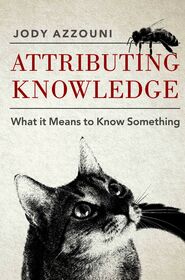
Attributing Knowledge
What It Means to Know Something
-
10% KEDVEZMÉNY?
- A kedvezmény csak az 'Értesítés a kedvenc témákról' hírlevelünk címzettjeinek rendeléseire érvényes.
- Kiadói listaár GBP 19.99
-
9 025 Ft (8 595 Ft + 5% áfa)
Az ár azért becsült, mert a rendelés pillanatában nem lehet pontosan tudni, hogy a beérkezéskor milyen lesz a forint árfolyama az adott termék eredeti devizájához képest. Ha a forint romlana, kissé többet, ha javulna, kissé kevesebbet kell majd fizetnie.
- Kedvezmény(ek) 10% (kb. 903 Ft)
- Kedvezményes ár 8 122 Ft (7 736 Ft + 5% áfa)
Iratkozzon fel most és részesüljön kedvezőbb árainkból!
Feliratkozom
9 025 Ft

Beszerezhetőség
Becsült beszerzési idő: A Prosperónál jelenleg nincsen raktáron, de a kiadónál igen. Beszerzés kb. 3-5 hét..
A Prosperónál jelenleg nincsen raktáron.
Why don't you give exact delivery time?
A beszerzés időigényét az eddigi tapasztalatokra alapozva adjuk meg. Azért becsült, mert a terméket külföldről hozzuk be, így a kiadó kiszolgálásának pillanatnyi gyorsaságától is függ. A megadottnál gyorsabb és lassabb szállítás is elképzelhető, de mindent megteszünk, hogy Ön a lehető leghamarabb jusson hozzá a termékhez.
A termék adatai:
- Kiadó OUP USA
- Megjelenés dátuma 2025. augusztus 18.
- ISBN 9780197803042
- Kötéstípus Puhakötés
- Terjedelem480 oldal
- Méret 231x163x35 mm
- Súly 680 g
- Nyelv angol 613
Kategóriák
Rövid leírás:
In this book Jody Azzouni challenges existing epistemological conventions about knowledge: what it means to know something, who or what is seen as knowing, and how we talk about it. He argues that the classic restrictive conditions philosophers routinely place on knowers only hold in special cases, and suggests that knowledge can be equally attributed to children, sophisticated animals (great apes, orcas), unsophisticated animals (bees), and machinery or devices (driverless cars). Through this perspective and a close examination of its relation to linguistics and psychology, Azzouni freshly approaches longstanding epistemological puzzles including the dogmatism paradox, Gettier puzzles, Agrippa's trilemma, and the surprise-exam paradox.
TöbbHosszú leírás:
In Attributing Knowledge, Jody Azzouni challenges philosophical conventions about what it means to know something. He argues that the restrictive conditions philosophers place on knowers only hold in special cases; knowledge can be attributed to babies, sophisticated animals (great apes, orcas), unsophisticated animals (bees), and machinery (drones, driverless cars).
Azzouni also gives a fresh defense of fallibilism. Relying on lexical semantics and ordinary usage, he shows that there are no knowledge norms for assertion or action. He examines everyday cases of knowledge challenge and attribution to show many recent and popular epistemological positions are wrong. By providing a long-sought intelligible characterization of knowledge attribution, Azzouni explains why the concept has puzzled philosophers so long, and he solves longstanding and recent puzzles that have perplexed epistemologists--including the dogmatism paradox, Gettier puzzles, and the surprise-exam paradox.
"This is a terrific book, full of surprises. For instance, Chapter 9 is full of points that are original, insightful, and useful in helping to resolve stale debates. I especially liked the points that we don't ordinarily describe someone as losing knowledge by gaining defeating evidence, that "knows" is vague and tri-scoped, that vagueness needn't be explained by appeal to precise metasemantic machinery, and that Williamson's anti-luminosity argument founders on the fact that knowledge doesn't require confidence. Bravo!" --Ram Neta, University of North Carolina, Chapel Hill
Praise for Jody Azzouni's Ontology without Borders:
"Azzouni offers a very strong drink, proposing that we do without central elements of what almost anyone would call logic or ontology. His arguments are serious and wide-ranging. If he's right, the reader will have learned something very important. If he's wrong, then the reader who figures out how he went wrong will also have learned something very important. Not every book has this feature." --Michael Gorman, The Catholic University of America
... an excellent, engaging piece of analytic philosophy...Summing Up: Recommended. Graduate students, researchers, faculty.
Tartalomjegyzék:
07/04/2025
Több
