

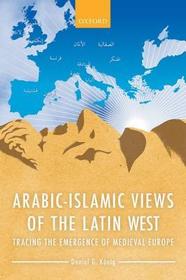
Arabic-Islamic Views of the Latin West
Tracing the Emergence of Medieval Europe
-
10% KEDVEZMÉNY?
- A kedvezmény csak az 'Értesítés a kedvenc témákról' hírlevelünk címzettjeinek rendeléseire érvényes.
- Kiadói listaár GBP 137.50
-
65 690 Ft (62 562 Ft + 5% áfa)
Az ár azért becsült, mert a rendelés pillanatában nem lehet pontosan tudni, hogy a beérkezéskor milyen lesz a forint árfolyama az adott termék eredeti devizájához képest. Ha a forint romlana, kissé többet, ha javulna, kissé kevesebbet kell majd fizetnie.
- Kedvezmény(ek) 10% (cc. 6 569 Ft off)
- Kedvezményes ár 59 121 Ft (56 306 Ft + 5% áfa)
Iratkozzon fel most és részesüljön kedvezőbb árainkból!
Feliratkozom
65 690 Ft

Beszerezhetőség
Megrendelésre a kiadó utánnyomja a könyvet. Rendelhető, de a szokásosnál kicsit lassabban érkezik meg.
Why don't you give exact delivery time?
A beszerzés időigényét az eddigi tapasztalatokra alapozva adjuk meg. Azért becsült, mert a terméket külföldről hozzuk be, így a kiadó kiszolgálásának pillanatnyi gyorsaságától is függ. A megadottnál gyorsabb és lassabb szállítás is elképzelhető, de mindent megteszünk, hogy Ön a lehető leghamarabb jusson hozzá a termékhez.
A termék adatai:
- Kiadó OUP Oxford
- Megjelenés dátuma 2015. november 5.
- ISBN 9780198737193
- Kötéstípus Keménykötés
- Terjedelem452 oldal
- Méret 241x172x30 mm
- Súly 826 g
- Nyelv angol 0
Kategóriák
Rövid leírás:
An insight into how the Arabic-Islamic world perceived medieval Western Europe, refuting previous claims that the Muslim world regarded Western Europe as a cultural backwater, and instead arguing for the presence of cultural and information flows between the two very different societies.
TöbbHosszú leírás:
Arabic-Islamic Views of the Latin West provides an insight into how the Arabic-Islamic world perceived medieval Western Europe in an age that is usually associated with the rise and expansion of Islam, the Spanish Reconquista, and the Crusades. Previous scholarship has maintained that the Arabic-Islamic world regarded Western Europe as a cultural backwater at the periphery of civilization that clung to a superseded religion. It holds mental barriers imposed by Islam responsible for the Muslim world's arrogant and ignorant attitude towards its northern neighbours. This study refutes this view by focussing on the mechanisms of transmission and reception that characterized the flow of information between both cultural spheres. By explaining how Arabic-Islamic scholars acquired and processed data on medieval Western Europe, it traces the two-fold 'emergence' of Latin-Christian Europe -- a sphere that increasingly encroached upon the Mediterranean and therefore became more and more important in Arabic-Islamic scholarly literature.
Chapter One questions previous interpretations of related Arabic-Islamic records that reduce a large and differentiated range of Arabic-Islamic perceptions to a single basic pattern subsumed under the keywords 'ignorance', 'indifference', and 'arrogance'. Chapter Two lists channels of transmission by means of which information on the Latin-Christian sphere reached the Arabic-Islamic sphere. Chapter Three deals with the general factors that influenced the reception and presentation of this data at the hands of Arabic-Islamic scholars. Chapters Four to Eight analyse how these scholars acquired and dealt with information on themes such as the western dimension of the Roman Empire, the Visigoths, the Franks, the papacy and, finally, Western Europe in the age of Latin-Christian expansionism. Against this background, Chapter Nine provides a concluding re-evaluation.
König's work marks a major contribution to the historiography of Christian-Muslim contact in the Middle Ages and constitutes a valuable collection of research on the history of the Latin West according to non-Latin sources. ... König's magisterial study helps us to view the history of intercultural contact in its complexity rather than reduce it into factitious and self-aggrandizing generalizations.
Tartalomjegyzék:
Arabic-Islamic Records on Latin-Christian Europe: Introduction
An Evolving Information Landscape, 7th-15th centuries
Scholars At Work
Discovery of the Roman West
The Visigoths: History of a Conquered People
From the Franks to France
From the Patriarch of Rome to the Pope
The Expanding Latin-Christian Sphere
Arabic-Islamic Records on Latin-Christian Europe: A Re-evaluation
Bibliography
Index

