

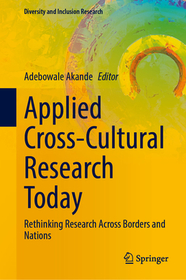
Applied Cross-Cultural Research Today
Rethinking Research Across Borders and Nations
Sorozatcím: Diversity and Inclusion Research;
-
20% KEDVEZMÉNY?
- A kedvezmény csak az 'Értesítés a kedvenc témákról' hírlevelünk címzettjeinek rendeléseire érvényes.
- Kiadói listaár EUR 181.89
-
71 046 Ft (67 663 Ft + 5% áfa)
Az ár azért becsült, mert a rendelés pillanatában nem lehet pontosan tudni, hogy a beérkezéskor milyen lesz a forint árfolyama az adott termék eredeti devizájához képest. Ha a forint romlana, kissé többet, ha javulna, kissé kevesebbet kell majd fizetnie.
- Kedvezmény(ek) 20% (cc. 14 209 Ft off)
- Kedvezményes ár 56 837 Ft (54 130 Ft + 5% áfa)
- A kedvezmény érvényes eddig: 2026. június 30.
Iratkozzon fel most és részesüljön kedvezőbb árainkból!
Feliratkozom
62 521 Ft

Beszerezhetőség
Még nem jelent meg, de rendelhető. A megjelenéstől számított néhány héten belül megérkezik.
Why don't you give exact delivery time?
A beszerzés időigényét az eddigi tapasztalatokra alapozva adjuk meg. Azért becsült, mert a terméket külföldről hozzuk be, így a kiadó kiszolgálásának pillanatnyi gyorsaságától is függ. A megadottnál gyorsabb és lassabb szállítás is elképzelhető, de mindent megteszünk, hogy Ön a lehető leghamarabb jusson hozzá a termékhez.
A termék adatai:
- Kiadó Springer Nature Switzerland
- Megjelenés dátuma 2026. május 26.
- ISBN 9783032119216
- Kötéstípus Keménykötés
- Terjedelem762 oldal
- Méret 235x155 mm
- Nyelv angol
- Illusztrációk LI, 762 p. 50 illus., 41 illus. in color. 700
Kategóriák
Hosszú leírás:
This book explores how culture quietly shapes our lives, influencing everything from the way we speak and lead to the way we grieve and resolve conflicts. Culture is often overlooked because it’s invisible, yet it influences everything we do. This book reveals that hidden force, demonstrating how cultural codes affect behavior, emotion, and decision-making in various settings.
Through real-world examples ranging from refugee camps to boardrooms, the book argues that understanding culture is no longer optional. It’s essential. With a focus on application, this book equips scholars, researchers, practitioners, and leaders to engage with culture thoughtfully and effectively. Whether they are studying psychology, managing teams, or working in global contexts, readers will find the tools they need to navigate cultural complexity with clarity and respect.
TöbbTartalomjegyzék:
"
Part I: Mapping Minds and Cultures: Ideologies, Intelligence, and Organizational Insight.- Chapter 1. Decoding Culture: The Science, Politics, and Purpose of Applied Cross-Cultural Research.- Chapter 2. Fractured Realities, Shared Futures: Reclaiming the Power of Applied Cross-Cultural Research.- Chapter 3. Conservatism/Liberalism at Individual and Country Levels: Three Psychological Continents in the World Today.- Chapter 4. Cultural Intelligence and the Four-Day Workweek: Building Adaptive Organizational Culture Through Managerial Innovation.- Chapter 5. Cross-Cultural Relations and Expatriate Online Inclusion.- Part II: Method Matters: Rethinking Research for a Complex Cultural Landscape.- Chapter 6. Designing Social Science Research: Paradigms, Principles and Methodological Reasoning.- Chapter 7. The Challenges and Promises of People Analytics: A Critical Reappraisal.- Chapter 8. Expanding the Toolkit of Qualitative Methods in Cross-Cultural Settings: Combining Face-To-Face and Online Approaches.- Chapter 9. The Craft of Social Research: Methodology, Measurement, and Interpretation.- Part III: Identities and Knowledge Sharing in Context: Power, Perception, and Belonging Across Cultures.- Chapter 10. Cultural and Structural Challenges to Female Leadership: A Comparative Study of Austria and Greece Within the EU Framework.- Chapter 11. The Influence of Threat, Belonging, and Discrimination Among Men: A Cross-Cultural Application.- Chapter 12. On the Nature of Measurement: A Treatise on the Cultural Specificity of Learning.- Chapter 13. Cultural Correlates of Attribution and Self-Evaluation.- Chapter 14. Generational Power Dynamics in Knowledge Sharing: HRM Strategies in Age-Diverse Industrial Workforces.- Part IV: Intercultural 2.0: Virtual Encounters and the New Global Mindset.- Chapter 15. Overcoming Communication Barriers in Intercultural Encounters: The Potential of Digitalization and Virtuality From an Organizational Communication Perspective.- Chapter 16. Leading Digitalization of International Interaction Processes: A Discussion of Intercultural Communication Challenges and the Emerging Role of Artificial Intelligence in Organizations.- Chapter 17. Technology, Leadership, and Cultural Adaptation in Education: Advancing Quality Through Hybrid Didactic.- Chapter 18. Cross-Cultural Management and the Role of Surface-Level Traits in Intercultural Interaction and Adjustment.- Part V: the Cultural Anatomy of Work: Leadership, Emotion, and Institutional Dynamics.- Chapter 19. Teachers as Victims: Bullying in the School Workplace.- Chapter 20. The Qualitative Eye:Administration as a Cultural Process in an Arab-Israeli College.- Chapter 21. Unlocking the Potential: The Impact of Inclusive Leadership in Modern Organization.- Part VI: Challenging Power, Redefining Culture: Leadership, Justice, and Human Capital in a Shifting World.- Chapter 22. Advanced Global Talent Management Strategies in the Modern Workplace.- Chapter 23. “The Environmental Policy in China and Poland: Does Democracy Clean a Country’s Air?”.- Chapter 24. The Censure of Dei in Education: How Authoritarianism and Maladaptive Cognitive Traits Work to Limit Diversity and Cross-Cultural Interactions.- Chapter 25. Whistleblowing in the United States: A Multimethod Study.- Chapter 26. Toward Living Systems: Ecological and Cultural Paradigms in Contemporary Management.- Chapter 27. The Inheritance of Feeling: From Aristotle and Darwin to Barrett, Boyle, and Akande - Mapping the Emotional Imagination Across Time, Thought, and Society.
" Több
