

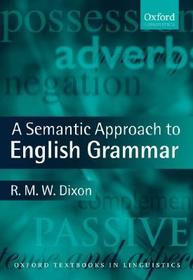
A Semantic Approach to English Grammar
Sorozatcím: Oxford Textbooks in Linguistics;
-
10% KEDVEZMÉNY?
- A kedvezmény csak az 'Értesítés a kedvenc témákról' hírlevelünk címzettjeinek rendeléseire érvényes.
- Kiadói listaár GBP 60.00
-
27 090 Ft (25 800 Ft + 5% áfa)
Az ár azért becsült, mert a rendelés pillanatában nem lehet pontosan tudni, hogy a beérkezéskor milyen lesz a forint árfolyama az adott termék eredeti devizájához képest. Ha a forint romlana, kissé többet, ha javulna, kissé kevesebbet kell majd fizetnie.
- Kedvezmény(ek) 10% (cc. 2 709 Ft off)
- Kedvezményes ár 24 381 Ft (23 220 Ft + 5% áfa)
Iratkozzon fel most és részesüljön kedvezőbb árainkból!
Feliratkozom
27 090 Ft

Beszerezhetőség
Megrendelésre a kiadó utánnyomja a könyvet. Rendelhető, de a szokásosnál kicsit lassabban érkezik meg.
Why don't you give exact delivery time?
A beszerzés időigényét az eddigi tapasztalatokra alapozva adjuk meg. Azért becsült, mert a terméket külföldről hozzuk be, így a kiadó kiszolgálásának pillanatnyi gyorsaságától is függ. A megadottnál gyorsabb és lassabb szállítás is elképzelhető, de mindent megteszünk, hogy Ön a lehető leghamarabb jusson hozzá a termékhez.
A termék adatai:
- Kiadás sorszáma 2
- Kiadó OUP Oxford
- Megjelenés dátuma 2005. június 30.
- ISBN 9780199247400
- Kötéstípus Puhakötés
- Terjedelem562 oldal
- Méret 246x172x32 mm
- Súly 987 g
- Nyelv angol
- Illusztrációk numerous tables 0
Kategóriák
Rövid leírás:
This book shows how grammar helps people communicate and looks at the ways grammar and meaning interrelate. The author starts from the notion that a speaker codes a meaning into grammatical forms which the listener is then able to recover: each word, he shows, has its own meaning and each bit of grammar its own function, their combinations creating and limiting the possibilities for different words. He uncovers a rationale for the varying grammatical properties of different words and in the process explains many facts about English - such as why we can say I wish to go, I wish that he would go, and I want to go but not I want that he would go.
TöbbHosszú leírás:
This book shows how grammar helps people communicate and looks at the ways grammar and meaning interrelate. The author starts from the notion that a speaker codes a meaning into grammatical forms which the listener is then able to recover: each word, he shows, has its own meaning and each bit of grammar its own function, their combinations creating and limiting the possibilities for different words. He uncovers a rationale for the varying grammatical properties of different words and in the process explains many facts about English - such as why we can say I wish to go, I wish that he would go, and I want to go but not I want that he would go.
The first part of the book reviews the main points of English syntax and discusses English verbs in terms of their semantic types including those of Motion, Giving, Speaking, Liking, and Trying. In the second part Professor Dixon looks at eight grammatical topics, including complement clauses, transitivity and causatives, passives, and the promotion of a non-subject to subject, as in Dictionaries sell well.
This is the updated and revised edition of A New Approach to English Grammar on Semantic Principles. It includes new chapters on tense and aspect, nominalizations and possession, and adverbs and negation, and contains a new discussion of comparative forms of adjectives. It also explains recent changes in English grammar, including how they has replaced the tabooed he as a pronoun referring to either gender, as in When a student reads this book, they will learn a lot about English grammar in a most enjoyable manner.
This is, in many ways, a near-perfect model of how a descriptive grammar of ANY language should be presented. Although the grammatical treatment and exposition are excellent, for me, one of the best parts of the book are the examples and how they are presented.
Tartalomjegyzék:
Part I Introduction
Orientation
Grammatical Sketch
Part II The Semantic Types
Noun, Adjective, and Verb Types
Primary-A Verb Types
Primary-B Verb Types
Secondary Verb Types
Part III Some Grammatical Topics
Tense and Aspect
Complement Clauses
Transitivity and Causatives
Nominalisations and Possession
Passives
Adverbs and Negation
Promotion to Subject
GIVE A VERB, HAVE A VERB, and TAKE A VERB Constructions
Appendix
References
Books by R.M.W. Dixon
Index

