

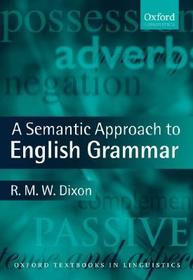
A Semantic Approach to English Grammar
Series: Oxford Textbooks in Linguistics;
- Publisher's listprice GBP 60.00
-
27 090 Ft (25 800 Ft + 5% VAT)
The price is estimated because at the time of ordering we do not know what conversion rates will apply to HUF / product currency when the book arrives. In case HUF is weaker, the price increases slightly, in case HUF is stronger, the price goes lower slightly.
- Discount 10% (cc. 2 709 Ft off)
- Discounted price 24 381 Ft (23 220 Ft + 5% VAT)
Subcribe now and take benefit of a favourable price.
Subscribe
27 090 Ft

Availability
printed on demand
Why don't you give exact delivery time?
Delivery time is estimated on our previous experiences. We give estimations only, because we order from outside Hungary, and the delivery time mainly depends on how quickly the publisher supplies the book. Faster or slower deliveries both happen, but we do our best to supply as quickly as possible.
Product details:
- Edition number 2
- Publisher OUP Oxford
- Date of Publication 30 June 2005
- ISBN 9780199247400
- Binding Paperback
- No. of pages562 pages
- Size 246x172x32 mm
- Weight 987 g
- Language English
- Illustrations numerous tables 0
Categories
Short description:
This book shows how grammar helps people communicate and looks at the ways grammar and meaning interrelate. The author starts from the notion that a speaker codes a meaning into grammatical forms which the listener is then able to recover: each word, he shows, has its own meaning and each bit of grammar its own function, their combinations creating and limiting the possibilities for different words. He uncovers a rationale for the varying grammatical properties of different words and in the process explains many facts about English - such as why we can say I wish to go, I wish that he would go, and I want to go but not I want that he would go.
MoreLong description:
This book shows how grammar helps people communicate and looks at the ways grammar and meaning interrelate. The author starts from the notion that a speaker codes a meaning into grammatical forms which the listener is then able to recover: each word, he shows, has its own meaning and each bit of grammar its own function, their combinations creating and limiting the possibilities for different words. He uncovers a rationale for the varying grammatical properties of different words and in the process explains many facts about English - such as why we can say I wish to go, I wish that he would go, and I want to go but not I want that he would go.
The first part of the book reviews the main points of English syntax and discusses English verbs in terms of their semantic types including those of Motion, Giving, Speaking, Liking, and Trying. In the second part Professor Dixon looks at eight grammatical topics, including complement clauses, transitivity and causatives, passives, and the promotion of a non-subject to subject, as in Dictionaries sell well.
This is the updated and revised edition of A New Approach to English Grammar on Semantic Principles. It includes new chapters on tense and aspect, nominalizations and possession, and adverbs and negation, and contains a new discussion of comparative forms of adjectives. It also explains recent changes in English grammar, including how they has replaced the tabooed he as a pronoun referring to either gender, as in When a student reads this book, they will learn a lot about English grammar in a most enjoyable manner.
This is, in many ways, a near-perfect model of how a descriptive grammar of ANY language should be presented. Although the grammatical treatment and exposition are excellent, for me, one of the best parts of the book are the examples and how they are presented.
Table of Contents:
Part I Introduction
Orientation
Grammatical Sketch
Part II The Semantic Types
Noun, Adjective, and Verb Types
Primary-A Verb Types
Primary-B Verb Types
Secondary Verb Types
Part III Some Grammatical Topics
Tense and Aspect
Complement Clauses
Transitivity and Causatives
Nominalisations and Possession
Passives
Adverbs and Negation
Promotion to Subject
GIVE A VERB, HAVE A VERB, and TAKE A VERB Constructions
Appendix
References
Books by R.M.W. Dixon
Index

