

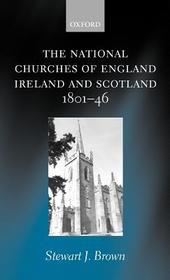
The National Churches of England, Ireland, and Scotland 1801-46
- Publisher's listprice GBP 202.50
-
91 428 Ft (87 075 Ft + 5% VAT)
The price is estimated because at the time of ordering we do not know what conversion rates will apply to HUF / product currency when the book arrives. In case HUF is weaker, the price increases slightly, in case HUF is stronger, the price goes lower slightly.
- Discount 10% (cc. 9 143 Ft off)
- Discounted price 82 286 Ft (78 368 Ft + 5% VAT)
Subcribe now and take benefit of a favourable price.
Subscribe
91 428 Ft

Availability
printed on demand
Why don't you give exact delivery time?
Delivery time is estimated on our previous experiences. We give estimations only, because we order from outside Hungary, and the delivery time mainly depends on how quickly the publisher supplies the book. Faster or slower deliveries both happen, but we do our best to supply as quickly as possible.
Product details:
- Publisher OUP Oxford
- Date of Publication 6 December 2001
- ISBN 9780199242351
- Binding Hardback
- No. of pages472 pages
- Size 226x146x29 mm
- Weight 669 g
- Language English 0
Categories
Short description:
The book provides a comparative study of the national Churches of England, Ireland, and Scotland: the Churches established by law to instruct the people and serve as guardians of the nation's faith. It traces the end of the confessional State idea in the United Kingdom from 1801 to 1846, and explores the movements to assert the spiritual independence of the Churches from State control.
MoreLong description:
In 1801, the United Kingdom was a semi-confessional State, and the national established Churches of England, Ireland and Scotland were vital to the constitution. They expressed the religious conscience of the State and served as guardians of the faith. Through their parish structures, they provided religious and moral instruction, and rituals for common living.
This book explores the struggle to strengthen the influence of the national Churches in the first half of the nineteenth century. For many, the national Churches would help form the United Kingdom into a single Protestant nation-state, with shared beliefs, values and a sense of national mission. Between 1801 and 1825, the State invested heavily in the national Churches. But during the 1830s the growth of Catholic nationalism in Ireland and the emergence of liberalism in Britain thwarted the efforts to unify the nation around the established Churches. Within the national Churches themselves, moreover, voices began calling for independence from the State connection - leading to the Oxford Movement in England and the Disruption of the Church of Scotland.
Stewart Brown is the first in the modern period to have tried to produce a comprehensive study setting all three churches in comparative perspective. With a wealth of material to hand, this was an ambitious task. The result is a triumph of clarity and scholarship ... this will become a vital resource for historians of British religion.

