

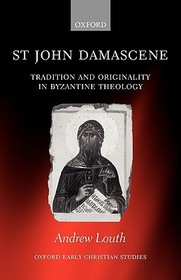
St John Damascene
Tradition and Originality in Byzantine Theology
Series: Oxford Early Christian Studies;
- Publisher's listprice GBP 62.00
-
27 993 Ft (26 660 Ft + 5% VAT)
The price is estimated because at the time of ordering we do not know what conversion rates will apply to HUF / product currency when the book arrives. In case HUF is weaker, the price increases slightly, in case HUF is stronger, the price goes lower slightly.
- Discount 10% (cc. 2 799 Ft off)
- Discounted price 25 194 Ft (23 994 Ft + 5% VAT)
Subcribe now and take benefit of a favourable price.
Subscribe
27 993 Ft

Availability
printed on demand
Why don't you give exact delivery time?
Delivery time is estimated on our previous experiences. We give estimations only, because we order from outside Hungary, and the delivery time mainly depends on how quickly the publisher supplies the book. Faster or slower deliveries both happen, but we do our best to supply as quickly as possible.
Product details:
- Edition number New ed
- Publisher OUP Oxford
- Date of Publication 7 October 2004
- ISBN 9780199275274
- Binding Paperback
- No. of pages346 pages
- Size 216x137x19 mm
- Weight 435 g
- Language English
- Illustrations frontispiece, 3 halftones 80
Categories
Short description:
This is the first examination of the whole range of the thought of John Damascene, one-time Arab civil servant, later a Palestinian monk, who thought of himself as a Byzantine churchman. He was one of the most influential of Byzantine theologians, whose work came to provide an essential resource for later Western theology. Many will be surprised by his subtle theology of images, defended against iconoclasts, and manifest in his sermons and sacred poetry.
MoreLong description:
John Damascene, one-time senior civil servant in the Umayyad Arab Empire, became a monk near Jerusalem in the early years of the eighth century. He never set foot in the Byzantine Empire, yet his influence on Byzantine theology was ultimately determinative, and beyond that his theological work became a key resource for Western theology from Scholasticism to Romanticism. His searching criticism of Imperial Byzantine iconoclasm earned him harsh condemnation from the Byzantine iconoclasts. This is the first book to present an overall account of John's life and work; it makes use of recent scholarship about the transformation of the former Byzantine territories of the Middle East after the seventh-century Arab Conquest, and the new critical edition of the Damascene's prose works. It sets John's theological work in the context of the process of preserving, defining, defending, and also celebrating the Christian faith of the early synods of the Church that took place in the Palestinian monasteries during the first century of Arab rule. John's own contribution is explored in detail: his amazing three-part Fountain Head of Knowledge, which provided the logical tools for arguing theologically, outlined the multifarious forms of heresy, and set out with clarity and learning the fundamental doctrines of Orthodox Christianity; as well as his treatises against iconoclasm, his preaching, for which he was famous in his lifetime, and, the work for which he is most renowned in the Orthodox world, his sacred poetry that still graces the liturgy of the Orthodox Church. The life and thought of this subject of the Arab Caliphs, a Christian monk who thought of himself as a Byzantine, poses intriguing questions about identity in a rapidly changing world, and the deeply traditional nature of his presentation of Christian theology calls for reflection about the relationship between tradition and originality in theology.
Review from previous edition Mr Louth writes like an angel.
Table of Contents:
Life and Times
John Damascene and Tradition
The Fountain Head of Knowledge: Nature and Development
Settling the Terms
Defining Error
Defining the Faith
Against the Iconoclasts
Chrysorrhoas ('flowing with gold'): John the Preacher
Steps to the Altar: John the Monk at Prayer
Glykorrhêmôn ('sweetly speaking'): John the Poet
Epilogue

