

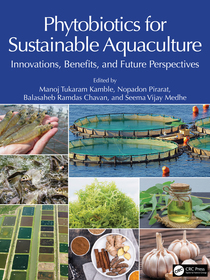
Phytobiotics for Sustainable Aquaculture
Innovations, Benefits, and Future Perspectives
- Publisher's listprice GBP 115.00
-
51 922 Ft (49 450 Ft + 5% VAT)
The price is estimated because at the time of ordering we do not know what conversion rates will apply to HUF / product currency when the book arrives. In case HUF is weaker, the price increases slightly, in case HUF is stronger, the price goes lower slightly.
- Discount 20% (cc. 10 384 Ft off)
- Discounted price 41 538 Ft (39 560 Ft + 5% VAT)
- Discount is valid until: 30 June 2026
Subcribe now and take benefit of a favourable price.
Subscribe
46 730 Ft

Availability
Estimated delivery time: In stock at the publisher, but not at Prospero's office. Delivery time approx. 3-5 weeks.
Not in stock at Prospero.
Why don't you give exact delivery time?
Delivery time is estimated on our previous experiences. We give estimations only, because we order from outside Hungary, and the delivery time mainly depends on how quickly the publisher supplies the book. Faster or slower deliveries both happen, but we do our best to supply as quickly as possible.
Product details:
- Edition number 1
- Publisher CRC Press
- Date of Publication 17 March 2026
- ISBN 9781041087755
- Binding Hardback
- No. of pages252 pages
- Size 280x210 mm
- Weight 630 g
- Language English
- Illustrations 1 Illustrations, black & white; 18 Illustrations, color; 10 Halftones, color; 1 Line drawings, black & white; 8 Line drawings, color; 18 Tables, black & white 688
Categories
Short description:
Phytobiotics for Sustainable Aquaculture: Innovations, Benefits, and Future Perspectives is a comprehensive reference on plant-derived compounds, including herbs, spices, and micro- and macroalgae, as tools for disease management, nutrition, welfare, and sustainability in farmed fish and shrimp.
MoreLong description:
Phytobiotics for Sustainable Aquaculture: Innovations, Benefits, and Future Perspectives is a comprehensive reference on plant-derived compounds, including herbs, spices, and micro- and macroalgae, as tools for disease management, nutrition, welfare, and sustainability in farmed fish and shrimp. The book covers molecular mechanisms and bioactive properties; demonstrates applications against bacterial, viral, fungal, and parasitic diseases; and evaluates roles in immune modulation, stress mitigation, growth, and reproduction. It also explores advanced delivery systems—nano- and microencapsulation for controlled and targeted release—and situates phytobiotics within regulatory and environmental frameworks, precision aquaculture, and future therapeutics. Applications include their use as natural anesthetics, functional feed additives, reproductive modulators, and, where appropriate, piscicides.
Key Features:
- Covers molecular mechanisms, bioactive compounds, and pathogen-management applications of phytobiotics
- Explores the targeted use of phytobiotics for combating bacterial, viral, fungal, and parasitic infections in aquaculture
- Discusses the role of phytobiotics in nutrition, stress reduction, and immune enhancement for improved aquaculture health
- Presents advanced delivery techniques such as nanoencapsulation, microencapsulation, and precision dosing
- Addresses regulatory challenges, environmental impact, and future innovations in sustainable aquaculture practices
This book is useful for researchers, professionals, veterinarians, nutritionists, hatchery managers, policymakers, and advanced students in aquaculture and nutraceutical sciences.
MoreTable of Contents:
Chapter 1. Phytobiotics in Aquaculture: Evolution, Innovations, and Sustainability Pathways. Chapter 2. Innovative Antibacterial Phytobiotics: Mechanisms and Sustainable Strategies for Aquaculture. Chapter 3. Antiviral Phytobiotics in Aquaculture: Innovations for Disease Control and Resilience. Chapter 4. Antifungal Phytobiotics: Cutting-Edge Solutions for Aquaculture Health. Chapter 5. Antihelminthic Phytobiotics: Novel Approaches to Parasite Management in Aquaculture. Chapter 6. Innovative Phytobiotics Against Aquatic Parasites: Targeting Protozoa and Metazoans. Chapter 7. Phytobiotics for Stress Management: Advancing Aquaculture Welfare. Chapter 8. Growth-Promoting Phytobiotics: Sustainable Approaches in Aquaculture Nutrition. Chapter 9. Phytobiotics for Disease Resistance and Immune Health in Aquaculture: Enhancing Resilience and Sustainability. Chapter 10. Phytobiotics as Natural Anesthetics: Applications in Aquaculture Handling and Welfare. Chapter 11. Phytobiotic Piscicides: Sustainable Solutions for Species Management in Aquaculture. Chapter 12. Phytobiotics in Reproductive Management: Innovations in Sex Reversal and Control. Chapter 13. Phytobiotics in Aquafeeds: Challenges, Opportunities, and Sustainable Practices. Chapter 14. Phytobiotics in Aquaculture: Regulatory Perspectives and Environmental Considerations
More
