

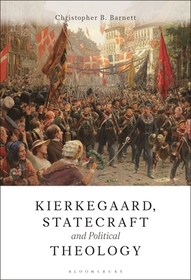
Kierkegaard, Statecraft and Political Theology
- Publisher's listprice GBP 85.00
-
38 377 Ft (36 550 Ft + 5% VAT)
The price is estimated because at the time of ordering we do not know what conversion rates will apply to HUF / product currency when the book arrives. In case HUF is weaker, the price increases slightly, in case HUF is stronger, the price goes lower slightly.
- Discount 20% (cc. 7 675 Ft off)
- Discounted price 30 702 Ft (29 240 Ft + 5% VAT)
- Discount is valid until: 30 June 2026
Subcribe now and take benefit of a favourable price.
Subscribe
38 377 Ft

Availability
Not yet published.
Why don't you give exact delivery time?
Delivery time is estimated on our previous experiences. We give estimations only, because we order from outside Hungary, and the delivery time mainly depends on how quickly the publisher supplies the book. Faster or slower deliveries both happen, but we do our best to supply as quickly as possible.
Product details:
- Publisher Bloomsbury Publishing (UK)
- Date of Publication 11 June 2026
- ISBN 9781350408531
- Binding Hardback
- No. of pages232 pages
- Size 234x156 mm
- Language
- Illustrations 10 bw illus 700
Categories
Short description:
What if S-ren Kierkegaard's rejection of modern politics was not a form of spiritual quietism but of Christian resistance?
MoreLong description:
"
Written against the fractured landscape of contemporary Christianity and the increasing popularity of ""political theology,"" Christopher B. Barnett wrestles with the question: what if S-ren Kierkegaard's rejection of modern politics was not a form of spiritual quietism, but of Christian resistance?
Tracing the rise of the modern secular state, Barnett argues that Kierkegaard's refusal of ""the political"" anticipates a crisis now impossible to ignore. For Kierkegaard, obsessive political passion signals a theological inversion: as the state grows in importance, God is displaced. The upshot is not freedom but moral exhaustion-a society saturated with envy, despair, and groupthink.
Barnett contends that Kierkegaard's reflections on politics and the modern state find a receptive audience in a trio of twentieth-century figures: Dietrich Bonhoeffer, Jacques Ellul, and Ren- Girard. Loosely gathered under the heading of ""apostolical radicalism,"" each of these thinkers demonstrates that the modern state organizes contemporary life through bureaucracy, technique, propaganda, and ritualized antagonism. State politics may promise meaning, identity, and moral clarity, but as the rise of political theology shows, it ultimately absorbs all aspects of life into the sphere of politics.
Kierkegaard, Statecraft and Political Theology unleashes Kierkegaard's political thought as a live provocation, drawing unexpected lines between Christian theology and praxis and our present age of social media, tribalized politics, and permanent war. Ultimately, this book challenges readers to ask whether the modern state leads towards salvation-or the apocalypse.
Table of Contents:
Preface
1. The Origin and Development of the Modern State: A Survey
2. Kierkegaard's Early Critique of the State and Politics
3. Conservative Radicalism?: Political Dissent in the Wake of Kierkegaard
4. The Danger of Political Theology
Conclusion: Seeing Through the Political Illusion
Works Cited

