

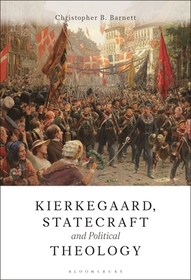
Kierkegaard, Statecraft and Political Theology
-
20% KEDVEZMÉNY?
- A kedvezmény csak az 'Értesítés a kedvenc témákról' hírlevelünk címzettjeinek rendeléseire érvényes.
- Kiadói listaár GBP 85.00
-
38 377 Ft (36 550 Ft + 5% áfa)
Az ár azért becsült, mert a rendelés pillanatában nem lehet pontosan tudni, hogy a beérkezéskor milyen lesz a forint árfolyama az adott termék eredeti devizájához képest. Ha a forint romlana, kissé többet, ha javulna, kissé kevesebbet kell majd fizetnie.
- Kedvezmény(ek) 20% (cc. 7 675 Ft off)
- Kedvezményes ár 30 702 Ft (29 240 Ft + 5% áfa)
- A kedvezmény érvényes eddig: 2026. június 30.
Iratkozzon fel most és részesüljön kedvezőbb árainkból!
Feliratkozom
38 377 Ft

Beszerezhetőség
Még nem jelent meg, de rendelhető. A megjelenéstől számított néhány héten belül megérkezik.
Why don't you give exact delivery time?
A beszerzés időigényét az eddigi tapasztalatokra alapozva adjuk meg. Azért becsült, mert a terméket külföldről hozzuk be, így a kiadó kiszolgálásának pillanatnyi gyorsaságától is függ. A megadottnál gyorsabb és lassabb szállítás is elképzelhető, de mindent megteszünk, hogy Ön a lehető leghamarabb jusson hozzá a termékhez.
A termék adatai:
- Kiadó Bloomsbury Publishing (UK)
- Megjelenés dátuma 2026. június 11.
- ISBN 9781350408531
- Kötéstípus Keménykötés
- Terjedelem232 oldal
- Méret 234x156 mm
- Nyelv
- Illusztrációk 10 bw illus 700
Kategóriák
Rövid leírás:
What if S-ren Kierkegaard's rejection of modern politics was not a form of spiritual quietism but of Christian resistance?
TöbbHosszú leírás:
"
Written against the fractured landscape of contemporary Christianity and the increasing popularity of ""political theology,"" Christopher B. Barnett wrestles with the question: what if S-ren Kierkegaard's rejection of modern politics was not a form of spiritual quietism, but of Christian resistance?
Tracing the rise of the modern secular state, Barnett argues that Kierkegaard's refusal of ""the political"" anticipates a crisis now impossible to ignore. For Kierkegaard, obsessive political passion signals a theological inversion: as the state grows in importance, God is displaced. The upshot is not freedom but moral exhaustion-a society saturated with envy, despair, and groupthink.
Barnett contends that Kierkegaard's reflections on politics and the modern state find a receptive audience in a trio of twentieth-century figures: Dietrich Bonhoeffer, Jacques Ellul, and Ren- Girard. Loosely gathered under the heading of ""apostolical radicalism,"" each of these thinkers demonstrates that the modern state organizes contemporary life through bureaucracy, technique, propaganda, and ritualized antagonism. State politics may promise meaning, identity, and moral clarity, but as the rise of political theology shows, it ultimately absorbs all aspects of life into the sphere of politics.
Kierkegaard, Statecraft and Political Theology unleashes Kierkegaard's political thought as a live provocation, drawing unexpected lines between Christian theology and praxis and our present age of social media, tribalized politics, and permanent war. Ultimately, this book challenges readers to ask whether the modern state leads towards salvation-or the apocalypse.
Tartalomjegyzék:
Preface
1. The Origin and Development of the Modern State: A Survey
2. Kierkegaard's Early Critique of the State and Politics
3. Conservative Radicalism?: Political Dissent in the Wake of Kierkegaard
4. The Danger of Political Theology
Conclusion: Seeing Through the Political Illusion
Works Cited

