

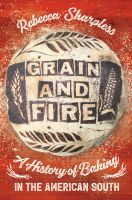
Grain and Fire
A History of Baking in the American South
- Publisher's listprice GBP 24.99
-
11 282 Ft (10 745 Ft + 5% VAT)
The price is estimated because at the time of ordering we do not know what conversion rates will apply to HUF / product currency when the book arrives. In case HUF is weaker, the price increases slightly, in case HUF is stronger, the price goes lower slightly.
- Discount 10% (cc. 1 128 Ft off)
- Discounted price 10 154 Ft (9 671 Ft + 5% VAT)
Subcribe now and take benefit of a favourable price.
Subscribe
11 282 Ft

Availability
Estimated delivery time: In stock at the publisher, but not at Prospero's office. Delivery time approx. 3-5 weeks.
Not in stock at Prospero.
Why don't you give exact delivery time?
Delivery time is estimated on our previous experiences. We give estimations only, because we order from outside Hungary, and the delivery time mainly depends on how quickly the publisher supplies the book. Faster or slower deliveries both happen, but we do our best to supply as quickly as possible.
Product details:
- Publisher The University of North Carolina Press
- Date of Publication 28 June 2022
- ISBN 9781469668369
- Binding Hardback
- No. of pages344 pages
- Size 241x162x24 mm
- Weight 280 g
- Language English
- Illustrations 29 halftones 207
Categories
Short description:
Like everything about the American South, southern baking is far more complicated than it seems. Rebecca Sharpless here weaves a brilliant chronicle, vast in perspective and entertaining in detail, revealing how three global food traditions merged to create what we know as the southern baking tradition.
MoreLong description:
While a luscious layer cake may exemplify the towering glory of southern baking, like everything about the American South, baking is far more complicated than it seems. Rebecca Sharpless here weaves a brilliant chronicle, vast in perspective and entertaining in detail, revealing how three global food traditions?Indigenous American, European, and African?collided with and merged in the economies, cultures, and foodways of the South to create what we know as the southern baking tradition.
Recognizing that sentiments around southern baking run deep, Sharpless takes delight in deflating stereotypes as she delves into the suprising realities underlying the creation and consumption of baked goods. People who controlled the food supply in the South used baking to reinforce their power and make social distinctions. Who used white cornmeal and who used yellow, who put sugar in their cornbread and who did not had traditional meanings for southerners, as did the proportions of flour, fat, and liquid in biscuits. By the twentieth century, however, the popularity of convenience foods and mixes exploded in the region, as it did nationwide. Still, while some regional distinctions have waned, baking in the South continues to be a remarkable, and remarkably tasty, source of identity and entrepreneurship.

