

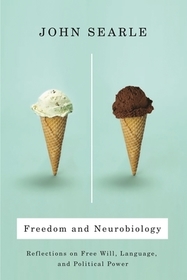
Freedom and Neurobiology
Reflections on Free Will, Language, and Political Power
Series: Columbia Themes in Philosophy;
- Publisher's listprice GBP 16.99
-
7 670 Ft (7 305 Ft + 5% VAT)
The price is estimated because at the time of ordering we do not know what conversion rates will apply to HUF / product currency when the book arrives. In case HUF is weaker, the price increases slightly, in case HUF is stronger, the price goes lower slightly.
- Discount 10% (cc. 767 Ft off)
- Discounted price 6 903 Ft (6 575 Ft + 5% VAT)
Subcribe now and take benefit of a favourable price.
Subscribe
7 670 Ft

Availability
Estimated delivery time: In stock at the publisher, but not at Prospero's office. Delivery time approx. 3-5 weeks.
Not in stock at Prospero.
Why don't you give exact delivery time?
Delivery time is estimated on our previous experiences. We give estimations only, because we order from outside Hungary, and the delivery time mainly depends on how quickly the publisher supplies the book. Faster or slower deliveries both happen, but we do our best to supply as quickly as possible.
Product details:
- Publisher Columbia University Press
- Date of Publication 3 October 2008
- ISBN 9780231137539
- Binding Paperback
- No. of pages128 pages
- Size 209x139 mm
- Language English 0
Categories
Short description:
In Freedom and Neurobiology, John Searle discusses the possibility of free will within the context of contemporary neurobiology. He begins by explaining the relationship between human reality and the more fundamental reality as described by physics and chemistry. Then he proposes a neurobiological resolution to the problem by demonstrating how various conceptions of free will have different consequences for the neurobiology of consciousness.
In the second half of the book, Searle applies his theory of social reality to the problem of political power, explaining the role of language in the formation of our political reality. Searle focuses on the institutional structures that organize, empower, and regulate our lives-money, property, marriage, government-and the way in which language constitutes them. He argues that consciousness and rationality are crucial to our existence and that they are the result of the biological evolution of our species. In conclusion, he addresses the problem of free will within the context of a neurobiological conception of consciousness and rationality, and he addresses the problem of political power within the context of this analysis.
MoreLong description:
In Freedom and Neurobiology, John Searle discusses the possibility of free will within the context of contemporary neurobiology. He begins by explaining the relationship between human reality and the more fundamental reality as described by physics and chemistry. Then he proposes a neurobiological resolution to the problem by demonstrating how various conceptions of free will have different consequences for the neurobiology of consciousness.
In the second half of the book, Searle applies his theory of social reality to the problem of political power, explaining the role of language in the formation of our political reality. Searle focuses on the institutional structures that organize, empower, and regulate our lives-money, property, marriage, government-and the way in which language constitutes them. He argues that consciousness and rationality are crucial to our existence and that they are the result of the biological evolution of our species. In conclusion, he addresses the problem of free will within the context of a neurobiological conception of consciousness and rationality, and he addresses the problem of political power within the context of this analysis.
More
