

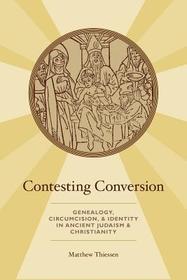
Contesting Conversion
Genealogy, Circumcision, and Identity in Ancient Judaism and Christianity
- Publisher's listprice GBP 32.49
-
14 669 Ft (13 970 Ft + 5% VAT)
The price is estimated because at the time of ordering we do not know what conversion rates will apply to HUF / product currency when the book arrives. In case HUF is weaker, the price increases slightly, in case HUF is stronger, the price goes lower slightly.
- Discount 10% (cc. 1 467 Ft off)
- Discounted price 13 202 Ft (12 573 Ft + 5% VAT)
Subcribe now and take benefit of a favourable price.
Subscribe
14 669 Ft

Availability
printed on demand
Why don't you give exact delivery time?
Delivery time is estimated on our previous experiences. We give estimations only, because we order from outside Hungary, and the delivery time mainly depends on how quickly the publisher supplies the book. Faster or slower deliveries both happen, but we do our best to supply as quickly as possible.
Product details:
- Publisher OUP USA
- Date of Publication 12 July 2018
- ISBN 9780190912703
- Binding Paperback
- No. of pages258 pages
- Size 231x155x17 mm
- Weight 417 g
- Language English 0
Categories
Short description:
Matthew Thiessen offers a nuanced study of the nature of Jewish thought regarding Jewishness, circumcision, and conversion. Focusing on texts from the Hebrew Bible, Second Temple Judaism, and early Christianity, he gives a compelling account of the varieties of Judaism from which the Christian movement arose.
MoreLong description:
Winner of the Manfred Lautenschlaeger Award for Theological Promise
Matthew Thiessen offers a nuanced and wide-ranging study of the nature of Jewish thought on Jewishness, circumcision, and conversion. Examining texts from the Hebrew Bible, Second Temple Judaism, and early Christianity, he gives a compelling account of the various forms of Judaism from which the early Christian movement arose.
Beginning with analysis of the Hebrew Bible, Thiessen argues that there is no evidence that circumcision was considered to be a rite of conversion to Israelite religion. In fact, circumcision, particularly the infant circumcision practiced within Israelite and early Jewish society, excluded from the covenant those not properly descended from Abraham. In the Second Temple period, many Jews began to subscribe to a definition of Jewishness that enabled Gentiles to become Jews. Other Jews, such as the author of Jubilees, found this definition problematic, reasserting a strictly genealogical conception of Jewish identity. As a result, some Gentiles who underwent conversion to Judaism in this period faced criticism because of their suspect genealogy.
Thiessen's examination of the way in which Jews in the Second Temple period perceived circumcision and conversion allows a deeper understanding of early Christianity. Contesting Conversion shows that careful attention to a definition of Jewishness that was based on genealogical descent has crucial implications for understanding the variegated nature of early Christian mission to the Gentiles in the first century C.E.
Table of Contents:
Abbreviations
Introduction
Part I: Genealogy and Circumcision in the Hebrew Bible
Chapter 1: Ishmael, Isaac, and Covenantal Circumcision in Genesis 17
Chapter 2: Uncircumcised and Circumcised Gentiles in the Hebrew Bible
Part II: Genealogy and Circumcision in Early Judaism and Christianity
Chapter 3: Eighth-Day Circumcision in Jubilees
Chapter 4: Jewishness as Genealogy in the Late Second Temple Period
Chapter 5: Jews, Gentiles, and Circumcision in Early Christianity
Conclusion
Notes
Bibliography

