

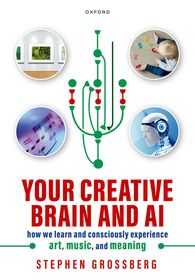
Your Creative Brain and AI
How We Learn and Consciously Experience Art, Music, and Meaning
-
10% KEDVEZMÉNY?
- A kedvezmény csak az 'Értesítés a kedvenc témákról' hírlevelünk címzettjeinek rendeléseire érvényes.
- Kiadói listaár GBP 17.99
-
8 122 Ft (7 735 Ft + 5% áfa)
Az ár azért becsült, mert a rendelés pillanatában nem lehet pontosan tudni, hogy a beérkezéskor milyen lesz a forint árfolyama az adott termék eredeti devizájához képest. Ha a forint romlana, kissé többet, ha javulna, kissé kevesebbet kell majd fizetnie.
- Kedvezmény(ek) 10% (cc. 812 Ft off)
- Kedvezményes ár 7 310 Ft (6 962 Ft + 5% áfa)
Iratkozzon fel most és részesüljön kedvezőbb árainkból!
Feliratkozom
8 122 Ft

Beszerezhetőség
Becsült beszerzési idő: A Prosperónál jelenleg nincsen raktáron, de a kiadónál igen. Beszerzés kb. 3-5 hét..
A Prosperónál jelenleg nincsen raktáron.
Why don't you give exact delivery time?
A beszerzés időigényét az eddigi tapasztalatokra alapozva adjuk meg. Azért becsült, mert a terméket külföldről hozzuk be, így a kiadó kiszolgálásának pillanatnyi gyorsaságától is függ. A megadottnál gyorsabb és lassabb szállítás is elképzelhető, de mindent megteszünk, hogy Ön a lehető leghamarabb jusson hozzá a termékhez.
A termék adatai:
- Kiadó OUP Oxford
- Megjelenés dátuma 2026. február 3.
- ISBN 9780198965374
- Kötéstípus Keménykötés
- Terjedelem256 oldal
- Méret 282x225x20 mm
- Súly 944 g
- Nyelv angol 676
Kategóriák
Rövid leírás:
How do our minds learn and consciously experience visual art, music, and the languages whose meanings enable us to think and communicate about our experiences in the world? This book provides an introductory and self-contained description of exciting answers to the questions that modern theories of mind and brain have proposed.
TöbbHosszú leírás:
How do our brains give rise to our conscious minds? How do our minds learn and consciously experience miraculous creations of our civilizations, such as visual art, music, and the languages whose meanings enable us to think and communicate about our experiences in the world?
How does human learning and language differ from some Artificial Intelligence algorithms that fail to explain how human minds work? Unlike these AI algorithms, whose flaws are explained in the book, human brains provide a blueprint for the paradigm of autonomous adaptive intelligence that promises to revolutionize all aspects of society during this century and beyond.
This book provides an introductory and self-contained description of exciting answers to these questions that modern theories of mind and brain have proposed. For over 50 years, Stephen Grossberg has been internationally acknowledged to be the most important pioneer and current research leader whose work explains how our brains make our minds. He is often called the Father of AI because he introduced the modern neural networks paradigm in 1957 as a Dartmouth college Freshman, as well as the main equations that help to explain how our brains make our minds. He has also been called the Newton and Einstein of the Mind because he and many gifted collaborators have subsequently developed neural network models of essentially all the main processes whereby our brains make our conscious and unconscious minds in both healthy individuals and clinical patients.
Grossberg published his award-winning Magnum Opus, Conscious Mind, Resonant Brain: How Each Brain Makes a Mind, in 2021 to provide a self-contained and non-technical overview and synthesis of these discoveries. The current book describes his recent discoveries about art, music, and meaning in accessible language intended to appeal to all readers who love art and music, and who wonder about the mystery of how languages acquire meaning.
Tartalomjegyzék:
Overview: My personal odyssey and discoveries that led to this book
Art: How humans consciously see and recognize visual art
Music: How humans learn and consciously perform musical lyrics and melodies
Language and Meaning: How children learn to understand language meanings
Explainable AI and Biological Intelligence: Contrasting deep learning with adaptive resonance

