

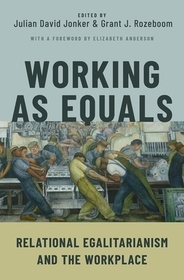
Working as Equals
Relational Egalitarianism and the Workplace
-
10% KEDVEZMÉNY?
- A kedvezmény csak az 'Értesítés a kedvenc témákról' hírlevelünk címzettjeinek rendeléseire érvényes.
- Kiadói listaár GBP 25.99
-
11 734 Ft (11 175 Ft + 5% áfa)
Az ár azért becsült, mert a rendelés pillanatában nem lehet pontosan tudni, hogy a beérkezéskor milyen lesz a forint árfolyama az adott termék eredeti devizájához képest. Ha a forint romlana, kissé többet, ha javulna, kissé kevesebbet kell majd fizetnie.
- Kedvezmény(ek) 10% (cc. 1 173 Ft off)
- Kedvezményes ár 10 560 Ft (10 058 Ft + 5% áfa)
Iratkozzon fel most és részesüljön kedvezőbb árainkból!
Feliratkozom
11 734 Ft

Beszerezhetőség
Becsült beszerzési idő: A Prosperónál jelenleg nincsen raktáron, de a kiadónál igen. Beszerzés kb. 3-5 hét..
A Prosperónál jelenleg nincsen raktáron.
Why don't you give exact delivery time?
A beszerzés időigényét az eddigi tapasztalatokra alapozva adjuk meg. Azért becsült, mert a terméket külföldről hozzuk be, így a kiadó kiszolgálásának pillanatnyi gyorsaságától is függ. A megadottnál gyorsabb és lassabb szállítás is elképzelhető, de mindent megteszünk, hogy Ön a lehető leghamarabb jusson hozzá a termékhez.
A termék adatai:
- Kiadó OUP USA
- Megjelenés dátuma 2023. június 30.
- ISBN 9780197634301
- Kötéstípus Puhakötés
- Terjedelem256 oldal
- Méret 157x236x15 mm
- Súly 381 g
- Nyelv angol 408
Kategóriák
Rövid leírás:
This volume of essays by leading moral and political philosophers explores questions about justice in the workplace and contributes to lively debates about work taking place within political philosophy and business ethics. The essays push the relational egalitarian tradition in new directions, helping to show its promise and its limits. At a time of widening inequality and rapid change in the nature of work, the volume addresses issues of current and future concern.
TöbbHosszú leírás:
Are hierarchical arrangements in the workplace, including the employer-employee relationship, consistent with the ideal of relating to one another as moral equals? With this question at its core, this volume of essays by leading moral and political philosophers explores ideas about justice in the workplace, contributing to both political philosophy and business ethics. Relational egalitarians propose that the ideal of equality is primarily an ideal of social relationships and view the equality of social relationships as having priority over the distributive arrangements. Yet contemporary workplaces are characterized by hierarchical employer-employee relationships. The essays push discussions of the relational egalitarian tradition in new directions, helping to show its promise and its limits. They address pressing concerns at a time of widening inequality and rapid changes in the nature of work.
The contributors explore two overarching topics. First, they consider whether the relational ideal of equality really applies to the workplace. In doing so, they explore the scope of the relational egalitarian approach and its promise for extending political philosophy beyond the institutions of the state. Second, they consider what workplace relations and workplace actors would have to be like in order to fulfill the relational egalitarian ideal. In examining these two issues, the contributors both flesh out the relational egalitarian ideal and add to our understanding of the ethical norms of the workplace.
The book is an invaluable resource for those studying political philosophy and ethics, particularly relational egalitarianism. Additionally, lawyers interested in the foundations of labor law and antidiscrimination law will find it highly informative.
In times of the 'big quit,' questions about workplace relations have come to the fore of public discussions again -- and philosophers have turned to them as well. This volume brings together an interesting range of papers on philosophical dimensions of work, discussing both moral and institutional demands, from angles such as autonomy, reason-giving, or democracy. They are worth reading not only for where they agree but also for where they disagree, showing what normative values are at stake in the organization of work life.
Tartalomjegyzék:
Foreword
Elizabeth Anderson
1. Introduction
Grant J. Rozeboom and Julian David Jonker
2. What Is Wrong with the Commodification of Human Labor Power: The Argument from “Democratic Character”
Debra Satz
3. An Objection to Workplace Hierarchy Itself?
Niko Kolodny
4. Seeing Like a Firm: Social Equality, Conservatism, and the Aesthetics of Inequality
Pierre-Yves Néron
5. Self-Employment and Independence
Iñigo González Ricoy
6. Hobby Lobby and the Moral Structure of the Employee-Employer Relationship
David Silver
7. Justice in Human Capital
Michael Cholbi
8. Can Employers Discriminate without Treating Some Employees Worse Than Others? Discrimination, the Comparative View, and Relational Equality
Kasper Lippert-Rasmussen
9. A Cooperative Paradigm of Employment
Sabine Tsuruda
10. The Workplace as a Cooperative Institution
Julian David Jonker
11. Relational Egalitarianism, Institutionalism, and Workplace Hierarchy
Brian Berkey
12. Good Enough for Equality
Grant J. Rozeboom

