

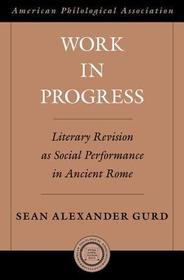
Work in Progress
Literary Revision as Social Performance in Ancient Rome
Sorozatcím: Society for Classical Studies American Classical Studies; 57;
-
10% KEDVEZMÉNY?
- A kedvezmény csak az 'Értesítés a kedvenc témákról' hírlevelünk címzettjeinek rendeléseire érvényes.
- Kiadói listaár GBP 110.00
-
49 665 Ft (47 300 Ft + 5% áfa)
Az ár azért becsült, mert a rendelés pillanatában nem lehet pontosan tudni, hogy a beérkezéskor milyen lesz a forint árfolyama az adott termék eredeti devizájához képest. Ha a forint romlana, kissé többet, ha javulna, kissé kevesebbet kell majd fizetnie.
- Kedvezmény(ek) 10% (cc. 4 967 Ft off)
- Kedvezményes ár 44 699 Ft (42 570 Ft + 5% áfa)
Iratkozzon fel most és részesüljön kedvezőbb árainkból!
Feliratkozom
49 665 Ft

Beszerezhetőség
Megrendelésre a kiadó utánnyomja a könyvet. Rendelhető, de a szokásosnál kicsit lassabban érkezik meg.
Why don't you give exact delivery time?
A beszerzés időigényét az eddigi tapasztalatokra alapozva adjuk meg. Azért becsült, mert a terméket külföldről hozzuk be, így a kiadó kiszolgálásának pillanatnyi gyorsaságától is függ. A megadottnál gyorsabb és lassabb szállítás is elképzelhető, de mindent megteszünk, hogy Ön a lehető leghamarabb jusson hozzá a termékhez.
A termék adatai:
- Kiadó OUP USA
- Megjelenés dátuma 2012. január 5.
- ISBN 9780199837519
- Kötéstípus Keménykötés
- Terjedelem192 oldal
- Méret 160x239x20 mm
- Súly 386 g
- Nyelv angol 0
Kategóriák
Rövid leírás:
Work in Progress offers the first in-depth study of the cultural and social importance of literary revision among ancient Greek and Roman authors.
TöbbHosszú leírás:
Work in Progress offers an in-depth study of the role of literary revision in the compositional practices and representational strategies of Roman authors at the end of the republic and the beginning of the principate. It focuses on Cicero, Horace, Quintilian, Martial, and Pliny the Younger, but also offers discussions of Isocrates, Plato, and Hellenistic poetry. The book's central argument is that revision made textuality into a medium of social exchange. Revisions were not always made by authors working alone: often, they were the result of conversations between an author and friends or literary contacts, and these conversations exemplified a commitment to collective debate and active collaboration. Revision was thus much more than an unavoidable element in literary genesis: it was one way in which authorship became a form of social agency. Consequently, when we think about revision for authors of the late republic and early empire we should not think solely of painstaking attendance to craft aimed exclusively at the perfection of a literary work. Nor should we think of the resulting texts as closed and invariant statements sent from an author to his reader. So long as an author was still willing to revise, his text served as a temporary platform around and in which a community came into being.
The theories of revision that guide the author's study come from the new genetic criticism that has been successfully applied, especially in Europe, to modern authors. While many of the tools of analysis applicable to modern authors (author-written manuscripts, corrected proofs, etc.) are not available for ancient authors, Sean Gurd has amassed a surprising number of passages in ancient texts about revision, its importance to the author, and the circle of critics involved in the process of rewriting.
Gurd provides a coherent reading of the differing representations of audiences and of writers' responses to those audiences from Cicero to Pliny.
Tartalomjegyzék:
1. Introduction
2. Isocrates, Plato and Quintilian: Revision, Pedagogy, and the Formation of Selves
3. Cicero: Collective Revision and a Literary Republic
4. Horace: Revision, Ridicule, and Censorship
5. Pliny the Younger: Genetic and General Publics
Conclusion
Notes
Works Cited

