

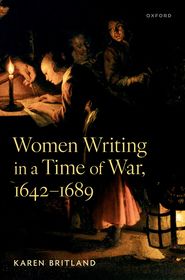
Women Writing in a Time of War, 1642-1689
-
10% KEDVEZMÉNY?
- A kedvezmény csak az 'Értesítés a kedvenc témákról' hírlevelünk címzettjeinek rendeléseire érvényes.
- Kiadói listaár GBP 88.00
-
39 732 Ft (37 840 Ft + 5% áfa)
Az ár azért becsült, mert a rendelés pillanatában nem lehet pontosan tudni, hogy a beérkezéskor milyen lesz a forint árfolyama az adott termék eredeti devizájához képest. Ha a forint romlana, kissé többet, ha javulna, kissé kevesebbet kell majd fizetnie.
- Kedvezmény(ek) 10% (kb. 3 973 Ft)
- Kedvezményes ár 35 759 Ft (34 056 Ft + 5% áfa)
Iratkozzon fel most és részesüljön kedvezőbb árainkból!
Feliratkozom
39 732 Ft

Beszerezhetőség
Becsült beszerzési idő: A Prosperónál jelenleg nincsen raktáron, de a kiadónál igen. Beszerzés kb. 3-5 hét..
A Prosperónál jelenleg nincsen raktáron.
Why don't you give exact delivery time?
A beszerzés időigényét az eddigi tapasztalatokra alapozva adjuk meg. Azért becsült, mert a terméket külföldről hozzuk be, így a kiadó kiszolgálásának pillanatnyi gyorsaságától is függ. A megadottnál gyorsabb és lassabb szállítás is elképzelhető, de mindent megteszünk, hogy Ön a lehető leghamarabb jusson hozzá a termékhez.
A termék adatai:
- Kiadó OUP Oxford
- Megjelenés dátuma 2025. június 26.
- ISBN 9780198946557
- Kötéstípus Keménykötés
- Terjedelem288 oldal
- Méret 240x160x20 mm
- Súly 581 g
- Nyelv angol 599
Kategóriák
Rövid leírás:
Women Writing in a Time of War, 1642-1689 examines the stereotype of the apolitical woman who was nevertheless valuable as a messenger or secret agent during the English civil wars because her imagined lack of political acumen obscured her partisan behaviour.
TöbbHosszú leírás:
Women Writing in a Time of War, 1642-1689 explores the stereotype of the apolitical woman who was nevertheless valuable as a messenger or secret agent during the English civil wars, not least because her imagined lack of political acumen obscured her partisan behaviour. It examines the interconnections between early modern men and women's cultural production, analyzing the secret writing and communication strategies employed by agents and spies during the wars and arguing that an attention to clandestine modes of writing provides new insights into women's literary production during the conflict. Encouraging us to understand such literary production differently, Britland offers a new history of early modern political writing, one deeply imbricated in-but by no means exclusively focused on-the literary work and experiences of women, the non-elite, and the racially marginalized in early modern England and its colonial trade networks.
An attentiveness to the narrative strategies deployed by women writers during the English civil wars also helps us to think about the long histories subtending our own reading and writing practices. Not only does the relative invisibility of female agents in our own historiography reveal a persistent tendency in contemporary criticism to overlook women's contributions to major historical events, but, the book argues, the early modern instrumentalization of women's bodies-particularly the bodies of women from non-elite backgrounds who acted as couriers within elite communication networks-acts as a caution against adopting contemporary methods of reading (particularly computer-aided reading) that can downplay or ignore the contributions of women and non-elite people. This book makes a case for not separating our discussions of women from those of men, nor for privileging analyses of the rich over those of the poor, at the same time as it remains deeply embedded in the literary, material, and merchant cultures of later seventeenth-century England.
Tartalomjegyzék:
List of Figures
Note on the Text and Abbreviations
Introduction: Hidden Works of Darkness
All Their Lying Pamphlets: Creating Suspicion
Sympathetic Letters: Reading Between the Lines
Material Difference: Disguise and Personhood
Networked Connections: Debt, Duplicity, and Distance
Conclusion: Being Objective
APPENDIX: Aphra Behn in Flanders
Bibliography
Index

