

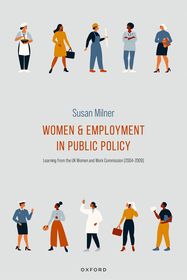
Women and Employment in Public Policy
Learning from the UK Women and Work Commission (2004-2009)
-
20% KEDVEZMÉNY?
- A kedvezmény csak az 'Értesítés a kedvenc témákról' hírlevelünk címzettjeinek rendeléseire érvényes.
- Kiadói listaár GBP 90.00
-
40 635 Ft (38 700 Ft + 5% áfa)
Az ár azért becsült, mert a rendelés pillanatában nem lehet pontosan tudni, hogy a beérkezéskor milyen lesz a forint árfolyama az adott termék eredeti devizájához képest. Ha a forint romlana, kissé többet, ha javulna, kissé kevesebbet kell majd fizetnie.
- Kedvezmény(ek) 20% (cc. 8 127 Ft off)
- Kedvezményes ár 32 508 Ft (30 960 Ft + 5% áfa)
- A kedvezmény érvényes eddig: 2026. június 30.
Iratkozzon fel most és részesüljön kedvezőbb árainkból!
Feliratkozom
40 635 Ft

Beszerezhetőség
Becsült beszerzési idő: A Prosperónál jelenleg nincsen raktáron, de a kiadónál igen. Beszerzés kb. 3-5 hét..
A Prosperónál jelenleg nincsen raktáron.
Why don't you give exact delivery time?
A beszerzés időigényét az eddigi tapasztalatokra alapozva adjuk meg. Azért becsült, mert a terméket külföldről hozzuk be, így a kiadó kiszolgálásának pillanatnyi gyorsaságától is függ. A megadottnál gyorsabb és lassabb szállítás is elképzelhető, de mindent megteszünk, hogy Ön a lehető leghamarabb jusson hozzá a termékhez.
A termék adatai:
- Kiadó OUP Oxford
- Megjelenés dátuma 2024. május 20.
- ISBN 9780198875437
- Kötéstípus Keménykötés
- Terjedelem336 oldal
- Méret 240x165x25 mm
- Súly 672 g
- Nyelv angol 505
Kategóriák
Rövid leírás:
Using documentary evidence and interviews from leading policy actors from the period, Women and Employment in Public Policy takes as its starting point the UK Women and Work Commission, which was convened in 2004 to examine causes of the gender pay gap.
TöbbHosszú leírás:
In the UK, women's economic empowerment through employment is a success story of the last three decades.
And yet women are over-represented in low-paid, insecure jobs, are under-represented in top jobs, and earn less than men on average, with a marked income gap over the lifecourse. When Labour took office in 1997, a new wave of women MPs entered parliament in record numbers, and women gained access to ministerial roles, including a newly-created minister for women. However, policy on women and employment remained an area of conflict. New rights were secured, particularly for mothers, but when Labour left office a sizeable policy agenda remained unfinished.
Using documentary evidence and interviews from leading policy actors from the period, Women and Employment in Public Policy takes as its starting point the Women and Work Commission, which was convened in 2004 to examine causes of the gender pay gap. The commission was unable to defuse conflicts over equal pay but it set out an agenda for change at the level of government, private-sector work organizations, and public-sector organizations. Milner examines why the commission could not resolve key conflicts, and why its broad-based recommendations were only partially taken up. She traces the subsequent development of policy, observing well-established preferences for 'light-touch' regulation which can raise awareness but leave entrenched practices unchallenged, and weaken individual women's access to redress. Detailed study of the working of the commission provides lessons on the policy process, particularly for those seeking to influence policy. It also shows that within the wider policy space, opportunities for action to effect change are possible - based on appeals to instrumental logic or political exchange - but are constrained by party leadership.
Tartalomjegyzék:
Foreword
Introduction. Women and employment: a 'stalled' revolution
Feminizing British politics? Women in the legislature and the executive
Understanding policy on women and employment: the gender pay gap as a policy problem
Reaching the limits of the Equal Pay Act (1970-2007)
Feminizing Labour: the party and trade unions
The women's policy machinery: strengthening women's voice in government?
The Women and Work Commission: bridging different approaches to the gender pay gap
The Women and Work Commission: implementation, influence and effectiveness
The unfinished campaign for equal pay in the UK
The part-time working penalty and the under-valuing of women's work
Families and childcare: an unfinished revolution
Training and skills: a long-standing policy gap
Setting the standard? The public sector's role in promoting gender equality
Conclusion

