

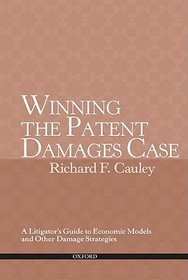
Winning the Patent Damages Case
A Litigator's Guide to Economic Models and Other Damage Strategies
-
10% KEDVEZMÉNY?
- A kedvezmény csak az 'Értesítés a kedvenc témákról' hírlevelünk címzettjeinek rendeléseire érvényes.
- Kiadói listaár GBP 135.00
-
60 952 Ft (58 050 Ft + 5% áfa)
Az ár azért becsült, mert a rendelés pillanatában nem lehet pontosan tudni, hogy a beérkezéskor milyen lesz a forint árfolyama az adott termék eredeti devizájához képest. Ha a forint romlana, kissé többet, ha javulna, kissé kevesebbet kell majd fizetnie.
- Kedvezmény(ek) 10% (cc. 6 095 Ft off)
- Kedvezményes ár 54 857 Ft (52 245 Ft + 5% áfa)
Iratkozzon fel most és részesüljön kedvezőbb árainkból!
Feliratkozom
60 952 Ft

Beszerezhetőség
A kiadónál véglegesen elfogyott, nem rendelhető. Érdemes újra keresni a címmel, hátha van újabb kiadás.
Why don't you give exact delivery time?
A beszerzés időigényét az eddigi tapasztalatokra alapozva adjuk meg. Azért becsült, mert a terméket külföldről hozzuk be, így a kiadó kiszolgálásának pillanatnyi gyorsaságától is függ. A megadottnál gyorsabb és lassabb szállítás is elképzelhető, de mindent megteszünk, hogy Ön a lehető leghamarabb jusson hozzá a termékhez.
A termék adatai:
- Kiadó Oxford University Press
- Megjelenés dátuma 2008. december 18.
- ISBN 9780195366938
- Kötéstípus Puhakötés
- Terjedelem180 oldal
- Méret 235x156x11 mm
- Súly 324 g
- Nyelv angol 0
Kategóriák
Hosszú leírás:
Winning the Patent Damages Case is a guide for patent litigators and in-house counsel who are either considering an action for patent infringement or who are facing the spectre of a lengthy, expensive litigation. Winning the Patent Damages Case provide readers with an analytical framework for determining the likely damages award in a patent case, which is critical to the decision of whether to settle the case and for how much. It gives valuable information on to
how to structure the patent case from the outset and assists accused infringers in how to prepare a "shadow" damages case that may result in a much more reasonable damages award in the event of a loss. Finally, the book provides practical suggestions on discovery how to select and work with a damages
expert.
Tartalomjegyzék:
SECTION I: Background and Initial Considerations of the Patent Damages Case
Chapter 1. Winning the Reasonable Royalty Case
The Brief Early History of the Reasonable Royalty Remedy
[A] The Pre-codified Reasonable Royalty Remedy
The Modern Era of Reasonable Royalty Begins - Georgia Pacific
[A] List of Factors
[B] Consideration of Rigorous Economic Analysis
Chapter 2: Introducing the Combatants
2.01 The Plaintiff (Types of Plaintiffs-Six Categories)
[A] The Dominant Competitor
[B] The Minor Competitor
[C] Non-Producing Entities (NPEs)
[D] Universities
[E] Patent Trolls
[F] Individuals
2.02 The Defendant
Chapter 3. Stranger than Fiction - Imagining the Hypothetical Negotiation
3.01 Applying Game Theory to Hypothetical Negotiation
[A] A Zero Sum Game
[B] Perfect Exchange of Information
[C] You Can't Walk Away
[D] Date of Infringement
[E] Assumption of Validity
3.02 Determining the Reasonable Royalty Value
[A] Game Theory & The Lemney/Shapiro Analysis
[B] Injunctions
[C] Two More Variables
SECTION II: A Strategic Look at the Georgia-Pacific Factors
Chapter 4. Finding the Price of the Patent -- Is there an Established Royalty?
(Factor 1: The royalties received by the patentee for the licensing of the patent in suit, proving or tending to prove an established royalty)
4.01 Relevance and Application
4.02 Economic Criteria
[A] Market Price
[B] Time Constraints
[C] Example
4.03 The Defendant's Established Royalty Strategy
[A] Uniform Royalty/ Licensing Rates
[B] Success or Failure of Market Rates?
4.04 The Plaintiff's Established Royalty Strategy -Considerations
[A] Number of Licenses
[B] Patent-in-Suit
[C] Time Period of License
[D] Example Case: Monsanto Co v. McFarling
[E] Lump Sum & Paid Up Royalties (Example Cases)
[F] Effects on Royalty of Widespread Infringement
4.05 Analysis
4.06 Discovery
[A] Obtaining Licensing Materials
[B] Knowing the Patent's Utility
[C] Economic/Market Models
[D] Using Your Expert and Attacking Your Opponent's
[E] Particular Issues Where Plaintiff Is an NPE
Chapter 5: Gauging the Infringer's Price Range -- Licensing-in Practices
Factor 2: The rates paid by the licensee for the use of other patents comparable to the patent in suit.
5.01 Relevance and Application
5.02 Analysis
[A] Determining the Type of Patented Technology
[1] Core Technology
[2] Peripheral Technology
[B] Is the Patented Technology Essential to the Product?
[C] Defendant's Strategy
5.03 Discovery and Using Your Expert (and Attacking Your Opponent's)
Chapter 6: Keeping it Exclusive - How Valuable is that License?
Factor 3: The nature and scope of the license, as exclusive or non-exclusive; or as restricted or non-restricted in terms of territory or with respect to whom the manufactured product may be sold.
6.01 Relevance and Application
6.02 Analysis
[A] Who Makes (and How to Make) the Exclusive License Argument
[B] Defendant's Strategy
6.03 Discovery
[A] Use Your Economic Experts
[B] If the Plaintiff is an NPE
Chapter 7: Keeping it to Yourself - the Hypothetical Negotiation Where the Seller Doesn't Want to Sell
Factor 4: The licensor's established policy and marketing program to maintain his patent monopoly by not licensing others to use the invention or by granting licenses under special conditions designed to preserve that monopoly.
7.01 Relevance and Application
[A] Sample Scenario: Tiny Motors Corp.
[B] Establishing Historical Practices
7.02 Analysis
7.03 Discovery and Using Your Experts
Chapter 8: Selling Your Enemy the Stick to Beat You With - The Hypothetical Negotiation Where the Plaintiff and Defendant Compete
Factor 5: The commercial relationship between the licensor and licensee, such as, whether they are competitors in the same territory in the same line of business; or whether they are inventor and promoter.
8.01 Relevance and Application
8.02 Analysis
8.03 Discovery and Using Your Experts
Chapter 9: Boosting the Royalty Rate with Unpatented Products - Mercy Sakes Alive! Looks Like we Got us a Convoy!
Factor 6: The effect of selling the patented specialty in promoting sales of other products of the licensee; the existing value of the invention to the licensor as a generator of sales of his non-patented items; and the extent of such derivative or convoyed sales.
9.01 Relevance and Application
9.02 Analysis
[A] Plaintiff Considerations
[B] Defendant's Perspective
9.03 Discovery and Using Your Experts
Chapter 10: How Much Time is left? The Effect of an Expiring Patent
Factor 7: The duration of the patent and the term of the license.
10.01 Relevance and Application
10.02 Discovery
Chapter 11: Buy my Product - Buy my Patent! How the Success of a Patentholder's Product Can Raise the Royalty Rate
Factor 8: The established profitability of the product made under the patent; its commercial success; and its current popularity.
11.01 Relevance and Application
11.02 Discovery
Chapter 12: Why New and Improved Costs more than the Old Stuff - The Better Your Invention, the Higher the Royalty Rate
Factor 9: The utility and advantages of the patent property over the old modes or devices, if any, that had been used for working out similar results.
12.01 Relevance and Application
12.02 Analysis
12.03 Discovery
Chapter 13: The Smaller the Bang, the Smaller the Bucks - Allocating the Value of the Patented Component
Factor 10: The portion of the realizable profit that should be credited to the invention as distinguished from non-patented elements, the manufacturing process, business risks, or significant features or improvements added by the infringer
13.01 Relevance and Application
13.02 Analysis
13.03 Discovery
SECTION III: WINNING THE LOST PROFITS CASE
Chapter 14: The Theory of Lost Profits
14.01 The Panduit Factors
14.02 Competition between the Plaintiff and the Defendant and the Defining Market-The Battle of the Flying Bikes
14.03 Analysis
14.04 Discovery
Chapter 15: Market Players
15.01 How Many Players Are in the Market? And Why Does It Matter?
15.02 Analysis
Chapter 16: Working the Hypothetical Work-around-Alternative Non-Infringing Substitutes
16.01 Analysis
16.02 Discovery
Chapter 17: Lost Profits on Unpatented Products and Components-The Entire Market Value Rule
17.01 Analysis
17.02 Discovery
Chapter 18: Recovering Profits Lost by Price Erosion-And Paying Attention to the Demand Curve
18.01 Analysis
18.02 Discovery

