

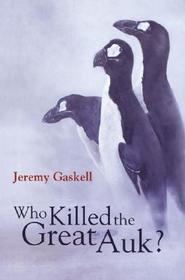
Who Killed the Great Auk?
-
10% KEDVEZMÉNY?
- A kedvezmény csak az 'Értesítés a kedvenc témákról' hírlevelünk címzettjeinek rendeléseire érvényes.
- Kiadói listaár GBP 93.00
-
41 989 Ft (39 990 Ft + 5% áfa)
Az ár azért becsült, mert a rendelés pillanatában nem lehet pontosan tudni, hogy a beérkezéskor milyen lesz a forint árfolyama az adott termék eredeti devizájához képest. Ha a forint romlana, kissé többet, ha javulna, kissé kevesebbet kell majd fizetnie.
- Kedvezmény(ek) 10% (cc. 4 199 Ft off)
- Kedvezményes ár 37 791 Ft (35 991 Ft + 5% áfa)
Iratkozzon fel most és részesüljön kedvezőbb árainkból!
Feliratkozom
41 989 Ft

Beszerezhetőség
Megrendelésre a kiadó utánnyomja a könyvet. Rendelhető, de a szokásosnál kicsit lassabban érkezik meg.
Why don't you give exact delivery time?
A beszerzés időigényét az eddigi tapasztalatokra alapozva adjuk meg. Azért becsült, mert a terméket külföldről hozzuk be, így a kiadó kiszolgálásának pillanatnyi gyorsaságától is függ. A megadottnál gyorsabb és lassabb szállítás is elképzelhető, de mindent megteszünk, hogy Ön a lehető leghamarabb jusson hozzá a termékhez.
A termék adatai:
- Kiadó OUP Oxford
- Megjelenés dátuma 2000. november 9.
- ISBN 9780198564782
- Kötéstípus Keménykötés
- Terjedelem240 oldal
- Méret 243x163x17 mm
- Súly 520 g
- Nyelv angol
- Illusztrációk colour frontispiece, numerous halftones, line drawings, maps 0
Kategóriák
Rövid leírás:
The Great Auk is one of the world's most famous extinct birds. This curious seabird was flightless, stood upright like a human, and sported an enormous beak. In this fascinating book, Jeremy A. Gaskell takes the reader on a tour of some of the wildest and coldest places on earth as he tries to uncover the facts behind its disappearance. Eyewitness accounts of the Great Auk spanning four centuries tell how it was hunted by sailors, coastal dwellers, and merchants for its ample flesh, its eggs, and its soft down. Gaskell shows how its fate was inextricably bound up with the prevailing social, economic, and political conditions of the late 18th century, and was also a result of widespread scientific misapprehensions. Many of the leading natural historians of the day took an active interest in the Great Auk and its disappearance, and the predicament of the Great Auk was partly responsible for the institution of the first seabird protection laws. Sadly, attempts to save it were in vain. This book tells why.
TöbbHosszú leírás:
The Great Auk is one of the world's most famous extinct birds. It was undoubtedly a most curious creature: a flightless bird with tiny wings, it stood upright like a human, and sported an enormous beak. On land, the Great Auk was clumsy and awkward, but it was perfectly adapted for swift and efficient movement in the sea, where it spent the large part of the year. In its heyday, it populated the North Atlantic, from Western Europe across to North America, and was a familiar sight to islanders and coastal dwellers when, each May, it would climb ashore for the short breeding season. Yet by the mid-nineteenth century sightings of the bird were but rare occurrences, and just a few decades later even the most assiduous Victorian explorers could not find it. So what happened to the Great Auk? What - or who - caused it to disappear from the northern oceans? Jeremy A. Gaskell draws on eyewitness accounts spanning some four centuries to relate the tale of the Great Auk's extinction. He tells how the Great Auk was hunted by sailors, coastal dwellers, and merchants for its ample flesh, its eggs, and its soft down. He shows how the fate of the Great Auk was inextricably bound up with the prevailing social, economic, and political conditions of the late 18th century. It was also a result of widespread scientific misapprehensions about the nature and geographical range of this mysterious seabird. The disappearance of the Great Auk had a considerable impact on the public imagination of the late 19th Century. Specimens of the birds or their eggs soon began to fetch astronomical prices among collectors. Charles Kingsley used the last Great Auk as a character in The Water Babies. It became the stuff of legend. More importantly, its plight keenly interested a number of great Victorian ornithologists, men like John Wolley, Alfred Newton, and John James Audubon. Later, these self-same men were to cause some of the very first legislation on seabird protection to come into place. As a result this is also the story of the beginnings of bird conservation. This intriguing book takes the reader on a tour of some of the wildest and coldest places on earth, in its attempt to uncover the history of the last days of the Great Auk. We travel with Audubon to Labrador, sail to the remote Scottish island of St Kilda, experience the hardship of life in the colonies of Newfoundland, and follow the peregrinations of intrepid naturalists as they put to sea in search of the very last of the Great Auks. The text is enhanced by numerous maps, photographs, and line drawings, and includes a fine original colour frontispiece by Jan Wilczur.
"This little book is a fitting memorial to the lost penguin of the northern seas. It's a labour of love."
Tartalomjegyzék:
Introduction - Who killed the Great Auk?
This rare and noble bird
Geirfuglasker: The Icelandic bird skerries
Travels with Audubon in Labrador
Westward ho!
A visit to Funk Island
Books of authority
Wild foulis biggand - The Great Auk on St. Kilda
The New-Found-Land
Uncouth regions
Mercenary and cruel
The old wisdom of the Faeroe Islands
In search of the Great Auk
Last appearances
Generation after generation
Bird protection: A pressing need
An Act of Parliament
Epilogue
Appendices: Description of the Great Auk based on a specimen acquired by Audubon in London; Discussion of Great Auk nomenclature; Abridged version of the Act for the Preservation of Sea Birds, 1869; The Victorian egg collectors.

