

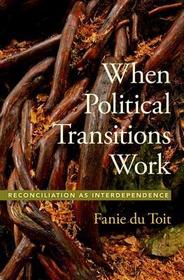
When Political Transitions Work
Reconciliation as Interdependence
Sorozatcím: Studies in Strategic Peacebuilding;
-
20% KEDVEZMÉNY?
- A kedvezmény csak az 'Értesítés a kedvenc témákról' hírlevelünk címzettjeinek rendeléseire érvényes.
- Kiadói listaár GBP 90.00
-
40 635 Ft (38 700 Ft + 5% áfa)
Az ár azért becsült, mert a rendelés pillanatában nem lehet pontosan tudni, hogy a beérkezéskor milyen lesz a forint árfolyama az adott termék eredeti devizájához képest. Ha a forint romlana, kissé többet, ha javulna, kissé kevesebbet kell majd fizetnie.
- Kedvezmény(ek) 20% (cc. 8 127 Ft off)
- Kedvezményes ár 32 508 Ft (30 960 Ft + 5% áfa)
- A kedvezmény érvényes eddig: 2026. június 30.
Iratkozzon fel most és részesüljön kedvezőbb árainkból!
Feliratkozom
40 635 Ft

Beszerezhetőség
Becsült beszerzési idő: A Prosperónál jelenleg nincsen raktáron, de a kiadónál igen. Beszerzés kb. 3-5 hét..
A Prosperónál jelenleg nincsen raktáron.
Why don't you give exact delivery time?
A beszerzés időigényét az eddigi tapasztalatokra alapozva adjuk meg. Azért becsült, mert a terméket külföldről hozzuk be, így a kiadó kiszolgálásának pillanatnyi gyorsaságától is függ. A megadottnál gyorsabb és lassabb szállítás is elképzelhető, de mindent megteszünk, hogy Ön a lehető leghamarabb jusson hozzá a termékhez.
A termék adatai:
- Kiadó OUP USA
- Megjelenés dátuma 2018. augusztus 30.
- ISBN 9780190881856
- Kötéstípus Keménykötés
- Terjedelem312 oldal
- Méret 160x231x25 mm
- Súly 544 g
- Nyelv angol 0
Kategóriák
Rövid leírás:
In When Political Transitions Work, Fanie du Toit develops a coherent and versatile theory of reconciliation-as-interdependence, based on the assumption that a state's success is inextricably linked to their enemies, and a policy of mutual well-being is the surest and shortest path to prosperity and peace for both.
TöbbHosszú leírás:
The peaceful end of apartheid in South Africa was a monumental event in late twentieth century history. A racist regime built upon a foundation of colonialist exploitation, South Africa had become by that point a tinderbox: suffused with day-to-day violence and political extremism on all sides. Yet two decades later it was a stable democracy with a growing economy. How did such a deeply divided, conflicted society manage this remarkable transition?
In When Political Transitions Work, Fanie du Toit, who has been a participant and close observer in post-conflict developments throughout Africa for decades, offers a new theory for why South Africa's reconciliation worked and why its lessons remain relevant for other nations emerging from civil conflicts. He uses reconciliation as a framework for political transition and seeks to answer three key questions: how do the reconciliation processes begin; how can political transitions result in inclusive and fair institutional change; and to what extent does reconciliation change the way a society functions? Looking at South Africa, one of reconciliation's most celebrated cases, Du Toit shows that the key ingredient to successful reconciliations is acknowledging the centrality of relationships. He further develops his own theoretical approach to reconciliation-as-interdependence-the idea that reconciliation is the result of an integrated process of courageous leadership, fair and inclusive institutions, and social change built toward a mutual goal of prosperity.
As Du Toit conveys, the motivation for reconciliation is the long-term well-being of one's own community, as well as that of enemy groups. Without ensuring the conditions in which one's enemy can flourish, one's own community is unlikely to prosper sustainably.
Mostly about the South African transition from apartheid to independence and its current state of post-reconciliation disquiet and dissatisfaction, this thoughtful book sets out useful general theoretical constructs and examines the relationship of reconciliation to independence and interdependence.
Tartalomjegyzék:
Acknowledgements
Introducing the Argument
SECTION ONE: MOMENTS IN TRANSITION
Chapter One: Making the case for reconciliation
Chapter Two: Settling on a shared future
Chapter Three: Dealing with a violent past
Chapter Four: A justice promise or just a promise?
SECTION TWO: THEORETICAL LANDSCAPES
Chapter Five: The forgiving embrace
Chapter Six: Restoring the rule of law
Chapter Seven: Valuing political difference
SECTION THREE: TOWARDS INTERDEPENDENCE
Chapter Eight: Reconciliation as interdependence
Chapter Nine: Conclusion
Bibliography
Table I

