

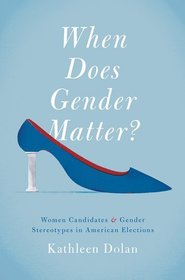
When Does Gender Matter?
Women Candidates and Gender Stereotypes in American Elections
-
10% KEDVEZMÉNY?
- A kedvezmény csak az 'Értesítés a kedvenc témákról' hírlevelünk címzettjeinek rendeléseire érvényes.
- Kiadói listaár GBP 145.00
-
65 467 Ft (62 350 Ft + 5% áfa)
Az ár azért becsült, mert a rendelés pillanatában nem lehet pontosan tudni, hogy a beérkezéskor milyen lesz a forint árfolyama az adott termék eredeti devizájához képest. Ha a forint romlana, kissé többet, ha javulna, kissé kevesebbet kell majd fizetnie.
- Kedvezmény(ek) 10% (kb. 6 546 Ft)
- Kedvezményes ár 58 921 Ft (56 115 Ft + 5% áfa)
Iratkozzon fel most és részesüljön kedvezőbb árainkból!
Feliratkozom
65 467 Ft

Beszerezhetőség
Megrendelésre a kiadó utánnyomja a könyvet. Rendelhető, de a szokásosnál kicsit lassabban érkezik meg.
Why don't you give exact delivery time?
A beszerzés időigényét az eddigi tapasztalatokra alapozva adjuk meg. Azért becsült, mert a terméket külföldről hozzuk be, így a kiadó kiszolgálásának pillanatnyi gyorsaságától is függ. A megadottnál gyorsabb és lassabb szállítás is elképzelhető, de mindent megteszünk, hogy Ön a lehető leghamarabb jusson hozzá a termékhez.
A termék adatai:
- Kiadó OUP USA
- Megjelenés dátuma 2014. szeptember 25.
- ISBN 9780199968275
- Kötéstípus Keménykötés
- Terjedelem264 oldal
- Méret 163x239x20 mm
- Súly 522 g
- Nyelv angol
- Illusztrációk 6 b/w line 0
Kategóriák
Rövid leírás:
Scholars and political observers raise concerns that the sex of a woman candidate can complicate her chances of success. This perspective is primarily motivated by concerns about the negative impact of voter gender stereotypes. Instead, this book demonstrates that gender stereotypes have little impact on voter decisions involving women candidates.
TöbbHosszú leírás:
As the number of women candidates for office in the U.S. increases each election cycle, scholars are confronted with questions about the impact of their sex on their chances of success. Chief among these questions involves the influence of gender stereotypes on the decisions voters make in elections in which women run against men. Previous research documents that voters see women and men as possessing different character traits and different abilities to handle policy issues. These findings, combined with anecdotal evidence of sexist attitudes toward women candidates, raises concerns that women candidates are hampered by their sex and gender considerations. Employing data from an original survey of 3150 U.S. adults conducted in 2010, this book confronts scholarly concerns that gender stereotypes work to undermine women's chances of success. Challenging the conventional wisdom, these data demonstrate that voters do not rely heavily on gender stereotypes when evaluating and voting for women candidates. Voters do hold gendered attitudes, both positive and negative, about women candidates, but these attitudes are not related to the political decisions voters make. Instead, in deciding for whom to vote, people are influenced by traditional political forces, like political party and incumbency, regardless of the sex of the candidates. There is also evidence that partisan stereotypes interact with gender stereotypes to influence reactions to candidates, both women and men, depending on their political party. In the end, this project demonstrates that women candidates win as often as do men and that partisan concerns trump gender every time.
In this must-read book for both scholars and practitioners, Kathleen Dolan offers compelling evidence that voters' gender stereotypes matter far less for women candidates' election outcomes than commonly believed. Her nuanced analysis of original panel study data from the 2010 election cycle significantly advances our understanding of how the effects of gendered attitudes and stereotypes vary depending on political party, level of office, and the gender of the candidates in the race.
Tartalomjegyzék:
Acknowledgements
List of Figures and Tables
Chapter 1 - Candidate Sex and Gender Stereotypes in American Elections
Chapter 2 - Studying Gender Stereotypes and Women Candidates
Chapter 3 - Attitudes, Stereotypes, and Support for Women Candidates
Chapter 4 - Do Stereotypes Shape Evaluations of Candidates?
Chapter 5 - The Role of Stereotypes in Vote Choice Decisions
Chapter 6 - Stereotypes in Other Places? Candidate Quality and Issue Campaigns
Chapter 7 - The Landscape for Women Candidates
Appendix A - Candidate Lists
Appendix B - Variable Construction
Appendix C - Campaign Ads and Websites
Appendix D - Survey Instrument
Appendix E - Additional Vote Choice Analysis
Notes
Bibliography
Index

