

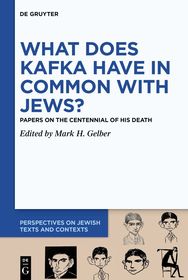
What Does Kafka have in Common with Jews?
Papers on the Centennial of his Death
Sorozatcím: Perspectives on Jewish Texts and Contexts; 30;
-
20% KEDVEZMÉNY?
- A kedvezmény csak az 'Értesítés a kedvenc témákról' hírlevelünk címzettjeinek rendeléseire érvényes.
- Kiadói listaár EUR 99.95
-
39 040 Ft (37 181 Ft + 5% áfa)
Az ár azért becsült, mert a rendelés pillanatában nem lehet pontosan tudni, hogy a beérkezéskor milyen lesz a forint árfolyama az adott termék eredeti devizájához képest. Ha a forint romlana, kissé többet, ha javulna, kissé kevesebbet kell majd fizetnie.
- Kedvezmény(ek) 20% (cc. 7 808 Ft off)
- Kedvezményes ár 31 232 Ft (29 745 Ft + 5% áfa)
- A kedvezmény érvényes eddig: 2026. június 30.
Iratkozzon fel most és részesüljön kedvezőbb árainkból!
Feliratkozom
39 040 Ft

Beszerezhetőség
Becsült beszerzési idő: A Prosperónál jelenleg nincsen raktáron, de a kiadónál igen. Beszerzés kb. 3-5 hét..
A Prosperónál jelenleg nincsen raktáron.
Why don't you give exact delivery time?
A beszerzés időigényét az eddigi tapasztalatokra alapozva adjuk meg. Azért becsült, mert a terméket külföldről hozzuk be, így a kiadó kiszolgálásának pillanatnyi gyorsaságától is függ. A megadottnál gyorsabb és lassabb szállítás is elképzelhető, de mindent megteszünk, hogy Ön a lehető leghamarabb jusson hozzá a termékhez.
A termék adatai:
- Kiadás sorszáma 1
- Kiadó De Gruyter
- Megjelenés dátuma 2025. szeptember 1.
- ISBN 9783111638379
- Kötéstípus Keménykötés
- Terjedelem300 oldal
- Méret 230x155 mm
- Súly 500 g
- Nyelv angol
- Illusztrációk 4 Illustrations, black & white; 1 Illustrations, color 744
Kategóriák
Rövid leírás:
This series focuses on the Jewish textual tradition as well as the ways it evolves in response to new intellectual, historical, social and political contexts. Fostering dialogue between literary, philosophical, political and religious perspectives, this series, which consists of original scholarship and proceedings of international conferences, reflects contemporary concerns of Jewish Studies in the broadest sense.
_x000D_ TöbbHosszú leírás:
By focusing on the Jewish textual traditions the book series Perspectives on Jewish Texts and Contexts examines both the continuity of a tradition through its transmission of canonical, classical and contemporary texts, as well as the ways that a tradition must continuously adapt itself to respond to new intellectual, historical, social and political contexts. Since there is no reading that is not also an interpretation, imbuing the past with concerns of the present day, the volumes in this series will examine the Jewish textual tradition through questions of its transmissibility, focusing on how these texts give rise to new commentaries, translations and adaptations. By attending to the evolving, topical concerns of Judaism, understood as a living textual tradition, and by fostering dialogue between literary, philosophical, political and religious perspectives, the book series, which consists of original scholarship and proceedings of international conferences, reflects contemporary concerns of Jewish Studies in the broadest sense.
Editorial Board
Prof. Robert Alter (University of California, Berkeley)
Prof. Steven E. Aschheim (Hebrew University, Jerusalem)
Prof. Leora Batnitzky (Princeton University, Princeton)
Prof. Richard I. Cohen (Hebrew University, Jerusalem)
Prof. Mark H. Gelber (Ben-Gurion University of the Negev, Beer Sheva)
Prof. Moshe Halbertal (Hebrew University, Jerusalem)
Prof. Christine Hayes (Yale University, New Haven)
Prof. Moshe Idel (Hebrew University, Jerusalem)
Prof. Menachem Lorberbaum (Tel Aviv University)
Prof. Samuel Moyn (Columbia University, New York)
Prof. Ilana Pardes ((Hebrew University, Jerusalem)
Prof. Alvin Rosenfeld (Indiana University, Bloomington)
Prof. David Ruderman (University of Pennsylvania, Philadelphia)

