

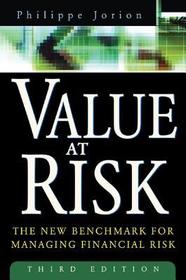
Value at Risk, 3rd Ed.
The New Benchmark for Managing Financial Risk
Sorozatcím: GENERAL FINANCE & INVESTING;
-
10% KEDVEZMÉNY?
- A kedvezmény csak az 'Értesítés a kedvenc témákról' hírlevelünk címzettjeinek rendeléseire érvényes.
- Kiadói listaár GBP 97.99
-
44 242 Ft (42 135 Ft + 5% áfa)
Az ár azért becsült, mert a rendelés pillanatában nem lehet pontosan tudni, hogy a beérkezéskor milyen lesz a forint árfolyama az adott termék eredeti devizájához képest. Ha a forint romlana, kissé többet, ha javulna, kissé kevesebbet kell majd fizetnie.
- Kedvezmény(ek) 10% (cc. 4 424 Ft off)
- Kedvezményes ár 39 818 Ft (37 922 Ft + 5% áfa)
Iratkozzon fel most és részesüljön kedvezőbb árainkból!
Feliratkozom
44 242 Ft

Beszerezhetőség
Megrendelésre a kiadó utánnyomja a könyvet. Rendelhető, de a szokásosnál kicsit lassabban érkezik meg.
Why don't you give exact delivery time?
A beszerzés időigényét az eddigi tapasztalatokra alapozva adjuk meg. Azért becsült, mert a terméket külföldről hozzuk be, így a kiadó kiszolgálásának pillanatnyi gyorsaságától is függ. A megadottnál gyorsabb és lassabb szállítás is elképzelhető, de mindent megteszünk, hogy Ön a lehető leghamarabb jusson hozzá a termékhez.
A termék adatai:
- Kiadás sorszáma 3
- Kiadó McGraw Hill
- Megjelenés dátuma 2006. november 16.
- ISBN 9780071464956
- Kötéstípus Keménykötés
- Terjedelem624 oldal
- Méret 233x167x35 mm
- Súly 998 g
- Nyelv angol 0
Kategóriák
Hosszú leírás:
Since its original publication, Value at Risk has become the industry standard in risk management. Now in its Third Edition, this international bestseller addresses the fundamental changes in the field that have occurred across the globe in recent years. Philippe Jorion provides the most current information needed to understand and implement VAR-as well as manage newer dimensions of financial risk. Featured updates include:
A major new feature of the Third Edition is the addition of short questions and exercises at the end of each chapter, making it even easier to check progress. Detailed answers are posted on the companion web site www.pjorion.com/var/. The web site contains other materials, including additional questions that course instructors can assign to their students.
Jorion leaves no stone unturned, addressing the building blocks of VAR from computing and backtesting models to forecasting risk and correlations. He outlines the use of VAR to measure and control risk for trading, for investment management, and for enterprise-wide risk management. He also points out key pitfalls to watch out for in risk-management systems.
The value-at-risk approach continues to improve worldwide standards for managing numerous types of risk. Now more than ever, professionals can depend on Value at Risk for comprehensive, authoritative counsel on VAR, its application, and its results-and to keep ahead of the curve.
Since its original publication, Value at Risk has become the industry standard in risk management. Now in its Third Edition, this international bestseller addresses the fundamental changes in the field that have occurred across the globe in recent years. Philippe Jorion provides the most current information needed to understand and implement VAR-as well as manage newer dimensions of financial risk. Featured updates include:
A major new feature of the Third Edition is the addition of short questions and exercises at the end of each chapter, making it even easier to check progress. Detailed answers are posted on the companion web site www.pjorion.com/var/. The web site contains other materials, including additional questions that course instructors can assign to their students.
Jorion leaves no stone unturned, addressing the building blocks of VAR from computing and backtesting models to forecasting risk and correlations. He outlines the use of VAR to measure and control risk for trading, for investment management, and for enterprise-wide risk management. He also points out key pitfalls to watch out for in risk-management systems.
The value-at-risk approach continues to improve worldwide standards for managing numerous types of risk. Now more than ever, professionals can depend on Value at Risk for comprehensive, authoritative counsel on VAR, its application, and its results-and to keep ahead of the curve.
TöbbTartalomjegyzék:
Preface
Acknowledgments
Part I. MOTIVATION
1. The Need for Risk Management
2. Lessons from Financial Disasters
3. VAR-Based Regulatory Capital
Part II. BUILDING BLOCKS
4. Tools for Measuring Risk
5. Computing VAR
6. Backtesting VAR
7. Portfolio Risk: Analytical Methods
8. Multivariate Models
9. Forecasting Risk and Correlations
Part III. VALUE-AT-RISK SYSTEMS
10. VAR Methods
11. VAR Mapping
12. Monte Carlo Methods
13. Liquidity Risk
14. Stress Testing
Part IV. APPLICATIONS OF RISK MANAGEMENT SYSTEMS
15. Using VAR to Measure and Control Risk
16. Using VAR for Active Risk Management
17. VAR and Risk Budgeting in Investment Management
Part V. EXTENSIONS OF RISK MANAGEMENT SYSTEMS
18. Credit Risk Management
19. Operational Risk Management
20. Integrated Risk Management
Part VI. THE RISK MANAGEMENT PROFESSION
21. Risk Management Guidelines and Pitfalls
22. Conclusions
References
Index

