

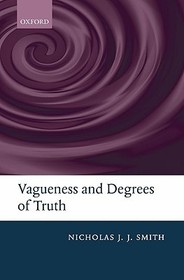
Vagueness and Degrees of Truth
-
10% KEDVEZMÉNY?
- A kedvezmény csak az 'Értesítés a kedvenc témákról' hírlevelünk címzettjeinek rendeléseire érvényes.
- Kiadói listaár GBP 97.00
-
43 795 Ft (41 710 Ft + 5% áfa)
Az ár azért becsült, mert a rendelés pillanatában nem lehet pontosan tudni, hogy a beérkezéskor milyen lesz a forint árfolyama az adott termék eredeti devizájához képest. Ha a forint romlana, kissé többet, ha javulna, kissé kevesebbet kell majd fizetnie.
- Kedvezmény(ek) 10% (cc. 4 380 Ft off)
- Kedvezményes ár 39 416 Ft (37 539 Ft + 5% áfa)
Iratkozzon fel most és részesüljön kedvezőbb árainkból!
Feliratkozom
43 795 Ft

Beszerezhetőség
Megrendelésre a kiadó utánnyomja a könyvet. Rendelhető, de a szokásosnál kicsit lassabban érkezik meg.
Why don't you give exact delivery time?
A beszerzés időigényét az eddigi tapasztalatokra alapozva adjuk meg. Azért becsült, mert a terméket külföldről hozzuk be, így a kiadó kiszolgálásának pillanatnyi gyorsaságától is függ. A megadottnál gyorsabb és lassabb szállítás is elképzelhető, de mindent megteszünk, hogy Ön a lehető leghamarabb jusson hozzá a termékhez.
A termék adatai:
- Kiadó OUP Oxford
- Megjelenés dátuma 2008. november 6.
- ISBN 9780199233007
- Kötéstípus Keménykötés
- Terjedelem350 oldal
- Méret 241x162x24 mm
- Súly 677 g
- Nyelv angol 0
Kategóriák
Rövid leírás:
Vagueness and Degrees of Truth develops and defends a new position on vagueness. To make the book accessible to non-specialists, Nicholas Smith includes both an introduction to the relevant philosophical literature, and a gentle but thorough introduction to the required logical tools and concepts.
TöbbHosszú leírás:
In Vagueness and Degrees of Truth, Nicholas Smith develops a new theory of vagueness: fuzzy plurivaluationism.
A predicate is said to be vague if there is no sharply defined boundary between the things to which it applies and the things to which it does not apply. For example, 'heavy' is vague in a way that 'weighs over 20 kilograms' is not. A great many predicates - both in everyday talk, and in a wide array of theoretical vocabularies, from law to psychology to engineering - are vague.
Smith argues, on the basis of a detailed account of the defining features of vagueness, that an accurate theory of vagueness must involve the idea that truth comes in degrees. The core idea of degrees of truth is that while some sentences are true and some are false, others possess intermediate truth values: they are truer than the false sentences, but not as true as the true ones. Degree-theoretic treatments of vagueness have been proposed in the past, but all have encountered significant objections. In light of these, Smith develops a new type of degree theory. Its innovations include a definition of logical consequence that allows the derivation of a classical consequence relation from the degree-theoretic semantics, a unified account of degrees of truth and subjective probabilities, and the incorporation of semantic indeterminacy - the view that vague statements need not have unique meanings - into the degree-theoretic framework.
As well as being essential reading for those working on vagueness, Smith's book provides an excellent entry-point for newcomers to the era - both from elsewhere in philosophy, and from computer science, logic and engineering. It contains a thorough introduction to existing theories of vagueness and to the requisite logical background.
It is an excellent book: clearly written and packed full of interesting ideas and arguments. Researchers in the area must read itshould become a cornerstone of the literature. . . . The technical material is self-contained and well presented, and the book would suit a graduate or an advanced undergraduate class not afraid of the odd bit of elementary mathematical formalism.
Tartalomjegyzék:
Introduction
Part 1: Foundations
Beginnings
The Space of Possible Theories of Vagueness
Part 2: Vagueness
What is Vagueness?
Accommodating Vagueness
Part 3: Degrees of Truth
Who's Afraid of Degrees of Truth?
Worldly Vagueness and Semantic Indeterminacy
Conclusion

