

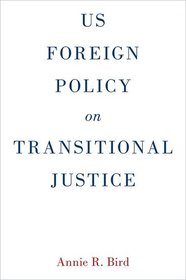
US Foreign Policy on Transitional Justice
-
10% KEDVEZMÉNY?
- A kedvezmény csak az 'Értesítés a kedvenc témákról' hírlevelünk címzettjeinek rendeléseire érvényes.
- Kiadói listaár GBP 41.99
-
18 958 Ft (18 055 Ft + 5% áfa)
Az ár azért becsült, mert a rendelés pillanatában nem lehet pontosan tudni, hogy a beérkezéskor milyen lesz a forint árfolyama az adott termék eredeti devizájához képest. Ha a forint romlana, kissé többet, ha javulna, kissé kevesebbet kell majd fizetnie.
- Kedvezmény(ek) 10% (cc. 1 896 Ft off)
- Kedvezményes ár 17 062 Ft (16 250 Ft + 5% áfa)
Iratkozzon fel most és részesüljön kedvezőbb árainkból!
Feliratkozom
18 958 Ft

Beszerezhetőség
Megrendelésre a kiadó utánnyomja a könyvet. Rendelhető, de a szokásosnál kicsit lassabban érkezik meg.
Why don't you give exact delivery time?
A beszerzés időigényét az eddigi tapasztalatokra alapozva adjuk meg. Azért becsült, mert a terméket külföldről hozzuk be, így a kiadó kiszolgálásának pillanatnyi gyorsaságától is függ. A megadottnál gyorsabb és lassabb szállítás is elképzelhető, de mindent megteszünk, hogy Ön a lehető leghamarabb jusson hozzá a termékhez.
A termék adatai:
- Kiadó OUP USA
- Megjelenés dátuma 2015. április 2.
- ISBN 9780199338412
- Kötéstípus Keménykötés
- Terjedelem238 oldal
- Méret 239x163x25 mm
- Súly 431 g
- Nyelv angol 0
Kategóriák
Rövid leírás:
Despite the diverse interests of Presidents, Congress, and the State Department, this book argues that US foreign policy on transitional justice is surprisingly consistent, characterized by an approach that is value-driven, strategic, and retributive, and that has influenced the field as a whole.
TöbbHosszú leírás:
Since the 1990s, the field of transitional justice has exploded with international support for the establishment of trials, truth commissions, and other measures aimed at helping societies address massive human rights violations. The United States' role has been particularly significant, providing extensive funding, political support, and technical assistance to such measures. Surprisingly, however, scant attention has been paid to analyzing the country's approach to transitional justice.
In this book, Bird offers the first systematic and cross-cutting account of US foreign policy on transitional justice. She examines the development of US foreign policy on the field from World War I to the present, with an in-depth examination of US involvement in measures in Cambodia, Liberia, and Colombia. She supports her findings with nearly 200 interviews with key US and foreign government officials, staff of transitional justice measures, and country experts.
By "opening the black box" of US foreign policy, Bird shows how diverse interests and the constantly evolving priorities of presidential administrations, Congress, the State Department, and other agencies shape US involvement in transitional justice. Despite bureaucratic battles, Bird argues that US foreign policy on transitional justice is surprisingly consistent and characterized by an approach that is value-driven, strategic, and retributive. She demonstrates how this approach has influenced the field as a whole, including the type of transitional justice measures selected, their design, and how they are implemented.
In this timely and engaging book, Bird has identified an important evolution in United States foreign policy priorities since the 1990s: the instantiation of accountability and transitional justice as core diplomatic tools to be deployed in the response to conflict and mass violence. Through original research and the lens of several emblematic case studies, Bird traces the way in which these imperatives became concrete policy in the face of countervailing equities, inter-agency dissension, and sheer bureaucratic inertia. The book offers important insights into how the idea of justice can inform and inspire governmental action while also advancing other more hard-edged foreign policy priorities.
Tartalomjegyzék:
Acknowledgements
List of Abbreviations
Introduction
Chapter 1: The US Approach to Transitional Justice
Chapter 2: The Development of US Foreign Policy on Transitional Justice
Chapter 3: US Involvement in the Khmer Rouge Tribunal
Chapter 4: US Involvement in the Taylor Trial and Liberian Truth and Reconciliation Commission
Chapter 5: US Involvement in the Colombian Justice and Peace Process
Conclusion
Appendix 1
Appendix 2
Bibliography
Index

