

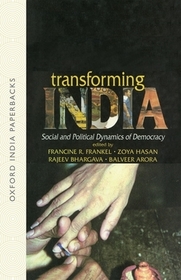
Transforming India
Social and Political Dynamics of Democracy
-
10% KEDVEZMÉNY?
- A kedvezmény csak az 'Értesítés a kedvenc témákról' hírlevelünk címzettjeinek rendeléseire érvényes.
- Kiadói listaár GBP 14.99
-
6 767 Ft (6 445 Ft + 5% áfa)
Az ár azért becsült, mert a rendelés pillanatában nem lehet pontosan tudni, hogy a beérkezéskor milyen lesz a forint árfolyama az adott termék eredeti devizájához képest. Ha a forint romlana, kissé többet, ha javulna, kissé kevesebbet kell majd fizetnie.
- Kedvezmény(ek) 10% (cc. 677 Ft off)
- Kedvezményes ár 6 091 Ft (5 801 Ft + 5% áfa)
Iratkozzon fel most és részesüljön kedvezőbb árainkból!
Feliratkozom
6 767 Ft

Beszerezhetőség
Bizonytalan ideig nincs raktáron a kiadónál, rendelése nem javasolt.
Why don't you give exact delivery time?
A beszerzés időigényét az eddigi tapasztalatokra alapozva adjuk meg. Azért becsült, mert a terméket külföldről hozzuk be, így a kiadó kiszolgálásának pillanatnyi gyorsaságától is függ. A megadottnál gyorsabb és lassabb szállítás is elképzelhető, de mindent megteszünk, hogy Ön a lehető leghamarabb jusson hozzá a termékhez.
A termék adatai:
- Kiadó OUP India
- Megjelenés dátuma 2002. április 18.
- ISBN 9780195658323
- Kötéstípus Puhakötés
- Terjedelem456 oldal
- Méret 215x140x25 mm
- Súly 431 g
- Nyelv angol 0
Kategóriák
Rövid leírás:
This volume provides a cross-disciplinary analysis by leading social scientists of contemporary India of the transformations unleashed by the introduction of egalitarian and liberal principles of government within the context of the colonial legacy, hierarchial social order, group-based identities and plural cultures. The combination of political processes and institutions that have impacted on democracy and changed owing to democracy.
TöbbHosszú leírás:
This volume provides a cross-disciplinary analysis by leading social scientists of contemporary India of the transformations unleashed by the introduction of egalitarian and liberal principles of government within the context of the colonial legacy, hierarchial social order, group-based identities and plural cultures. Among the transformations discussed are the electoral upsurge of historically marginalized groups creating a 'political democracy of castes', the autonomous mobilization of lower castes and dalits in competition with each other and in opposition to upper castes to assert social equality and capture state power, corruption of institutions by government, tendency towards regionalization, fragmentation of national political parties, violence between Hindus and Muslims, and economic reforms increasing inter-state disparities. The role of the electronic media, the police and the judiciary are also examined as countervailing forces at the all-India level. The book ends by addressing current debates about the implications for democratic principles protecting minority rights of Hindutva, a Sanskritic-based cultural definition of Indianness advanced by the Bharatiya Janata Party, and whether a parliamentary or presidential system is best suited to India.
...the strength of the book lies in the three thematic chapters that bring together the country experiences to study the industry evolution, and the role played by migration and multinational corporations in this industry: these should be essential reading for all development economists and policy makers.

