

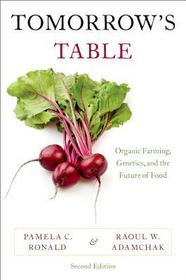
Tomorrow's Table
Organic Farming, Genetics, and the Future of Food
-
20% KEDVEZMÉNY?
- A kedvezmény csak az 'Értesítés a kedvenc témákról' hírlevelünk címzettjeinek rendeléseire érvényes.
- Kiadói listaár GBP 18.49
-
8 348 Ft (7 950 Ft + 5% áfa)
Az ár azért becsült, mert a rendelés pillanatában nem lehet pontosan tudni, hogy a beérkezéskor milyen lesz a forint árfolyama az adott termék eredeti devizájához képest. Ha a forint romlana, kissé többet, ha javulna, kissé kevesebbet kell majd fizetnie.
- Kedvezmény(ek) 20% (cc. 1 670 Ft off)
- Kedvezményes ár 6 678 Ft (6 360 Ft + 5% áfa)
- A kedvezmény érvényes eddig: 2026. június 30.
Iratkozzon fel most és részesüljön kedvezőbb árainkból!
Feliratkozom
8 348 Ft

Beszerezhetőség
Becsült beszerzési idő: A Prosperónál jelenleg nincsen raktáron, de a kiadónál igen. Beszerzés kb. 3-5 hét..
A Prosperónál jelenleg nincsen raktáron.
Why don't you give exact delivery time?
A beszerzés időigényét az eddigi tapasztalatokra alapozva adjuk meg. Azért becsült, mert a terméket külföldről hozzuk be, így a kiadó kiszolgálásának pillanatnyi gyorsaságától is függ. A megadottnál gyorsabb és lassabb szállítás is elképzelhető, de mindent megteszünk, hogy Ön a lehető leghamarabb jusson hozzá a termékhez.
A termék adatai:
- Kiadás sorszáma 2
- Kiadó OUP USA
- Megjelenés dátuma 2018. április 26.
- ISBN 9780199342082
- Kötéstípus Puhakötés
- Terjedelem376 oldal
- Méret 155x229x25 mm
- Súly 522 g
- Nyelv angol
- Illusztrációk 17 20
Kategóriák
Rövid leírás:
By the year 2050, Earth's population will double. If we continue with current farming practices, vast amounts of wilderness will be lost, millions of birds and billions of insects will die, and the public will lose billions of dollars as a consequence of environmental degradation. "Tomorrow's Table" argues that a judicious blend of two important strands of agriculture--genetic engineering and organic farming--is key to helping feed the world's growing population in an ecologically balanced manner.
TöbbHosszú leírás:
"Tomorrow's Table" argues that a judicious blend of two important strands of agriculture--genetic engineering and organic farming--is key to helping feed the world's growing population in an ecologically balanced manner. Pamela Ronald, a geneticist, and her husband, Raoul Adamchak, an organic farmer, take the reader inside their lives for roughly a year, allowing us to look over their shoulders so that we can see what geneticists and organic farmers actually do. Readers see the problems that farmers face, trying to provide larger yields without resorting to expensive or environmentally hazardous chemicals, a problem that will loom larger and larger as the century progresses. They learn how organic farmers and geneticists address these problems. The book is for consumers, farmers, and policy decision makers who want to make food choices and policy that will support ecologically responsible farming practices, and for anyone who wants accurate information about organic farming, genetic engineering, and their potential impacts on human health and the environment.
The first edition was published in hardcover in 2008 and in paperback in 2009. This second edition reflects the many and varied changes the fields of farming and genetic engineering have seen since 2009. It includes a new preface and three new chapters-one on politics and food-related protests such as the Marin county anti-vaccine movement and the subsequent outbreak of whooping cough, one on farming and food security, and one containing various recipes. Existing chapters on the tools of genetic engineering, organic vs. conventional foods, the tools of organic agriculture, and food labeling and legislature have all been updated.
Tartalomjegyzék:
Foreword to the First Edition by Sir Gordon Conway
Foreword to the Second Edition by Michael Specter
Preface to the First Edition
Preface to the Second Edition
Acknowledgments
About the Authors
Part I: Introduction
1. Green Revolution 2.0
Part II: The Farm
2. Why Organic Agriculture?
3. The Tools of Organic Agriculture
Part III: The Laboratory
4. The Tools of Genetic Engineering
Part IV: Consumers
5. Legislating Lunch
6. Whom Can We Trust?
7. Are Genetically Engineered Foods Safe to Eat?
8. The Mistrust of Science
Part V: The Environment
9. Conserving Wildlands
10. Weeds, Gene Flow, and the Environment
Part VI: Ownership
11. Who Owns the Seed?
12. The Seed Industry: Accelerating or Impeding Innovation?
Part VII: The World
13. Feeding the World Ethically
14. Choosing Innovation
Part VIII: Dinner
15. Deconstructing Dinner: Genetically Engineered, Organically Grown
Glossary
References
Index

