

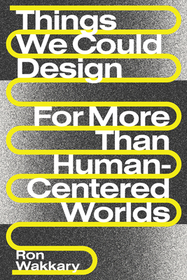
Things We Could Design
For More Than Human-Centered Worlds
Sorozatcím: Design Thinking, Design Theory;
- Kiadói listaár EUR 43.10
-
16 834 Ft (16 033 Ft + 5% áfa)
Az ár azért becsült, mert a rendelés pillanatában nem lehet pontosan tudni, hogy a beérkezéskor milyen lesz a forint árfolyama az adott termék eredeti devizájához képest. Ha a forint romlana, kissé többet, ha javulna, kissé kevesebbet kell majd fizetnie.
16 834 Ft

Beszerezhetőség
Csak rendelésre kapható a kiadónál, kissé időigényes.
Why don't you give exact delivery time?
A beszerzés időigényét az eddigi tapasztalatokra alapozva adjuk meg. Azért becsült, mert a terméket külföldről hozzuk be, így a kiadó kiszolgálásának pillanatnyi gyorsaságától is függ. A megadottnál gyorsabb és lassabb szállítás is elképzelhető, de mindent megteszünk, hogy Ön a lehető leghamarabb jusson hozzá a termékhez.
A termék adatai:
- Kiadó MIT Press
- Megjelenés dátuma 2021. január 1.
- ISBN 9780262542999
- Kötéstípus Puhakötés
- Terjedelem312 oldal
- Méret 228x153x18 mm
- Súly 508 g
- Nyelv angol
- Illusztrációk 51 B&W ILLUS. 347
Kategóriák
Hosszú leírás:
How posthumanist design enables a world in which humans share center stage with nonhumans, with whom we are entangled.
Over the past forty years, designers have privileged human values such that human-centered design is seen as progressive. Yet because all that is not human has been depleted, made extinct, or put to human use, today's design contributes to the existential threat of climate change and the ongoing extinctions of other species. In Things We Could Design, Ron Wakkary argues that human-centered design is not the answer to our problems but is itself part of the problem. Drawing on philosophy, design theory, and numerous design works, he shows the way to a relational and expansive design based on humility and cohabitation.
Wakkary says that design can no longer ignore its exploitation of nonhuman species and the materials we mine for and reduce to human use. Posthumanism, he argues, enables a rethinking of design that displaces the human at the center of thought and action. Weaving together posthumanist philosophies with design, he describes what he calls things--nonhumans made by designers--and calls for a commitment to design with more than human participation. Wakkary also focuses on design as "nomadic practices"--a multiplicity of intentionalities and situated knowledges that shows design to be expansive and pluralistic. He calls his overall approach "designing-with": the practice of design in a world in which humans share center stage with nonhumans, and in which we are bound together materially, ethically, and existentially.
2021 Kyoto Global Design Award Winner
Deep, beautiful, and a little quirky." Thomas Girard, The Ormsby Review
Tartalomjegyzék:
Chapter 1: Introduction
Part I: Design
Chapter 2 Prologue: Photobox, Long-Living Chair, and Olly
Chapter 2: Nomadic Practices
Chapter 3 Prologue: Fairphone, Pocket Receivers, and Kar-a-Sutra
Chapter 3: Designing Artifacts, Objects, and Products
Part II: Things
Chapter 4 Prologue: Phototrope, +Lichtlijn, New Faces, New Identities, Prayer Companion, and the Great Pacific Garbage Patch
Chapter 4: Things Are Interconnected and Transformative
Chapter 5 Prologue: Tilting Bowl, Being the Machine, Obscura 1C Digital Camera, Morse Things, Burgundian Black Collaboratory, and Mineral Accretion Factory: Underwater Table
Chapter 5: Things are Relational and Vital
Part III: Designer
Chapter 6 Prologue: Living in a Prototype, Greenscreen Dress, Supersurface, and Children Village
Chapter 6: The Designer as Biography
Chapter 7 Prologue: Anti-biographies and Lifepatch
Chapter 7: The Constituency of the Designer
Conclusion
Chapter 8: Designing-with
Notes
References
Index

