

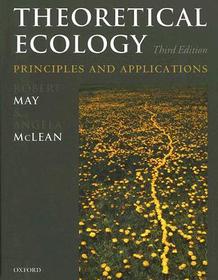
Theoretical Ecology
Principles and Applications
-
10% KEDVEZMÉNY?
- A kedvezmény csak az 'Értesítés a kedvenc témákról' hírlevelünk címzettjeinek rendeléseire érvényes.
- Kiadói listaár GBP 83.00
-
37 474 Ft (35 690 Ft + 5% áfa)
Az ár azért becsült, mert a rendelés pillanatában nem lehet pontosan tudni, hogy a beérkezéskor milyen lesz a forint árfolyama az adott termék eredeti devizájához képest. Ha a forint romlana, kissé többet, ha javulna, kissé kevesebbet kell majd fizetnie.
- Kedvezmény(ek) 10% (cc. 3 747 Ft off)
- Kedvezményes ár 33 727 Ft (32 121 Ft + 5% áfa)
Iratkozzon fel most és részesüljön kedvezőbb árainkból!
Feliratkozom
37 474 Ft

Beszerezhetőség
Megrendelésre a kiadó utánnyomja a könyvet. Rendelhető, de a szokásosnál kicsit lassabban érkezik meg.
Why don't you give exact delivery time?
A beszerzés időigényét az eddigi tapasztalatokra alapozva adjuk meg. Azért becsült, mert a terméket külföldről hozzuk be, így a kiadó kiszolgálásának pillanatnyi gyorsaságától is függ. A megadottnál gyorsabb és lassabb szállítás is elképzelhető, de mindent megteszünk, hogy Ön a lehető leghamarabb jusson hozzá a termékhez.
A termék adatai:
- Kiadás sorszáma 33
- Kiadó OUP Oxford
- Megjelenés dátuma 2007. február 15.
- ISBN 9780199209996
- Kötéstípus Puhakötés
- Terjedelem267 oldal
- Méret 245x188x16 mm
- Súly 592 g
- Nyelv angol
- Illusztrációk numerous line drawings, tables, halftones and mathematical examples 0
Kategóriák
Rövid leírás:
Theoretical Ecology provides a succinct, up-to-date overview of the field set in the context of applications, thereby bridging the traditional division of theory and practice. It describes the recent advances in our understanding of how interacting populations of plants and animals change over time and space, in response to natural or human-created disturbance.
TöbbHosszú leírás:
Robert May's seminal book has played a central role in the development of ecological science. Originally published in 1976, this influential text has overseen the transition of ecology from an observational and descriptive subject to one with a solid conceptual core. Indeed, it is a testament to its influence that a great deal of the novel material presented in the earlier editions has now been incorporated into standard undergraduate textbooks. It is now a quarter of a century since the publication of the second edition, and a thorough revision is timely.
Theoretical Ecology provides a succinct, up-to-date overview of the field set in the context of applications, thereby bridging the traditional division of theory and practice. It describes the recent advances in our understanding of how interacting populations of plants and animals change over time and space, in response to natural or human-created disturbance. In an integrated way, initial chapters give an account of the basic principles governing the structure, function, and temporal and spatial dynamics of populations and communities of plants and animals. Later chapters outline applications of these ideas to practical issues including fisheries, infectious diseases, tomorrow's food supplies, climate change, and conservation biology. Throughout the book, emphasis is placed on questions which as yet remain unanswered.
The editors have invited the top scientists in the field to collaborate with the next generation of theoretical ecologists. The result is an accessible, advanced textbook suitable for senior undergraduate and graduate level students as well as researchers in the fields of ecology, mathematical biology, environment and resources management. It will also be of interest to the general reader seeking a better understanding of a range of global environmental problems.
I would recommend this book to those seeking an overview of modern theoretical ecology and those seeking an easy access point to any one of the main topics covered. British Ecological Society bulletin 2008 39:1
Tartalomjegyzék:
Introduction
How Populations Cohere: Five Rules for Cooperation
Single species dynamics
Metapopulations and Their Spatial Dynamics
Predator Prey Interactions
Plant Population dynamics
Interspecific Competition and Multispecies Coexistence
Diversity and stability in ecological communities
Community: Patterns
Dynamics of Infectious Diseases
Fisheries
A Doubly Green Revolution
Conservation Biology
Climate Change and Conservation Biology
Unanswered Questions and why they Matter

