

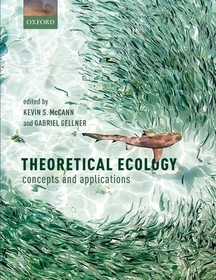
Theoretical Ecology
concepts and applications
-
10% KEDVEZMÉNY?
- A kedvezmény csak az 'Értesítés a kedvenc témákról' hírlevelünk címzettjeinek rendeléseire érvényes.
- Kiadói listaár GBP 34.49
-
15 572 Ft (14 830 Ft + 5% áfa)
Az ár azért becsült, mert a rendelés pillanatában nem lehet pontosan tudni, hogy a beérkezéskor milyen lesz a forint árfolyama az adott termék eredeti devizájához képest. Ha a forint romlana, kissé többet, ha javulna, kissé kevesebbet kell majd fizetnie.
- Kedvezmény(ek) 10% (cc. 1 557 Ft off)
- Kedvezményes ár 14 014 Ft (13 347 Ft + 5% áfa)
Iratkozzon fel most és részesüljön kedvezőbb árainkból!
Feliratkozom
15 572 Ft

Beszerezhetőség
Megrendelésre a kiadó utánnyomja a könyvet. Rendelhető, de a szokásosnál kicsit lassabban érkezik meg.
Why don't you give exact delivery time?
A beszerzés időigényét az eddigi tapasztalatokra alapozva adjuk meg. Azért becsült, mert a terméket külföldről hozzuk be, így a kiadó kiszolgálásának pillanatnyi gyorsaságától is függ. A megadottnál gyorsabb és lassabb szállítás is elképzelhető, de mindent megteszünk, hogy Ön a lehető leghamarabb jusson hozzá a termékhez.
A termék adatai:
- Kiadó OUP Oxford
- Megjelenés dátuma 2020. május 14.
- ISBN 9780198824299
- Kötéstípus Puhakötés
- Terjedelem320 oldal
- Méret 245x189x15 mm
- Súly 636 g
- Nyelv angol 4
Kategóriák
Rövid leírás:
This book continues the authoritative and established sequence of theoretical ecology books initiated by Robert M. May which helped pave the way for ecology to become a more robust theoretical science, encouraging the modern biologist to better understand the mathematics behind their theories.
TöbbHosszú leírás:
Theoretical Ecology: concepts and applications continues the authoritative and established sequence of theoretical ecology books initiated by Robert M. May which helped pave the way for ecology to become a more robust theoretical science, encouraging the modern biologist to better understand the mathematics behind their theories. This latest instalment builds on the legacy of its predecessors with a completely new set of contributions. Rather than placing emphasis on the historical ideas in theoretical ecology, the Editors have encouraged each contribution to: synthesize historical theoretical ideas within modern frameworks that have emerged in the last 10-20 years (e.g. bridging population interactions to whole food webs); describe novel theory that has emerged in the last 20 years from historical empirical areas (e.g. macro-ecology); and finally to cover the rapidly expanding area of theoretical ecological applications (e.g. disease theory and global change theory). The result is a forward-looking synthesis that will help guide the field through a further decade of discovery and development.
It is written for upper level undergraduate students, graduate students, and researchers seeking synthesis and the state of the art in growing areas of interest in theoretical ecology, genetics, evolutionary ecology, and mathematical biology.
A great and condensed overview of the state of the art including currently unresolved questions and challenges. Accordingly, the book will be extremely useful for scientists who are ready to establish their own research agenda in mathematically-oriented theoretical ecology.
Tartalomjegyzék:
1: Introduction Gabriel Gellner, Kevin S. McCann & Emily J. Champagne
2: Species coexistence Peter Chesson
3: The synergistic effects of interaction strength and lags on ecological stability Gabriel Gellner, Kevin S. McCann & Christopher Greyson-Gaito
4: Non-equilibrium dynamics and stochastic processes Karen C. Abbott
5: The impact of population structure on population and community dynamics André M. de Roos
6: Models for large ecological communities - a random matrix approach Stefano Allesina & Jacopo Grilli
7: A structural theory of mutualistic networks Jordi Bascompte & Antonio Ferrera
8: A data driven approach to complex ecological systems Michio Kondoh, Kazutaka Kawatsu, Yutaka Osada & Masayuki Ushio
9: Trait-based models of complex ecological network Ulrich Brose
10: Ecological networks: from structure to dynamics Sonia Kéfi
11: Trait-based ecological and eco-evolutionary theory Christopher A. Klausmeier, Colin T. Kremer & Thomas Koffel
12: Toward a general theory of metacommunity ecology Dominique Gravel & François Massol
13: Theories of diversity in disease ecology T. Alex Perkins & Jason R. Rohr
14: Climate change: Studying the effects of temperature on population and community dynamics David A. Vasseur
15: Alternative stable states, tipping points, and early warning signals of ecological transitions John M. Drake, Suzanne M. O'Regan, Vasilis Dakos, Sonia Kéfi & Pejman Rohani
16: Areas of current and future growth Kevin S. McCann & Gabriel Gellner

