

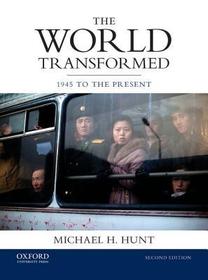
The World Transformed
1945 to the Present
-
10% KEDVEZMÉNY?
- A kedvezmény csak az 'Értesítés a kedvenc témákról' hírlevelünk címzettjeinek rendeléseire érvényes.
- Kiadói listaár GBP 89.99
-
40 630 Ft (38 695 Ft + 5% áfa)
Az ár azért becsült, mert a rendelés pillanatában nem lehet pontosan tudni, hogy a beérkezéskor milyen lesz a forint árfolyama az adott termék eredeti devizájához képest. Ha a forint romlana, kissé többet, ha javulna, kissé kevesebbet kell majd fizetnie.
- Kedvezmény(ek) 10% (cc. 4 063 Ft off)
- Kedvezményes ár 36 567 Ft (34 826 Ft + 5% áfa)
Iratkozzon fel most és részesüljön kedvezőbb árainkból!
Feliratkozom
40 630 Ft

Beszerezhetőség
Bizonytalan ideig nincs raktáron a kiadónál, rendelése nem javasolt.
Why don't you give exact delivery time?
A beszerzés időigényét az eddigi tapasztalatokra alapozva adjuk meg. Azért becsült, mert a terméket külföldről hozzuk be, így a kiadó kiszolgálásának pillanatnyi gyorsaságától is függ. A megadottnál gyorsabb és lassabb szállítás is elképzelhető, de mindent megteszünk, hogy Ön a lehető leghamarabb jusson hozzá a termékhez.
A termék adatai:
- Kiadás sorszáma 2
- Kiadó OUP USA
- Megjelenés dátuma 2015. augusztus 27.
- ISBN 9780199371020
- Kötéstípus Puhakötés
- Terjedelem624 oldal
- Méret 155x234x33 mm
- Súly 885 g
- Nyelv angol 0
Kategóriák
Rövid leírás:
Through its lively and accessible narrative, The World Transformed: 1945 to Present provides students with an account of the political, socio-economic, and cultural developments that have shaped global events since 1945.
TöbbHosszú leírás:
Through its lively and accessible narrative, The World Transformed: 1945 to Present provides students with an account of the political, socio-economic, and cultural developments that have shaped global events since 1945. The book's focus on three central and profoundly interconnected stories--the unfolding of the Cold War, the growth of the international economy, and the developing world's quest for political and economic independence--offers students a framework for understanding the past and making sense of the present. Attentive to overarching themes, individual historical figures, and diverse nations--and now substantially revised with a new Part 4 that examines world events since 1990--The World Transformed, Second Edition, is ideal for courses on post-1945 world history, international relations, or global topics.
It is difficult to imagine a better history of the world from 1945 to the present than the new edition of Michael Hunt's The World Transformed. Having added chapters that cover the post-Cold War decades, Hunt provides a remarkably informed, balanced, and nuanced exploration of an era of unprecedented globalization. His capacious narrative is attentive to both the upside and perils of ever accelerating transnational and cross-cultural connections and is replete with vignettes that underscore human agency. The World Transformed is the most compelling and thought-provoking assessment available on the tumultuous quarter-century from the end of World War II through the present day.
Tartalomjegyzék:
Preface
Introduction: The Post-1945 Watershed
International Politics Reconfigured
Wilson and Lenin as Rival Visionaries World War II and the Onset of the Cold War The Reach of Nationalism
The Global Economy in Transition
The First Phase of Globalization, 1870s-1914
Globalization Reborn, 1945 to the Present
The Colonial System on the Brink
Vulnerabilities of Empire
The Appearance of the "Third World"
Part One: Hopes and Fears Contend, 1945-1953
Chapter 1: The Cold War: Toward Soviet-American Confrontation
Origins of the Rivalry
From Cooperation to Conflict
U.S. Policy in Transition
Stalin's Pursuit of Territory and Security
The Conflict Goes Global
Drawing the Line in Europe
The Nuclear Arms Race Accelerates
Opening a Front in the Third World
Superpower Societies in an Unquiet Time
Soviet Society under Stress
The U.S. Anti-Communist Consensus
Chapter 2: The International Economy: Out of the Ruins
Anglo-American Remedies for an Ailing System Keynesian Economics and a Design for Prosperity The Bretton Woods Agreements
The U.S. Rescue Operation
Occupation and Recovery in Japan
Recovery in Western Europe
The American Economic Powerhouse
Good Times Return
Disney and the U.S. Economic Edge
"Coca-colonization" and the Mass Consumption Model
European Resistance to "Americanization"
Chapter 3: The Third World: First Tremors in Asia
The Appeal of Revolution and the Strong State The Chinese Communist Triumph Vietnam's Revolutionary Struggle
New States Under Conservative Elites
India's Status-Quo Independence
The Collaborative Impulse in the Philippines
Part Two: The Cold War System under Stress, 1953-1968
Chapter 4. The Cold War: A Tenuous Accommodation
The Beginnings of Coexistence Khrushchev Under Pressure Crosscurrents in American Policy
Crisis Points
To the Nuclear Brink in Cuba
The Vietnam Quagmire
The Quake of 1968
The American Epicenter
The Ground Shifts Abroad
Chapter 5. Abundance and Discontent in the Developed World
America at the Apogee
Triumph at Home and Abroad
Warning Signs of Economic Troubles
Recovery in Western Europe and Japan The Old World's New Course The Second Japanese Miracle
Voices of Discontent
The New Environmentalism The Feminist Upsurge Development and Inequality
Chapter 6. Third-World Hopes at High Tide
Revolutionary Trajectories in East Asia The Maoist Experiment in China Vietnam's Fight for the South
The Caribbean Basin: Between Reaction and Revolution
Guatemala's "Ten Years of Spring" Cuba and the Revolution that Survived
Decolonization in Sub-Saharan Africa
Ghana and Nkrumah's African Socialism
Colonial Legacies in Ghana and Beyond
Remaking the Middle East and North Africa
Economic Nationalism in Iran
A New Order for Egypt and the Region
Colonial Crisis in Algeria
Part Three: From Cold War to Globalization, 1968-1991
Chapter 7. The Cold War Comes to a Close
The Rise and Fall of Détente The Nixon Turnaround The Brezhnev Era
Western Europe and Détente
The U.S. Retreat from Détente
The Gorbachev Initiatives
Glasnost, Perestroika, and a New Foreign Policy
The Demise of the Soviet System
Explaining the Cold War Outcome The Role of Leaders Impersonal Forces
Chapter 8. Global Markets: One System, Three Centers
The United States in Transition
The Stagflation Crisis
The Free Market Solution
The Rise of an East Asian Bloc Japan Stays on Course The "Little Dragons" Stir
Capitalism with Chinese Characteristics
Vietnam in China's Footsteps
Revived Bloc Building in Europe Renewed Integration and the E.U. Post-'89 and the Opening to the East
Chapter 9. Divergent Paths in the Third World
The Changing Face of Revolutions Cambodia's Genocidal Revolution Religious Challenge in Iran
Revolutionary Aftershocks in the Middle East
Opposition to Settler Colonialism Apartheid under Siege Conflict over Palestine
Repression and Resistance in Guatemala
Dreams of Development in Disarray
Stalemated Economies The Population Explosion Women and Development
Part Four: Integration and Fragmentation: the 1990s and Beyond
Chapter 10. The Power and Perils of Globalization
The Dimensions of a New Global Order
The Pieces Fall into Place
The Magic of the Market
Creation's Destructive Side
Disrupted Lives, Torn Societies, Hollow Politics
The Specter of Inequality
An Environment under Stress
Saving People and the Planet
Agents of Reform
In the Name of Human Rights
In Defense of Life on the Planet
Chapter 11. A Regionally Configured World
The New World's New Era
Hegemonic Pretensions
Latin America Beyond the Cold War
Crosscurrents and Conflict in the Middle East
The Rise of Political Islam
Flash Points
The Return of Asia
Competing Development Models
China's Long Regional Role
The Old World's Old Problems
The EU Project in Trouble
The Geopolitical Pygmy
Final Reflections on the Post-1945 World: The Limits and Uses of History
Recommended Resources
Notes
Index

