

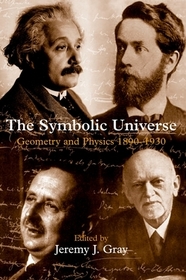
The Symbolic Universe
Geometry and Physics 1890-1930
-
10% KEDVEZMÉNY?
- A kedvezmény csak az 'Értesítés a kedvenc témákról' hírlevelünk címzettjeinek rendeléseire érvényes.
- Kiadói listaár GBP 197.50
-
89 171 Ft (84 925 Ft + 5% áfa)
Az ár azért becsült, mert a rendelés pillanatában nem lehet pontosan tudni, hogy a beérkezéskor milyen lesz a forint árfolyama az adott termék eredeti devizájához képest. Ha a forint romlana, kissé többet, ha javulna, kissé kevesebbet kell majd fizetnie.
- Kedvezmény(ek) 10% (cc. 8 917 Ft off)
- Kedvezményes ár 80 254 Ft (76 433 Ft + 5% áfa)
Iratkozzon fel most és részesüljön kedvezőbb árainkból!
Feliratkozom
89 171 Ft

Beszerezhetőség
Megrendelésre a kiadó utánnyomja a könyvet. Rendelhető, de a szokásosnál kicsit lassabban érkezik meg.
Why don't you give exact delivery time?
A beszerzés időigényét az eddigi tapasztalatokra alapozva adjuk meg. Azért becsült, mert a terméket külföldről hozzuk be, így a kiadó kiszolgálásának pillanatnyi gyorsaságától is függ. A megadottnál gyorsabb és lassabb szállítás is elképzelhető, de mindent megteszünk, hogy Ön a lehető leghamarabb jusson hozzá a termékhez.
A termék adatai:
- Kiadó OUP Oxford
- Megjelenés dátuma 1999. július 22.
- ISBN 9780198500889
- Kötéstípus Keménykötés
- Terjedelem302 oldal
- Méret 242x163x21 mm
- Súly 573 g
- Nyelv angol
- Illusztrációk line figures 0
Kategóriák
Rövid leírás:
The Symbolic Universe considers the ways in which many leading mathematicians between 1890 and 1930 attempted to apply geometry to physics. It concentrates on responses to Einstein's theories of special and general relativity, but also considers the philosophical implications of these ideas.
TöbbHosszú leírás:
With the development of the theory of relativity by Albert Einstein, physics underwent a revolution at the end of the 19th century. The boundaries of research were extended still further when in 1907-8 Minkowski applied geometrical ideas to this area of physics. This in turn opened the door to other researchers seeking to use non-Euclidean geometrical methods in relativity, and many notable mathematicians did so, Weyl in particular linking these ideas with broader philosophical issues in mathematics. The Symbolic Universe gives an overview of this exciting era, giving a full account for the first time of Minkowski's geometric reformulation of the theory of special relativity.
'It's expensive, The Symbolic Universe,and it is aimed at and will probably only be understood by theoretical physicists and mathematicians. But there's a gem - embedded in this collection of surveys by international authors on the relations between physics and mathematics since the development of Einstein's theory of relativity:the introducton, by editor Jeremy Gray, which offers a masterly and approachable review of the period.'
New Scientist
Tartalomjegyzék:
PART I
Introduction
Geometrizing configurations. Heinrich Hertz and his mathematical precursors
Einstein, Poincaré, and the testability of geometry
Geometry-formalisms and intuitions
PART II
Introduction
The non-Euclidean style of Minkowskian relativity
Geometries in collision: Einstein, Klein and Riemann
Hilbert and physics (1900-1915)
The Göttingen response to general relativity and Emmy Noether's theorems
PART III
Introduction
Ricci and Levi-Civita: from differential invariants to general relativity
Weyl and the theory of connections

