

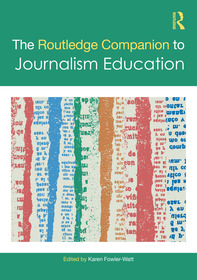
The Routledge Companion to Journalism Education
Sorozatcím: Routledge Journalism Companions;
-
20% KEDVEZMÉNY?
- A kedvezmény csak az 'Értesítés a kedvenc témákról' hírlevelünk címzettjeinek rendeléseire érvényes.
- Kiadói listaár GBP 245.00
-
110 617 Ft (105 350 Ft + 5% áfa)
Az ár azért becsült, mert a rendelés pillanatában nem lehet pontosan tudni, hogy a beérkezéskor milyen lesz a forint árfolyama az adott termék eredeti devizájához képest. Ha a forint romlana, kissé többet, ha javulna, kissé kevesebbet kell majd fizetnie.
- Kedvezmény(ek) 20% (cc. 22 123 Ft off)
- Kedvezményes ár 88 494 Ft (84 280 Ft + 5% áfa)
- A kedvezmény érvényes eddig: 2026. június 30.
Iratkozzon fel most és részesüljön kedvezőbb árainkból!
Feliratkozom
99 556 Ft

Beszerezhetőség
Még nem jelent meg, de rendelhető. A megjelenéstől számított néhány héten belül megérkezik.
Why don't you give exact delivery time?
A beszerzés időigényét az eddigi tapasztalatokra alapozva adjuk meg. Azért becsült, mert a terméket külföldről hozzuk be, így a kiadó kiszolgálásának pillanatnyi gyorsaságától is függ. A megadottnál gyorsabb és lassabb szállítás is elképzelhető, de mindent megteszünk, hogy Ön a lehető leghamarabb jusson hozzá a termékhez.
A termék adatai:
- Kiadás sorszáma 1
- Kiadó Routledge
- Megjelenés dátuma 2026. július 17.
- ISBN 9781032640938
- Kötéstípus Keménykötés
- Terjedelem548 oldal
- Méret 246x174 mm
- Nyelv angol
- Illusztrációk 33 Illustrations, black & white; 16 Halftones, black & white; 17 Line drawings, black & white; 2 Tables, black & white 700
Kategóriák
Rövid leírás:
The Routledge Companion to Journalism Education brings together a global and transdisciplinary field of scholars, practitioners, and journalism educators to provide the most contemporary, research-informed, and practice-focused reflection on journalism education today.
TöbbHosszú leírás:
The Routledge Companion to Journalism Education brings together a global and transdisciplinary field of scholars, practitioners, and journalism educators to provide the most contemporary, research-informed, and practice-focused reflection on journalism education today.
Organised thematically over five sections, contributions examine a range of urgent challenges for journalism education and practice. These include matters of inclusivity and diversity, trust, online and physical safety, social media polarisation, and new technologies, including AI. Through exploration of a range of social and historical factors and scrutiny of journalism’s normative values, including its relationship with industry accreditation bodies, this volume critically considers the potential for journalism education to lead change in the industry.
This is an essential companion for journalism educators the world over, as well as for anyone researching the future of journalism education and its bearing on practice.
TöbbTartalomjegyzék:
List of Contributors
Introduction: Re- imagining journalism education in a time of crisis
Karen Fowler-Watt
Part I: Historical perspectives; current challenges
Chapter 1: The evolution of journalism education in the UK
Chris Frost
Chapter 2: Professional identity: Educators' transition from industry to the academy
Catharine Eccles
Chapter 3: Journalism’s normative values and the challenge of objectivity
Tony Harcup
Chapter 4: Debunking false information: Journalism in the age of 'information disorder
Marju Himma and Maia Klaassen
Chapter 5: Teaching trust: Setting the stage for journalism education
Patrick R. Johnson and Melissa Tully
Chapter 6: Media manipulation: Fakes, frauds and liars: An instructor’s guide
Leonard M. Apcar
Chapter 7: Fluid futures: The changing boundaries of journalism
Nicole Blanchett, Colette Brin, Karen Owen and Lisa Taylor
Chapter 8: Elitism, inclusivity and marginalised voices
Verica Rupar
Chapter 9: What journalism should we teach? An ideological question and possible framework guided by India’s New Education Policy
Sundeep R. Muppidi
Chapter 10: What journalism should we teach? Global perspectives from journalism educators
Nico Drok
Part II: Teaching journalism/s I
Chapter 11: Embedding inclusivity in practice-based journalism pedagogy
Myra Evans
Chapter 12: Pop Up newsrooms: A global perspective
Melissa Wall and Devadas Rajaram
Chapter 13: Youth voices: Telling social media news stories from students to students
Arly Faundes and David Osorio
Chapter 14: Standards, benchmarks and accreditations: A case study from France
Pascal Guénée
Chapter 15: Embedding media law in the journalism curriculum: A critical reflection on the challenges of teaching undergraduate journalism students while satisfying the requirements of accrediting bodies
David Mascord
Chapter 16: Exploring faculty perspectives on partnerships between college journalism programmes and professional news outlets in the United States
Alison Burns
Chapter 17: The place and purpose of experiential learning projects in journalism education
Ben Parsons
Chapter 18: Challenges and opportunities for media education in Egypt: Instructors’ reflections on teaching journalism and media during COVID-19
Rasha El-Ibiary
Chapter 19: Journalism Education in wartime Ukraine: Resilience, innovation and global implications
Galyna Piskorska
Chapter 20: Integrating AI: Hopes and fears
Miriam Phillips
Part III: Teaching journalism/s II
Chapter 21: Journalism ethics
Eric Wishart
Chapter 22: Beyond knowledge exchange: Bridging the divide between journalism education and practice
Lada T. Price, Olatunji Ogunyemi, Desiree Hill, Alexandra Wake, Saadia Malik, Matthew Pearson, Paula Melani Rocha, Archana Kumari, Leire Iturregui, Marijana Markovikj, Eleonora Serafimovska, Dele Odunlami and Semiu Musa Bello
Chapter 23: Trauma, harassment and self-care: Building resilience in online environments
Jenny Kean
Chapter 24: Emotional literacy and news journalism
Stephen Jukes
Chapter 25: News literacy in the context of “information disorder”
Fran Yeoman
Chapter 26: Relearning photojournalism
Stuart Allan and Anna Gormley
Chapter 27: Complexity, connection and collaboration: Creativity as a key competency in a changing journalistic field
Tamara Witschge, Danielle Arets and Stijn Postema
Chapter 28: How to teach a moving method: Datajournalism education between maths anxiety and AI
Brigitte Alfter, Didde Elnif, Sandra Foresti and Adriana Homolova
CHAPTER 29: Social justice journalism
Nicole Carr
Part IV: Interdisciplinary approaches to journalism education
Chapter 30: Interactive documentary making
Lei Chen and David O. Dowling
Chapter 31: Sounding out freedom: Radio with and for teenagers deprived of their liberty – A transformative journalism approach
Mathew Charles
Chapter 32: Interdisciplinary approaches to journalism education in Hong Kong: A case study
Roselyn Du
Chapter 33: Mapping the field of open-source investigations
Stephen D. Reese and Azza El-Masri
Chapter 34: A manifesto for a new journalism education
Sarah Jones
Chapter 35: Challenging narratives using art: “Themstorytelling”, the archive and experimentation
Pablo Martinez Zaraate
Chapter 36: The evolving art of teaching literary journalism in the digital age
Jaron Murphy
Part V: Re-imagining journalism pedagogy and practice
Chapter 37: From where I stand: What should journalism education look like in the 21st century?
Fergal Keane
Chapter 38: Inside the J-School : Designing journalism education programmes for a changing world
Dr Margaret Hughes
Chapter 39: Outside the J-School: Entrepreneurial journalism as a mindset
Jo Royle
Chapter 40: Newsrooms under AI applications: Teaching journalism ethics and regulations for the future functions and roles
Manuel Chavez and Liz Nass
Chapter 41: Strategies for developing heutagogic approaches within journalism education
Katherine C. Blair
Chapter 42: Engaging journalism students in futures literacy
Bobbie Foster
Chapter 43: Teaching cross-border collaborative journalism: A method and a mindset
The challenge of teaching a remote journalism practice in one classroom: Pioneering educations and a suggestion to consider four levels of intensity
Brigitte Alfter and Ulla Sätereie
Chapter 44: Decolonising journalism through global Indigenous frameworks of educational sovereignty
Alvin Ntibinyane
Index
Több

