

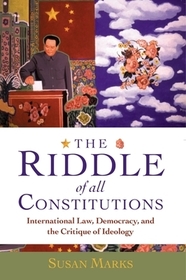
The Riddle of All Constitutions
International Law, Democracy, and the Critique of Ideology
-
10% KEDVEZMÉNY?
- A kedvezmény csak az 'Értesítés a kedvenc témákról' hírlevelünk címzettjeinek rendeléseire érvényes.
- Kiadói listaár GBP 57.00
-
25 735 Ft (24 510 Ft + 5% áfa)
Az ár azért becsült, mert a rendelés pillanatában nem lehet pontosan tudni, hogy a beérkezéskor milyen lesz a forint árfolyama az adott termék eredeti devizájához képest. Ha a forint romlana, kissé többet, ha javulna, kissé kevesebbet kell majd fizetnie.
- Kedvezmény(ek) 10% (cc. 2 574 Ft off)
- Kedvezményes ár 23 162 Ft (22 059 Ft + 5% áfa)
Iratkozzon fel most és részesüljön kedvezőbb árainkból!
Feliratkozom
25 735 Ft

Beszerezhetőség
Megrendelésre a kiadó utánnyomja a könyvet. Rendelhető, de a szokásosnál kicsit lassabban érkezik meg.
Why don't you give exact delivery time?
A beszerzés időigényét az eddigi tapasztalatokra alapozva adjuk meg. Azért becsült, mert a terméket külföldről hozzuk be, így a kiadó kiszolgálásának pillanatnyi gyorsaságától is függ. A megadottnál gyorsabb és lassabb szállítás is elképzelhető, de mindent megteszünk, hogy Ön a lehető leghamarabb jusson hozzá a termékhez.
A termék adatai:
- Kiadó OUP Oxford
- Megjelenés dátuma 2003. március 6.
- ISBN 9780199264131
- Kötéstípus Puhakötés
- Terjedelem176 oldal
- Méret 234x156x13 mm
- Súly 285 g
- Nyelv angol 0
Kategóriák
Rövid leírás:
The book examines current debates about the emergence of an international legal norm of democratic governance and also considers some of the wider theoretical issues to which those debates give rise. It asks should international law seek to promote democratic political arrangements? If so, on what basis, and using which of the many competing conceptions of democracy?
TöbbHosszú leírás:
The promotion of democracy is today a familiar feature of foreign policy, and an accepted part of the activities of international organizations. Should international law join in this move to promote democratic political arrangements? If so, on what basis, and with which of the many competing conceptions of democracy? Drawing on an eclectic range of source material, the author examines current debates about the emergence of an international legal 'norm of democratic governance', and considers how proposals for such a norm might be rearticulated to meet some of the concerns to which they give rise. She also uses these debates to illustrate some more general points about approaches to the study of international law. In doing so, she seeks to defend an approach to international legal scholarship that takes its cue from the tradition of ideology critique.
Review from previous edition Susan Marks has written a brilliantly provocative and sophisticated book giving a strikingly original and far-reaching slant to her analysis. The Riddle of All Constitutions provides an excellent critique of mainstream proposals about how to bring the pursuit of democracy into the thinking and interpretations of international law.
Tartalomjegyzék:
Introduction
Preface to a Critique of International Legal Ideology
International Law and the `Liberal Revolution'
Limits of the Liberal Revolution I. Low Intensity Democracy
Limits of the Liberal Revolution II: Pan-National Democracy
International Law and the Project of Cosmopolitan Democracy
Afterword: Critical Knowledge

