

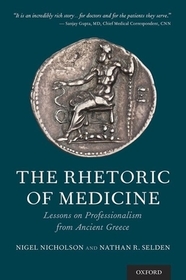
The Rhetoric of Medicine
Lessons on Professionalism from Ancient Greece
-
10% KEDVEZMÉNY?
- A kedvezmény csak az 'Értesítés a kedvenc témákról' hírlevelünk címzettjeinek rendeléseire érvényes.
- Kiadói listaár GBP 73.00
-
34 875 Ft (33 215 Ft + 5% áfa)
Az ár azért becsült, mert a rendelés pillanatában nem lehet pontosan tudni, hogy a beérkezéskor milyen lesz a forint árfolyama az adott termék eredeti devizájához képest. Ha a forint romlana, kissé többet, ha javulna, kissé kevesebbet kell majd fizetnie.
- Kedvezmény(ek) 10% (cc. 3 488 Ft off)
- Kedvezményes ár 31 388 Ft (29 894 Ft + 5% áfa)
Iratkozzon fel most és részesüljön kedvezőbb árainkból!
Feliratkozom
34 875 Ft

Beszerezhetőség
Megrendelésre a kiadó utánnyomja a könyvet. Rendelhető, de a szokásosnál kicsit lassabban érkezik meg.
Why don't you give exact delivery time?
A beszerzés időigényét az eddigi tapasztalatokra alapozva adjuk meg. Azért becsült, mert a terméket külföldről hozzuk be, így a kiadó kiszolgálásának pillanatnyi gyorsaságától is függ. A megadottnál gyorsabb és lassabb szállítás is elképzelhető, de mindent megteszünk, hogy Ön a lehető leghamarabb jusson hozzá a termékhez.
A termék adatai:
- Kiadó OUP USA
- Megjelenés dátuma 2019. június 6.
- ISBN 9780190457488
- Kötéstípus Keménykötés
- Terjedelem286 oldal
- Méret 239x155x25 mm
- Súly 567 g
- Nyelv angol 0
Kategóriák
Rövid leírás:
The Rhetoric of Medicine explores problems that confront medical professionals today by first examining similar problems that confronted physicians in ancient Greece. This framework provides illuminating entry points into challenges faced by the practice of medicine, enabling readers to understand more clearly their shape and operation in the modern context-as well as possible solutions to these problems. This text represents a unique collaboration between a classicist and a neurosurgeon, and is a call to interrogate the narratives and ideas that shape medical care and to revise and replace those that do not serve patient health.
TöbbHosszú leírás:
The Rhetoric of Medicine explores problems that confront medical professionals today by first examining similar problems that confronted physicians in ancient Greece. This framework provides illuminating entry points into challenges faced by the practice of medicine, enabling readers to understand more clearly their shape and operation in the modern context-as well as possible solutions to these problems. Topics covered include: larger cultural ideas about the body; tension between professional values and working for money; effective collaboration and competition with alternative healthcare providers; restrictions on political involvement that seem part of a physician's identity; maintaining a space for professional autonomy and judgment; mentoring that is effective but not exclusive; and physicians' recognition of themselves as patients as well as professionals.
The Rhetoric of Medicine represents a unique collaboration between a classicist and a neurosurgeon, reflecting both their scholarly work and extensive experience as administrators. Together, these two experts combine their personal experience as professionals with careful analysis of what it means to be a medical professional, both in ancient Greece and today. The Rhetoric of Medicine is a call to interrogate the narratives and ideas that shape medical care and to revise and replace those that do not serve patient health.
Advance Praise for The Rhetoric of Medicine
"It is an incredibly rich story with lessons around money, competition and autonomy for doctors and for the patients they serve."
-- Sanjay Gupta, MD, Staff Neurosurgeon, The Emory Clinic, Atlanta, GA, Chief Medical Correspondent, CNN
If we spend the time to dig deeply into the "rhetoric" of medicine over time, as the authors Nicholson and Selden have done, we find the motivations of early doctors, their foibles and how they perceived themselves. It is an incredibly rich story with lessons around money, competition and autonomy for doctors and for the patients they serve.
Tartalomjegyzék:
Introduction
Chapter 1: Body
Chapter 2: Money
Chapter 3: Competition
Chapter 4: Restriction
Chapter 5: Autonomy
Chapter 6: Mentoring
Chapter 7: Self
Conclusion

