

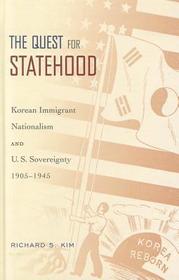
The Quest for Statehood
Korean Immigrant Nationalism and U.S. Sovereignty, 1905-1945
-
10% KEDVEZMÉNY?
- A kedvezmény csak az 'Értesítés a kedvenc témákról' hírlevelünk címzettjeinek rendeléseire érvényes.
- Kiadói listaár GBP 72.00
-
32 508 Ft (30 960 Ft + 5% áfa)
Az ár azért becsült, mert a rendelés pillanatában nem lehet pontosan tudni, hogy a beérkezéskor milyen lesz a forint árfolyama az adott termék eredeti devizájához képest. Ha a forint romlana, kissé többet, ha javulna, kissé kevesebbet kell majd fizetnie.
- Kedvezmény(ek) 10% (kb. 3 251 Ft)
- Kedvezményes ár 29 257 Ft (27 864 Ft + 5% áfa)
Iratkozzon fel most és részesüljön kedvezőbb árainkból!
Feliratkozom
32 508 Ft

Beszerezhetőség
Megrendelésre a kiadó utánnyomja a könyvet. Rendelhető, de a szokásosnál kicsit lassabban érkezik meg.
Why don't you give exact delivery time?
A beszerzés időigényét az eddigi tapasztalatokra alapozva adjuk meg. Azért becsült, mert a terméket külföldről hozzuk be, így a kiadó kiszolgálásának pillanatnyi gyorsaságától is függ. A megadottnál gyorsabb és lassabb szállítás is elképzelhető, de mindent megteszünk, hogy Ön a lehető leghamarabb jusson hozzá a termékhez.
A termék adatai:
- Kiadó OUP USA
- Megjelenés dátuma 2011. december 8.
- ISBN 9780195369991
- Kötéstípus Keménykötés
- Terjedelem240 oldal
- Méret 163x236x20 mm
- Súly 431 g
- Nyelv angol
- Illusztrációk 10 halftones 0
Kategóriák
Rövid leírás:
The Quest for Statehood explores the efforts of Korean immigrants to fight for the independence of their homeland by participating in civic and political activities in the United States that established them as an American ethnic group.
TöbbHosszú leírás:
Korean diasporic nationalism in the years between 1905 and 1945 played a foundational role in the emergence of the two separate Koreas after 1945 that both exist to this day. Koreans in the United States were a constitutive part of this historical trajectory. The Quest for Statehood traces the development of Korean immigrant nationalism within the context of the Korean independence movement which sought to liberate Korea from Japanese colonization. Regarding Japanese rule as illegitimate, Koreans in and out of the Korean peninsula viewed themselves as stateless peoples who wanted to establish a sovereign state of their own. Given Japanese repression in Korea, independence activities had to be carried out from abroad, creating conditions for the emergence of a diasporic nationalism. Situated at the nexus of geopolitical relations involving Korea, Japan, and the United States, Koreans in America came to play a vital role in the state-building project of Korean diasporic nationalism. The Quest for Statehood explores the consequences and implications of Korean diasporic identifications with the homeland in a U.S. setting. Due to the constraints of diasporic state-building, U.S.-based Koreans increasingly came to rely on the power of the United States to act as a sovereign state to pursue the national interests of Koreans throughout the diaspora. This study contends this strategic reliance on U.S. state power reflected the development of an ethnic consciousness among Korean immigrants in America. The efforts of Korean immigrants to fight for the independence of their homeland necessitated their participation in civic and political activities in the United States that established them as an American ethnic group. Korean nationalism thus paradoxically led to Korean immigrant incorporation into American political structures whereby ethnicity served as an organizational resource for making nationalist claims in the U.S. political arena. Ultimately, homeland nationalism was central to the assimilation of Korean immigrants as American ethnics.
This monograph goes a long way in explaining how Koreans clientelistic reliance on American patronage before World War II shaped a similarly dependent relationship of anticommunist development after 1945.
Tartalomjegyzék:
Introduction
Mapping the Geopolitical Terrain of the Korean Diaspora
Becoming Diasporic: From Labor Migrants to Exiled Nationalists, 1905-1919
Inaugurating a "New Korea": The March First Movement and the Korean Provisional Government
Contesting Issues of State Power in the Diaspora
Local Struggles and Diasporic Politics: The 1931 Court Cases of the Korean National Association of Hawaii
Kilsoo Haan and "Constructive Americanism": The Ethnicization of Korean Immigrant Nationalism, 1931-1945
"In Due Course": Diasporic Nationalism, the United Korean Committee in America, and U.S. Sovereignty
Conclusion
Notes
Bibliography

